
2-digit subtraction with regrouping, step by step
To subtract 2-digit numbers, line them up and subtract the ones, then the tens. If the top ones digit is too small, regroup: trade 1 ten for 10 ones. 52 − 18: 12 − 8 = 4, then 4 − 1 = 3, so 34. This page shows why with base-ten pictures, has a tool for any problem, and covers the mistakes children make.
2-digit subtraction: the big idea
52 is 5 tens and 2 ones. To take away 18 (1 ten and 8 ones), there aren’t enough ones. So one ten is broken into 10 ones: 52 becomes 4 tens and 12 ones. It is still 52, just split differently, and now 8 ones can be taken away.
How to subtract 2-digit numbers, step by step
- Line up tens and ones, bigger number on top.
- Ones first. If the top digit is smaller, cross out the tens digit, write one less, and put 1 in front of the ones digit.
- Subtract the ones, then the tens.
- Check by adding: answer + bottom number = top number.
Try any 2-digit subtraction
Type the problem and step through each column.
Worked examples
Example 1: No regrouping
8 − 5 = 3, 6 − 2 = 4.
Example 2: Regroup a ten
2 is less than 8, so trade 1 ten: 12 − 8 = 4, then 4 − 1 = 3.
Example 3: A zero in the ones
0 − 4 can’t be done: trade a ten, 10 − 4 = 6, then 6 − 3 = 3.
Example 4: Regroup with a bigger gap
11 − 7 = 4, then 8 − 4 = 4.
Other ways to subtract 2-digit numbers
Count up
For 52 − 48, count up from 48: 2 to 50, 2 more to 52. The answer is 4.
Subtract tens, then ones
52 − 18: 52 − 10 = 42, then 42 − 8 = 34.
Adjust both numbers
52 − 18 = 54 − 20 = 34. Adding 2 to both keeps the difference the same.
Practice 2-digit subtraction, with answers
Common mistakes
How to teach it at home
Dimes and pennies
Make 52¢ with 5 dimes and 2 pennies. To pay 18¢, swap a dime for 10 pennies. Children feel the trade.
Bundles of ten
Bundle straws into tens with rubber bands. Undo a bundle when you need more ones.
How many more?
“You have 52 points and I have 38. How many more do you have?” Count up to find out.
By grade
- Grade 1 (1.NBT.C.6): subtract multiples of 10, like 70 − 30.
- Grade 2 (2.NBT.B.5): subtract within 100 fluently, with regrouping.
- Next: 3-digit subtraction. Before: subtraction facts to 20.
Worksheets and practice
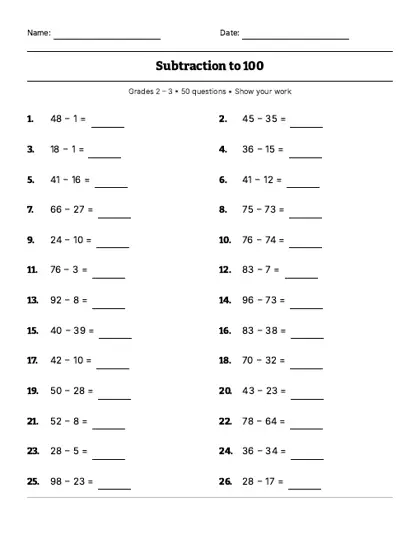
2-digit subtraction worksheet: printable PDF with an answer key. · Make a fresh test
Last reviewed
Questions parents ask
How do you subtract 2-digit numbers with regrouping?
Subtract the ones first. If the top ones digit is smaller, trade 1 ten for 10 ones, then subtract. 52 − 18: 12 − 8 = 4 and 4 − 1 = 3, so 34.
What is regrouping in subtraction?
Breaking 1 ten into 10 ones (or 1 hundred into 10 tens) so there are enough to subtract. Borrowing is the older name.
How do you subtract from a number ending in 0?
Trade a ten. 70 − 34: the 0 ones become 10, the 7 tens become 6. 10 − 4 = 6 and 6 − 3 = 3, so 36.
Can 2-digit subtraction be done in your head?
Yes. Subtract the tens, then the ones (52 − 10 − 8), or count up when the numbers are close (52 − 48 = 4).
What grade learns 2-digit subtraction?
Grade 1 subtracts multiples of 10. Grade 2 subtracts within 100 with regrouping fluently (2.NBT.B.5).