
How to convert percents to decimals
To change a percent to a decimal, divide by 100: move the decimal point two places to the left and drop the % sign. 35% = 0.35, 7% = 0.07, 120% = 1.2. This page shows why it works with pictures, the tricky cases, how to go back from decimals to percents, and practice with answers.
Percents and decimals: what percent means
Percent means “per hundred” or “out of 100”. 35% is 35 out of 100, which is 35 hundredths. Written as a decimal, 35 hundredths is 0.35. That is the whole idea: a percent is just a number of hundredths.
A 10 × 10 grid makes this easy to see. It has 100 squares, so each square is 1% and also 0.01.
How to convert percents to decimals, step by step
- Find the decimal point. In a whole-number percent like 35%, it is hiding at the end: 35.%
- Move it two places left. That is the same as dividing by 100. 35. becomes .35
- Fill empty places with zeros. 7% has only one digit, so 7. becomes .07
- Drop the % sign and write a 0 in front of the point for neatness: 0.35, 0.07.
A quick check: the decimal should be smaller than the percent number. 35% is about a third of the way to 1, and 0.35 is too.
Convert any percent to a decimal (or back)
Type a percent or a decimal. You’ll see the answer, the fraction, the steps and the hundred grid.
Worked examples: writing percents as decimals
The red arc shows the decimal point moving two places left.
Example 1: 45% as a decimal
Two digits, so the point moves just in front of them.
Example 2: 7% as a decimal
Only one digit, so a zero fills the empty tenths place. This is the one children get wrong most often.
Example 3: 120% as a decimal
More than 100%, so the decimal is more than 1.
Example 4: 12.5% as a decimal
There is already a decimal point. Move it two places left from where it is.
Example 5: 0.5% as a decimal
Less than 1%. Two zeros fill the gaps: half of one hundredth.
How to convert decimals to percents
Go the other way: multiply by 100. The decimal point moves two places to the right, then add the % sign.
Percents, decimals and fractions to know by heart
These come up so often in shops, tests and recipes that it is worth learning them as facts.
| Percent | Decimal | Fraction |
|---|---|---|
| 1% | 0.01 | 1/100 |
| 5% | 0.05 | 1/20 |
| 10% | 0.1 | 1/10 |
| 20% | 0.2 | 1/5 |
| 25% | 0.25 | 1/4 |
| 33⅓% | 0.333… | 1/3 |
| 50% | 0.5 | 1/2 |
| 75% | 0.75 | 3/4 |
| 100% | 1 | 1 |
| 150% | 1.5 | 3/2 |
Why moving the point works
Our number system is built on tens. Every place is worth ten times the place to its right. Dividing by 100 makes every digit worth a hundred times less, so each digit slides two places to the right of where it was. It is easier to move the point than the digits, and moving the point two places left does the same job.
Where you need this: calculators and spreadsheets use decimals. To find 25% off a $40 jacket, a calculator needs 0.25 × 40 = 10, so the jacket costs $30.
Common mistakes when converting percents to decimals
How to teach percents and decimals at home
Use money
A dollar is 100 cents, so cents are hundredths. 35% of a dollar is 35¢, which is $0.35. 7% is 7¢, which is $0.07, not 70¢. Money makes the zero obvious.
Color the hundred grid
Print graph paper, draw 10 × 10 squares and color a percent. Then write it three ways: 40%, 0.40, 40/100.
Go on a percent hunt
Battery levels, sale signs, food labels and test scores are all percents. For each one, ask: “What is that as a decimal?”
Estimate first
Before converting, ask whether the answer will be more or less than 1, and more or less than half. 7% is a tiny bit, so 0.07 makes sense and 0.7 does not.
Percents and decimals by grade
- Grade 4 (4.NF.C.6): write fractions with denominator 100 as decimals, like 62/100 = 0.62. This is the foundation.
- Grade 6 (6.RP.A.3c): understand a percent as a rate per 100 and find a percent of a quantity.
- Grade 7 (7.RP.A.3): use percents to solve problems with tax, tips, discounts and percent change.
Practice converting percents to decimals
Choose a direction, type your answers, then check.
Percent worksheets, charts and next steps
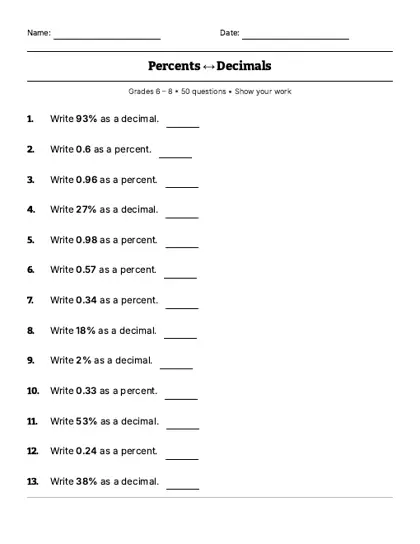
Percent to decimal worksheet: 50 conversions with an answer key.
Make a fresh percents and decimals test with the free test maker.
Next: finding a percent of a number · what percent is one number of another
See also the decimals chart and the percentages section.
Last reviewed
Questions parents ask
How do you write a percent as a decimal?
Divide by 100, which moves the decimal point two places to the left, then drop the % sign. 45% becomes 0.45, 7% becomes 0.07 and 120% becomes 1.2.
What is 5% as a decimal?
0.05. Five out of a hundred is five hundredths, so the 5 goes in the hundredths place with a 0 in the tenths place. Writing 0.5 would mean 50%.
Is 0.5 the same as 5%?
No. 0.5 is five tenths, which is 50%. 5% is five hundredths, which is 0.05. Moving the point two places in either direction shows the difference.
How do you convert a percent with a decimal, like 12.5%?
The same way: move the decimal point two places left. 12.5% becomes 0.125, and 0.5% becomes 0.005.
What is 100% as a decimal?
1. One hundred out of a hundred is the whole thing. Percents over 100 give decimals over 1: 150% is 1.5 and 200% is 2.
How do you turn a decimal into a percent?
Do the opposite: multiply by 100, which moves the decimal point two places right, and add the % sign. 0.6 becomes 60% and 0.08 becomes 8%.