
4th grade math
Fourth grade turns times tables into real calculation: multi-digit multiplication, long division and much more work with fractions. Children also meet angles and big numbers into the millions. This page lists every skill in order, what mastery looks like, signs a child needs help, and free 4th grade worksheets and lessons.
What 4th graders learn in math
The Common Core focuses grade 4 on three things: multi-digit multiplication and division, fraction equivalence and adding fractions, and geometry with lines and angles. All of it leans on times tables: a child who still counts to find 7 × 8 will find every multi-digit problem slow and error-prone.
4th grade math skills, in order
Operations and algebraic thinking
Multiplicative comparison (“3 times as many”), multi-step word problems, factors and multiples, prime and composite numbers, and number patterns.
Place value and big numbers
Place value to 1,000,000, comparing and rounding to any place, adding and subtracting multi-digit numbers with the standard method, multiplying up to 4 digits by 1 digit and 2 digits by 2 digits, and dividing up to 4 digits by 1 digit with remainders.
Fractions and decimals
Equivalent fractions, comparing fractions with different denominators, adding and subtracting fractions and mixed numbers with like denominators, multiplying a fraction by a whole number, and decimals as tenths and hundredths.
Measurement and data
Converting units (feet to inches, kilograms to grams), the area and perimeter formulas, line plots with fractions, and measuring angles with a protractor.
Geometry
Points, lines, rays, parallel and perpendicular lines, acute, right and obtuse angles, classifying shapes by their angles and sides, and lines of symmetry.
What mastery looks like by the end of the year
- Multiplies 2-digit by 2-digit numbers, like 34 × 26 = 884, and checks with an estimate.
- Divides a 3- or 4-digit number by a 1-digit number, with remainders, using long division.
- Explains why 2/3 = 4/6 and decides which of 3/5 and 2/3 is bigger.
- Adds fractions with the same denominator, including mixed numbers like 2 3/8 + 1 7/8.
- Measures and draws angles with a protractor.
- Converts between units, such as 3 feet = 36 inches.
Signs your child needs extra help
- Times tables are still slow, so every multiplication or division takes far too long.
- Loses track of place value in big numbers or lines up digits wrongly.
- Gets lost in the steps of long division.
- Adds denominators when adding fractions: 1/4 + 1/4 = 2/8.
- Reads the wrong scale on a protractor.
If times tables are the problem, fix them first: it speeds up everything else. The times table and multiplication facts worksheets for grade 3 are the right starting point.
Try a 4th grade math problem
Tap a question to see the answer and how to get it.
What is 34 × 26?
884. 34 × 20 = 680 and 34 × 6 = 204; 680 + 204 = 884.
What is 735 ÷ 6?
122 remainder 3. 6 × 122 = 732, and 735 − 732 = 3.
Which is bigger, 2/3 or 3/5?
2/3. As fifteenths: 2/3 = 10/15 and 3/5 = 9/15.
How many inches are in 3 feet?
36 inches. Each foot is 12 inches: 3 × 12.
Is 51 a prime number?
No. 51 = 3 × 17, so it has factors other than 1 and itself.
Round 45,678 to the nearest thousand.
46,000. The hundreds digit is 6, so round up.
4th grade math worksheets
Each one is a free PDF with an answer key and its own page with a preview, tips and a button to make a new version.
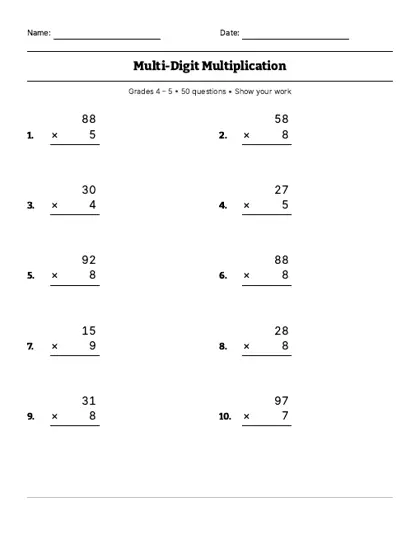 2-digit by 1-digit multiplicationGrade 4
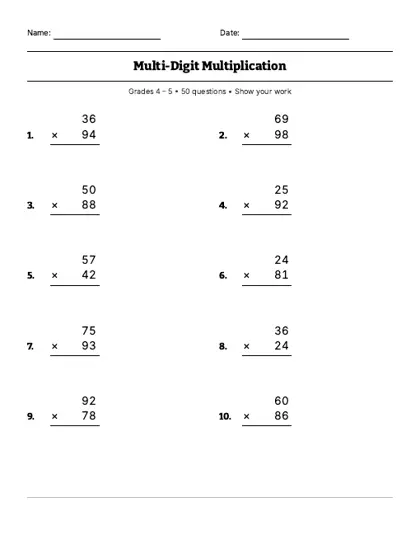 2-digit by 2-digit multiplicationGrade 4
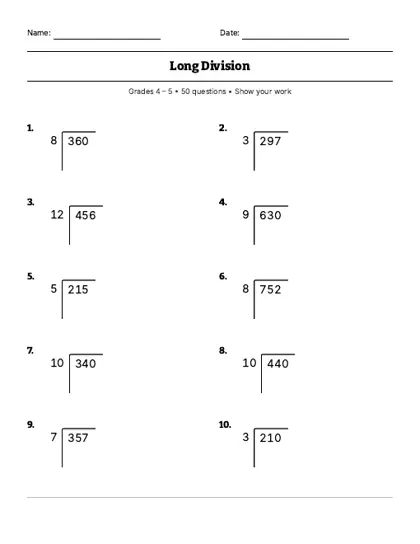 Division with remaindersGrade 4
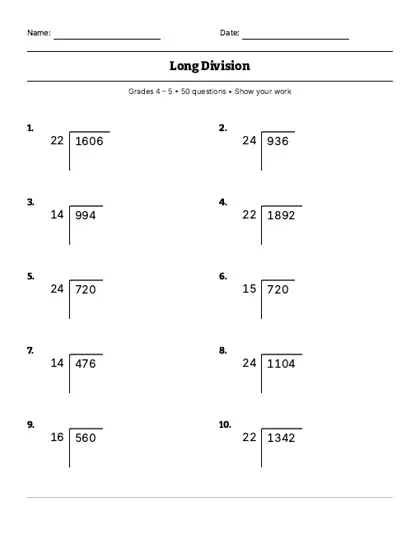 Long divisionGrades 4–5
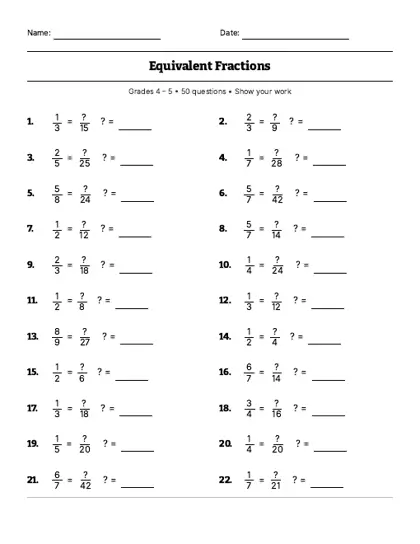 Equivalent fractionsGrades 3–4
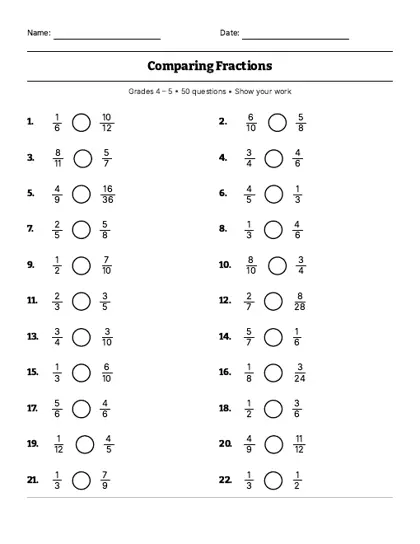 Comparing fractionsGrades 3–4
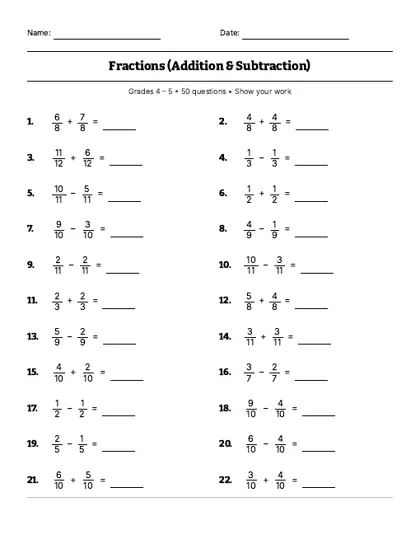 Adding and subtracting fractions with like denominatorsGrade 4
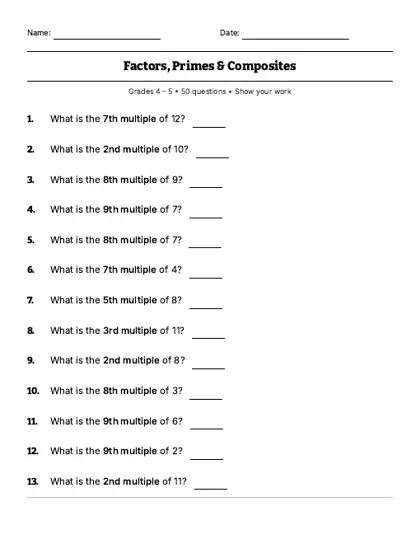 Factors and multiplesGrade 4
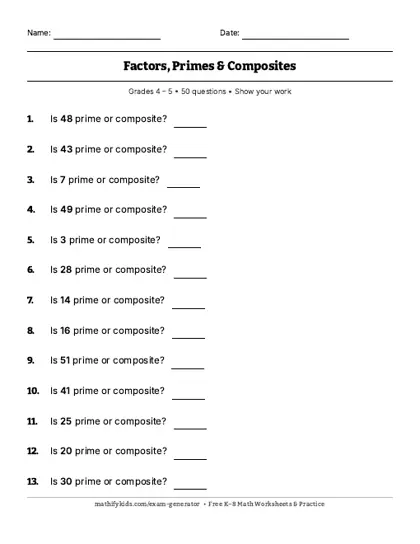 Prime numbersGrades 4–5
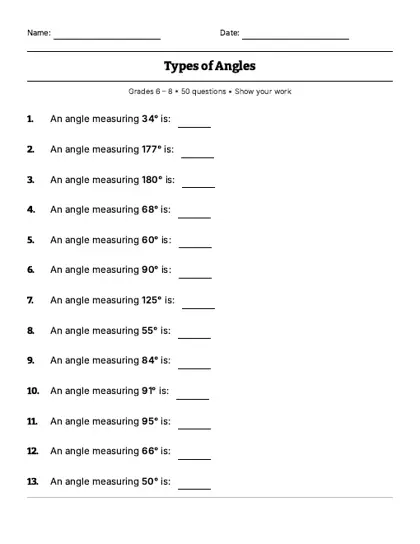 Types of anglesGrade 4
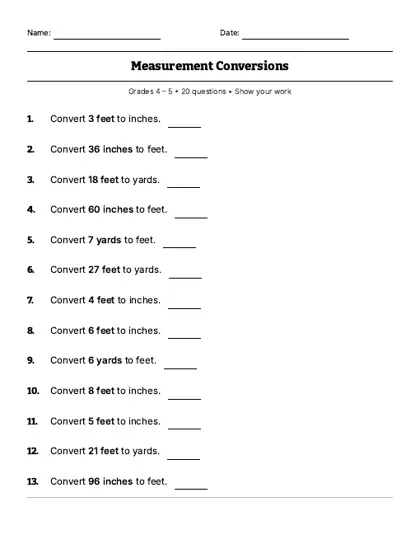 Customary unitsGrades 4–5
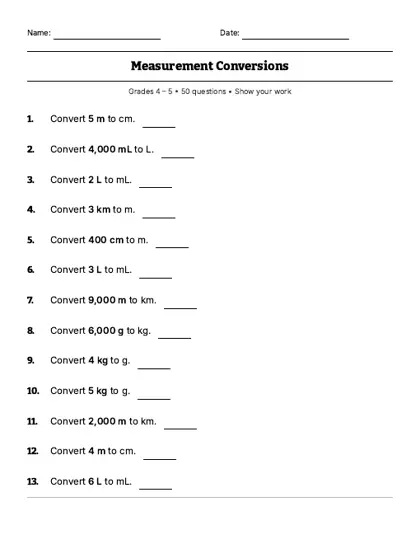 Metric unitsGrades 4–5
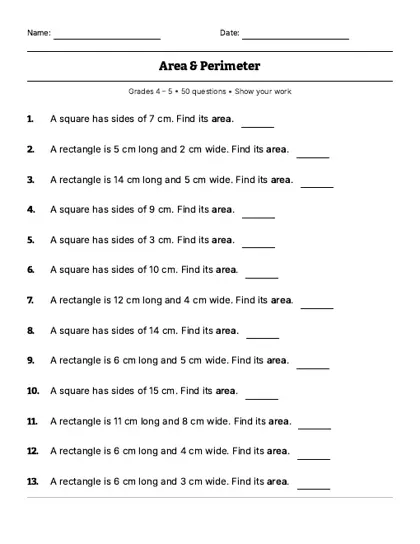 Area of rectanglesGrades 3–4
More 4th grade PDFs
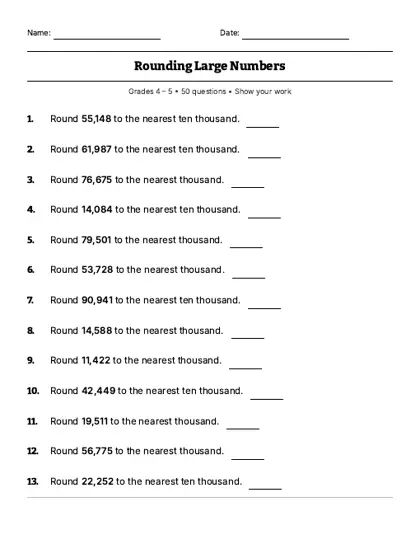 Rounding large numbersGrade 4
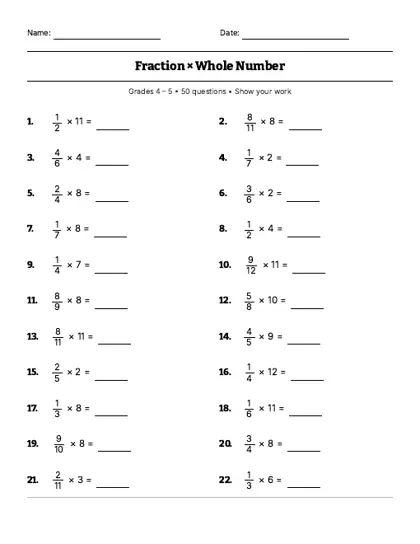 Fractions × whole numbersGrade 4
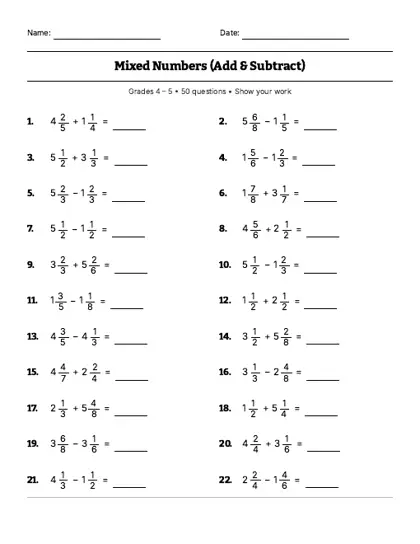 Adding mixed numbersGrades 4–5
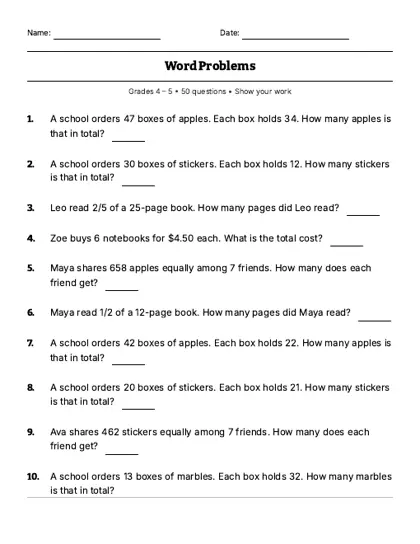 Word problems, grades 4–5Mixed
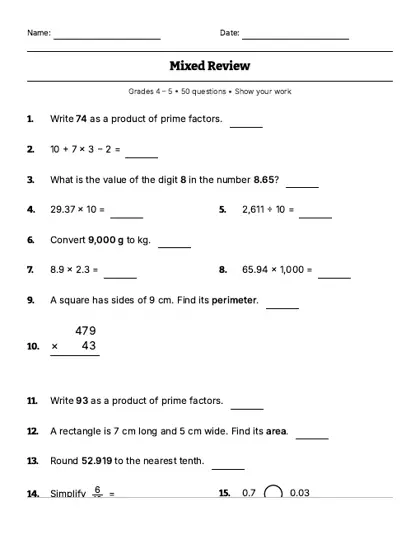 Mixed review, grades 4–5Check for gaps
4th grade math lessons and charts
- 2-digit by 2-digit multiplicationArea model and method
- Long divisionStep by step
- Equivalent fractionsSame amount, different names
- Comparing fractionsWhich is bigger?
- Measuring anglesUsing a protractor
- Factors and multiplesPrimes, GCF and LCM
- Fractions chartFraction wall
- Angles chartTypes of angles
How to help with 4th grade math at home
Estimate before you calculate
Ask “about how much?” before every multiplication or division. 34 × 26 is about 30 × 25 = 750, so 884 is believable and 8,840 is not.
Share things out
Divide snacks, cards or money between people and talk about the remainder. Remainders make sense when there really are 3 sweets left over.
Fold paper fractions
Fold strips of paper into halves, quarters and eighths and line them up to see that 2/4 = 4/8 = 1/2.
Hunt for angles
Doors, clock hands, scissors and laptops all make angles. Is it smaller or bigger than a right angle?
See 3rd grade math for the skills that lead into this year, and 5th grade math for what comes next.
Last reviewed
Questions parents ask
What math do 4th graders learn?
Multi-digit multiplication and long division, factors and primes, equivalent fractions and adding fractions with like denominators, decimals as tenths and hundredths, unit conversions, angles and lines.
Do 4th graders learn long division?
Yes. Grade 4 divides numbers up to 4 digits by a 1-digit divisor, with remainders (4.NBT.B.6). Two-digit divisors come in grade 5.
What fractions do 4th graders learn?
Equivalent fractions, comparing fractions with different denominators, adding and subtracting fractions and mixed numbers with the same denominator, and multiplying a fraction by a whole number.
How can I help my 4th grader with math?
Make sure the times tables are solid, ask for an estimate before every calculation, and use real sharing problems for division.
What is the hardest part of 4th grade math?
Long division and fraction equivalence. Both depend on fluent multiplication facts, which is why gaps from grade 3 show up so strongly in grade 4.
My child is behind in 4th grade math. Where do I start?
Check the times tables first, then place value. The grade 4–5 mixed review worksheet is a quick way to see which skills need work.