
Division for kids
Division is sharing into equal groups. Children learn what it means and the division facts in grade 3, divide bigger numbers with remainders in grade 4, and do long division with 2-digit divisors in grade 5. This page maps the path, has a sharing tool that shows remainders, explains long division and the divisibility rules, and links every lesson and worksheet.
What kids learn about division, grade by grade
- Grade 3 (3.OA.A.2 to 3.OA.C.7): division as equal sharing and equal groups, and division facts as the reverse of the times tables.
- Grade 4 (4.NBT.B.6): divide up to 4-digit numbers by 1-digit numbers, with remainders.
- Grade 5 (5.NBT.B.6): divide by 2-digit numbers; divide decimals to hundredths.
- Grade 6 (6.NS.B.2): long division fluently with the standard method.
The big idea behind division
Division answers two kinds of question. Sharing: 12 cookies shared by 3 children, how many each? Grouping: 12 cookies in bags of 3, how many bags? Both are 12 ÷ 3 = 4. Division is multiplication backwards: “3 times what is 12?”
Sharing tool: see division and remainders
Choose how many things and how many groups. Watch them share out equally, with any remainder left over.
Long division, step by step
Long division repeats four steps for each digit: divide, multiply, subtract, bring down. A memory aid: “Does McDonald’s Sell Burgers?” For 735 ÷ 6:
- 7 ÷ 6 = 1. Write 1. 1 × 6 = 6. 7 − 6 = 1. Bring down 3: 13.
- 13 ÷ 6 = 2. Write 2. 2 × 6 = 12. 13 − 12 = 1. Bring down 5: 15.
- 15 ÷ 6 = 2. Write 2. 2 × 6 = 12. 15 − 12 = 3. Nothing left to bring down.
- Answer: 122 remainder 3. Check: 6 × 122 + 3 = 735.
Divisibility rules
| Divisible by | If… | Example |
|---|---|---|
| 2 | it ends in 0, 2, 4, 6 or 8 | 346 |
| 3 | its digits add to a multiple of 3 | 471: 4 + 7 + 1 = 12 |
| 4 | its last two digits make a multiple of 4 | 1,324: 24 |
| 5 | it ends in 0 or 5 | 835 |
| 6 | it is divisible by 2 and by 3 | 354 |
| 9 | its digits add to a multiple of 9 | 729: 18 |
| 10 | it ends in 0 | 4,560 |
More in the divisibility rules lesson.
Where kids get stuck with division
Times tables aren’t solid
Division facts are times tables backwards. If 7 × 8 is slow, 56 ÷ 7 will be too. Fix the tables first.
Remainder bigger than the divisor
23 ÷ 4 = 4 r7. Fix: if the remainder is as big as the divisor, another group fits: 5 r3.
Forgetting a zero in the answer
612 ÷ 6 = 12 instead of 102. Fix: when a step gives 0, write 0 in the answer.
Remainders in word problems
30 children, 4 per car: 7 r2 means 8 cars, not 7. Fix: ask what the remainder means in the story.
Division lessons, in order
Division worksheets
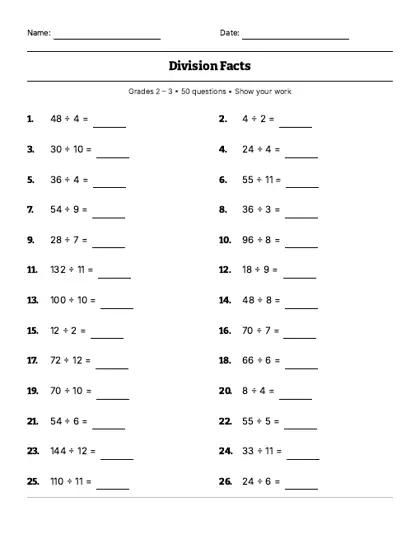 Division factsGrade 3
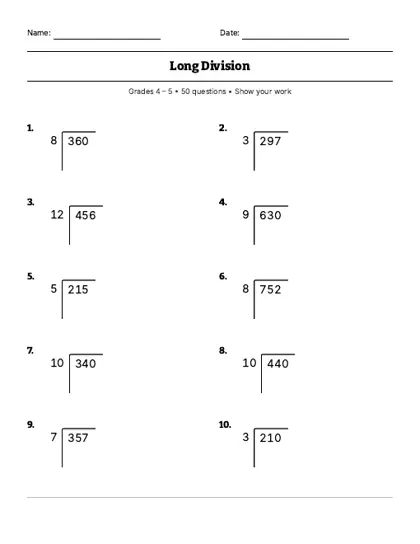 Division with remaindersGrade 4
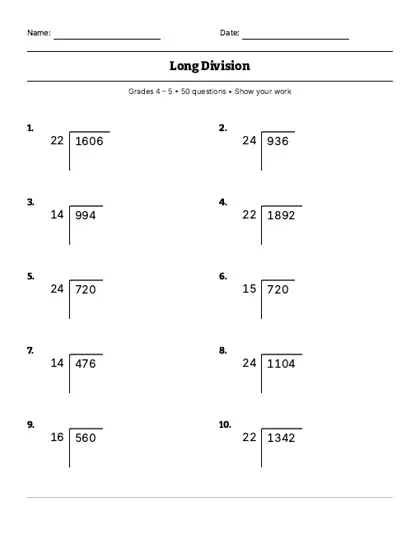 Long divisionGrades 4–5
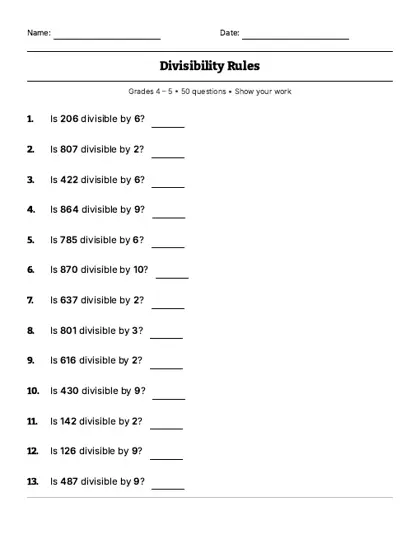 Divisibility rulesGrades 4–5
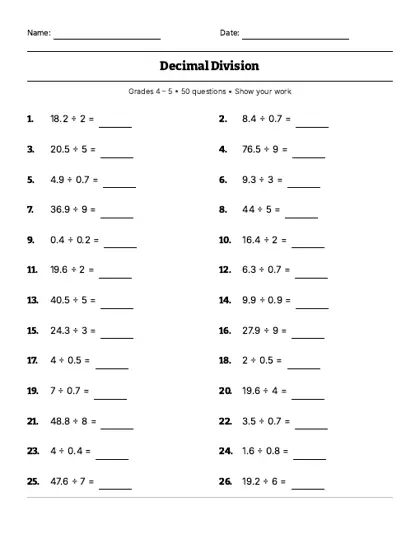 Dividing decimals
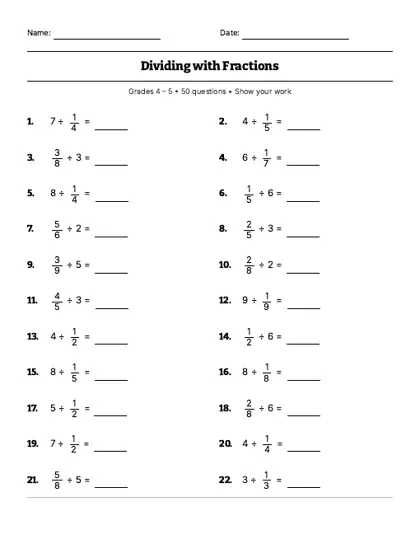 Dividing fractions and whole numbers
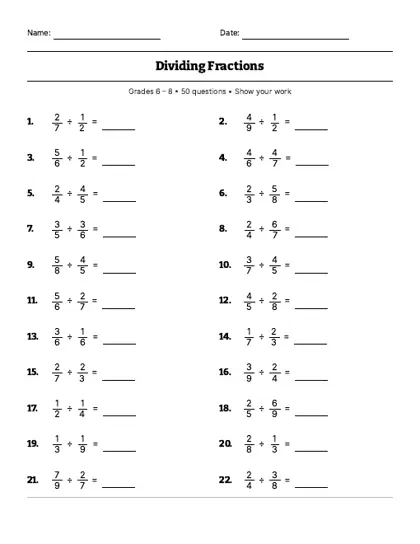 Dividing fractions
Make a fresh division facts test · Make a long division test
How to teach division at home
Deal out cards
Deal a stack of cards to the family. How many each? Any left? That is division with a remainder.
Pack into groups
Put eggs in cartons or socks in pairs. How many full groups can you make?
Split the bill
A $48 pizza shared by 4 people is $12 each. Real money makes division useful.
Related: multiplication · factors and multiples · 4th grade math
Last reviewed
Questions parents ask
What is division?
Division splits a number into equal groups. 12 ÷ 3 can mean sharing 12 into 3 groups (4 in each) or making groups of 3 (4 groups). Either way the answer is 4.
How do division and multiplication relate?
They undo each other. If 3 × 4 = 12, then 12 ÷ 3 = 4 and 12 ÷ 4 = 3. Knowing the times tables means knowing the division facts.
What is a remainder?
What is left over when a number can’t be shared equally. 23 ÷ 4 = 5 remainder 3: four groups of 5 use 20, and 3 are left. A remainder is always smaller than the number you divide by.
How do you do long division?
Divide, multiply, subtract, bring down, and repeat. For 735 ÷ 6: 7 ÷ 6 = 1 r1, bring down 3 to make 13; 13 ÷ 6 = 2 r1, bring down 5 to make 15; 15 ÷ 6 = 2 r3. Answer: 122 r3.
What are the divisibility rules?
Quick checks for whether a number divides exactly: by 2 if it is even, by 3 if its digits add to a multiple of 3, by 5 if it ends in 0 or 5, by 9 if its digits add to a multiple of 9, and by 10 if it ends in 0.
What grade learns division?
Grade 3 learns what division means and the division facts to 100 ÷ 10 (3.OA). Grade 4 divides up to 4 digits by 1 digit with remainders (4.NBT.B.6). Grade 5 divides by 2-digit numbers (5.NBT.B.6), and grade 6 uses the standard long division method fluently.