
5th grade math
Fifth grade finishes elementary math: fractions with different denominators, all four operations with decimals, volume, and the coordinate plane. It is the last year before middle school, so gaps here matter. This page lists every skill in order, what mastery looks like, signs a child needs help, and free 5th grade worksheets and lessons.
What 5th graders learn in math
The Common Core focuses grade 5 on three areas: adding, subtracting and multiplying fractions (and dividing with unit fractions), decimals to hundredths in all four operations, and volume. Multi-digit multiplication with the standard method and division with 2-digit divisors complete whole-number arithmetic.
5th grade math skills, in order
Expressions and patterns
Writing and evaluating expressions with parentheses (the start of the order of operations) and comparing two number patterns.
Place value, whole numbers and decimals
Powers of 10 and multiplying by 10, 100 and 1000, decimals to thousandths, comparing and rounding decimals, multi-digit multiplication with the standard method, division with 2-digit divisors, and adding, subtracting, multiplying and dividing decimals to hundredths.
Fractions
Adding and subtracting fractions with unlike denominators, multiplying fractions and mixed numbers, and dividing unit fractions by whole numbers (and whole numbers by unit fractions).
Measurement and data
Converting units within a system, line plots with fractions, and volume of rectangular prisms in cubic units.
Geometry
Plotting points on the coordinate plane (first quadrant) and classifying shapes in a hierarchy: every square is a rectangle, every rectangle is a parallelogram.
What mastery looks like by the end of the year
- Multiplies a 4-digit number by a 2-digit number with the standard method.
- Divides by a 2-digit number, such as 3,456 ÷ 12 = 288.
- Adds fractions with different denominators: 2/3 + 1/4 = 11/12.
- Multiplies decimals and places the point correctly: 0.6 × 0.4 = 0.24.
- Finds the volume of a box as length × width × height and explains why.
- Plots and reads points like (3, 5) on a coordinate grid.
Signs your child needs extra help
- Adds the tops and bottoms of fractions: 1/2 + 1/3 = 2/5.
- Misplaces the decimal point in multiplication or lines up decimals wrongly in addition.
- Long division falls apart with 2-digit divisors.
- Times tables are still slow, which makes every fraction and division problem harder.
- Mixes up x and y when plotting points.
Fractions are the biggest predictor of success in middle school math, so it is worth catching fraction gaps this year. The fractions section starts from the basics.
Try a 5th grade math problem
Tap a question to see the answer and how to get it.
What is 2/3 + 1/4?
11/12. As twelfths: 8/12 + 3/12 = 11/12.
What is 0.6 × 0.4?
0.24. 6 × 4 = 24, and two decimal places altogether.
What is 3,456 ÷ 12?
288. 12 × 288 = 3,456.
What is the volume of a box 5 cm × 3 cm × 2 cm?
30 cubic cm: one layer of 15 cubes, two layers.
What is 2 + 3 × (8 − 4)?
14. Brackets first (4), then multiply (12), then add.
What is 1/2 ÷ 4?
1/8. Share half a pizza between 4 people: each gets 1/8.
5th grade math worksheets
Each one is a free PDF with an answer key and its own page with a preview, tips and a button to make a new version.
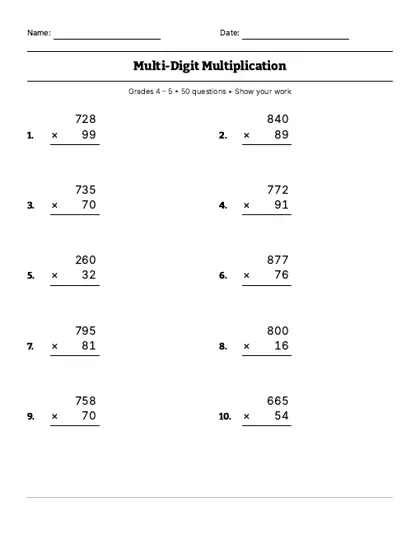 Multi-digit multiplicationGrade 5
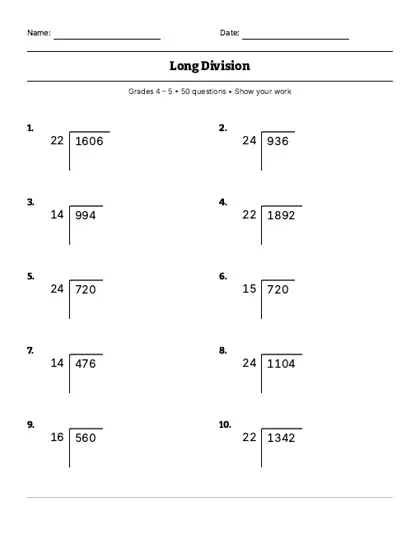 Long divisionGrades 4–5
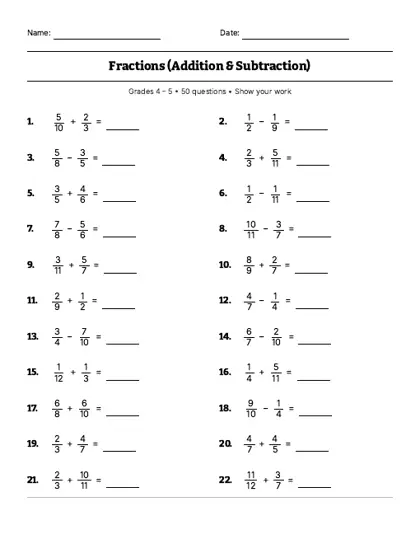 Adding and subtracting fractions with unlike denominatorsGrade 5
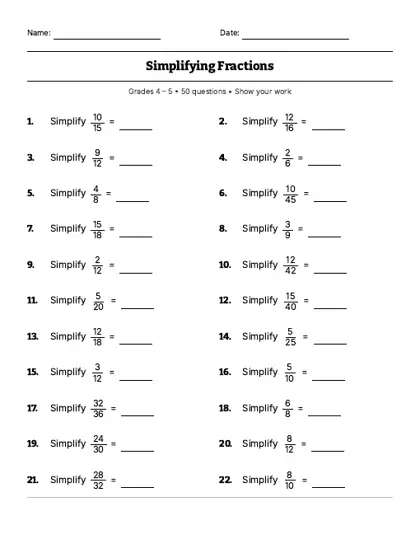 Simplifying fractionsGrades 4–5
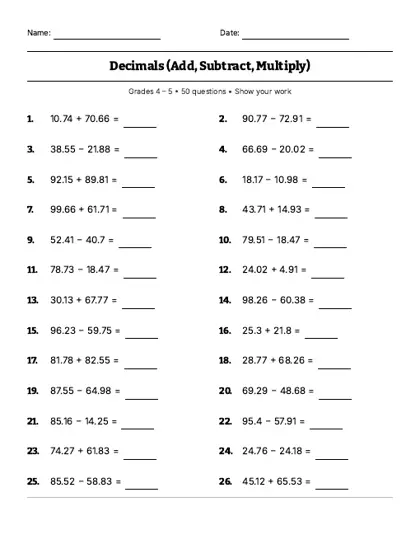 Adding and subtracting decimalsGrade 5
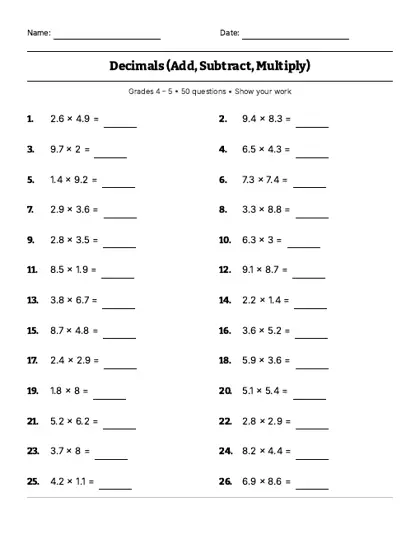 Multiplying decimalsGrades 5–6
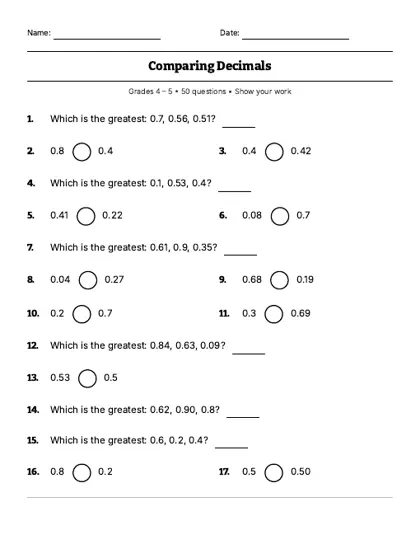 Comparing decimalsGrades 4–5
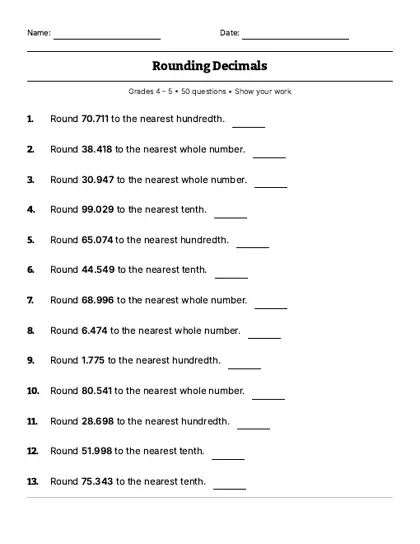 Rounding decimalsGrade 5
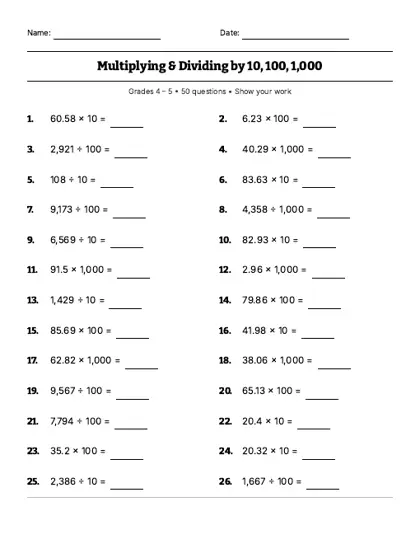 Multiply and divide by 10, 100 and 1000Grades 3–5
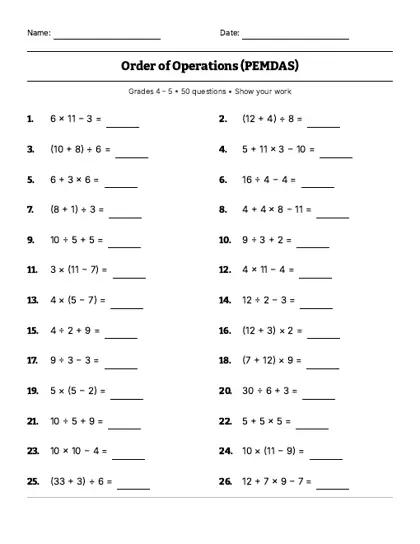 Order of operationsGrades 5–6
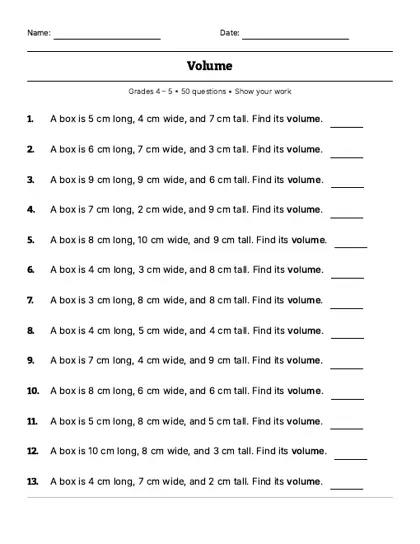 Volume of rectangular prismsGrade 5
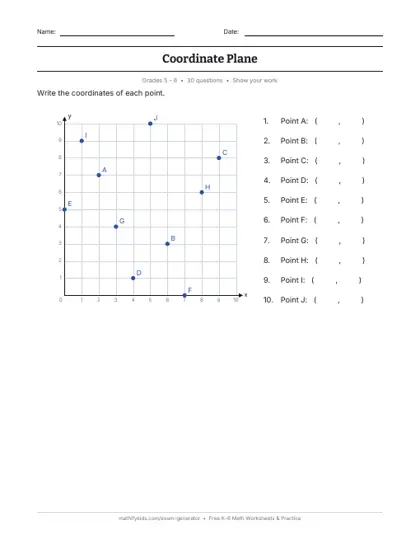 Coordinate planeGrades 5–6
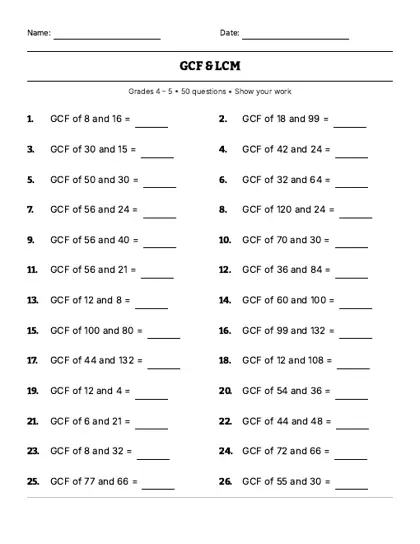 Greatest common factorGrade 6
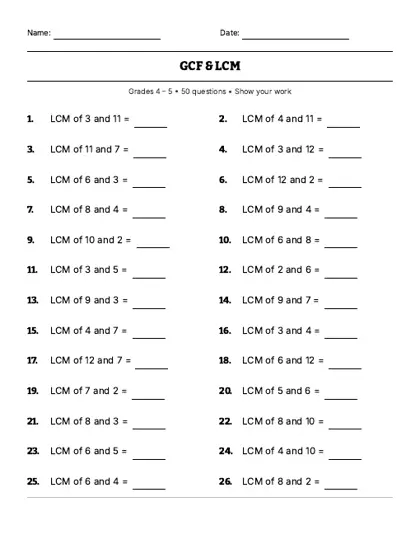 Least common multipleGrade 6
More 5th grade PDFs
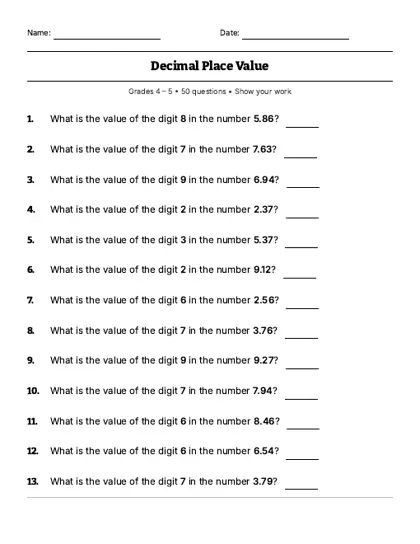 Decimal place valueGrade 5
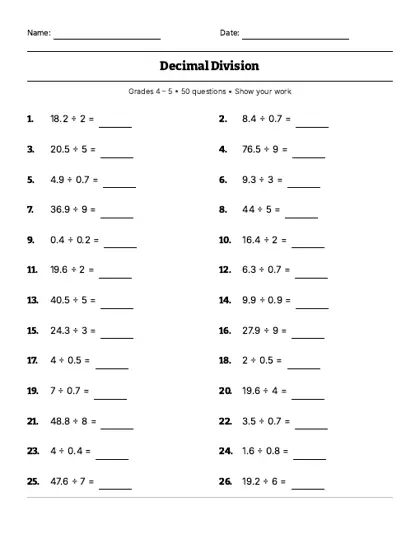 Dividing decimalsGrades 5–6
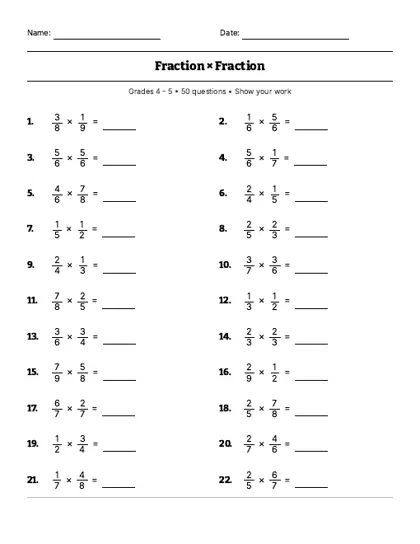 Multiplying fractionsGrade 5
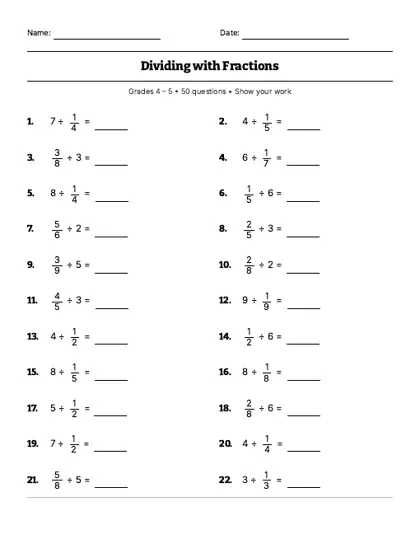 Dividing fractions and whole numbersGrade 5
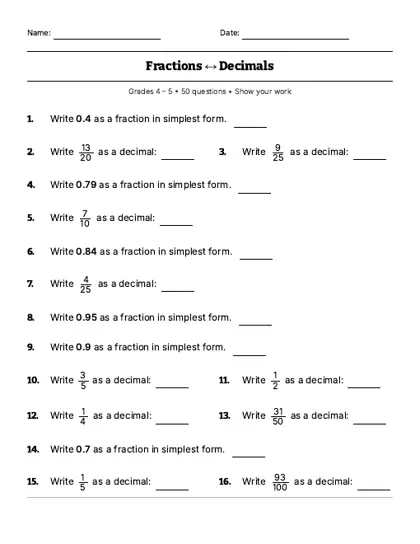 Fractions to decimalsGrades 4–5
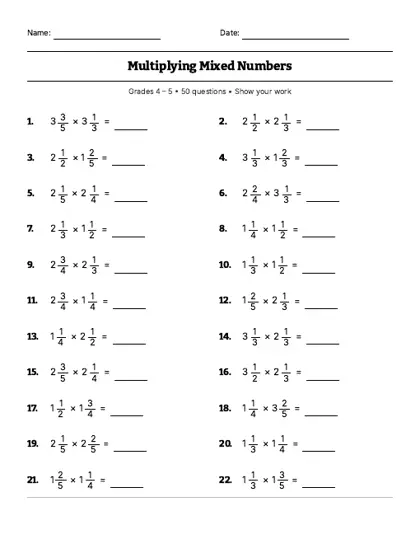 Multiplying mixed numbersGrade 5
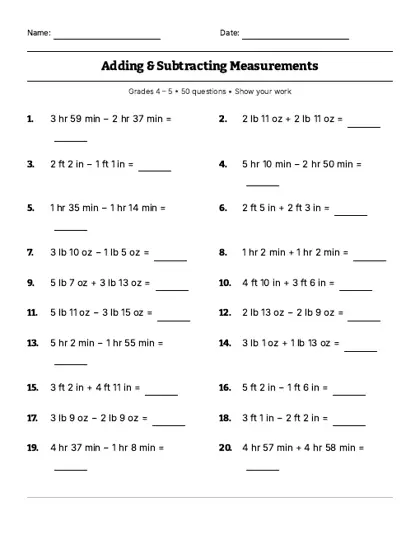 Adding measurementsGrade 5
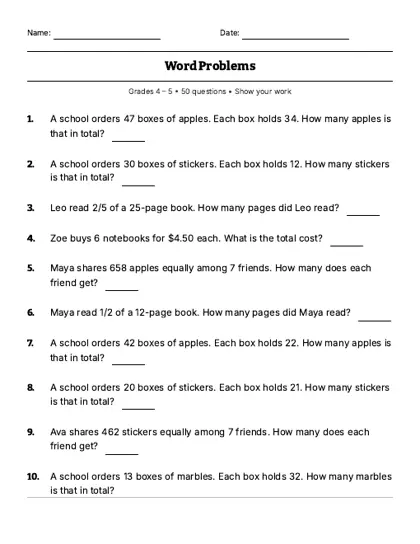 Word problems, grades 4–5Mixed
5th grade math lessons and charts
- Adding fractionsUnlike denominators
- Multiplying decimalsCount the places
- VolumeLayers of cubes
- Coordinate planePlotting points
- Multi-digit multiplicationStandard method
- Multiplying mixed numbersStep-by-step calculator
- DecimalsEverything about decimals
- Decimals chartPlace value and equivalents
How to help with 5th grade math at home
Double or halve a recipe
Doubling 3/4 cup or halving 1 1/2 teaspoons is real fraction practice, and the results get eaten.
Count the change
Decimals to hundredths are money. Estimate a shopping total, then work out the change from $20.
Fill a box
Fill a small box with sugar cubes or blocks, count them, then check with length × width × height.
Play battleships
Battleships on graph paper is coordinate-plane practice that doesn’t feel like practice.
See 4th grade math for the skills that lead into this year, and 6th grade math for what comes next.
Last reviewed
Questions parents ask
What math do 5th graders learn?
Adding and subtracting fractions with unlike denominators, multiplying fractions, all four operations with decimals, multi-digit multiplication and division with 2-digit divisors, volume, and the coordinate plane.
What fractions do 5th graders learn?
Adding and subtracting fractions and mixed numbers with different denominators, multiplying fractions and mixed numbers, and dividing unit fractions and whole numbers by each other.
Do 5th graders learn decimals?
Yes. Grade 5 reads and writes decimals to thousandths, compares and rounds them, and adds, subtracts, multiplies and divides decimals to hundredths.
How can I help my 5th grader with fractions?
Use pictures and real objects first: fraction bars, folded paper, recipes. Make sure equivalent fractions are secure, because adding with unlike denominators depends on them.
What is the hardest part of 5th grade math?
Fractions with unlike denominators and dividing by 2-digit numbers. Both depend on fluent times tables.
My child is behind in 5th grade math. Where do I start?
Check times tables, then equivalent fractions, then place value with decimals. The grade 4–5 mixed review worksheet helps find the gap.