
Kindergarten math
Kindergarten math is about counting, knowing what numbers mean, putting groups together and taking them apart, and naming shapes. Most of it happens with real objects, not worksheets. This page lists every skill, what mastery looks like by the end of the year, signs a child needs help, and free kindergarten worksheets and activities.
What kindergartners learn in math
The Common Core puts most of kindergarten into two areas: numbers to 20 (counting, writing and comparing them) and adding and taking away within 10. Children also describe and compare measurable things (longer, heavier) and name 2D and 3D shapes.
Hands-on counting matters more than anything written. A child who has counted hundreds of real objects understands numbers far better than one who has only traced them.
Kindergarten math skills, in order
Counting and cardinality
Count to 100 by ones and by tens, count on from any number, write numbers 0 to 20, count up to 20 objects and know the last number said is how many, and compare two groups or two numbers to 10.
Operations and algebraic thinking
Add and take away within 10 with objects, fingers and drawings; split numbers to 10 into pairs in different ways; find the number that makes 10 with any number from 1 to 9; add and subtract within 5 fluently.
Number and operations in base ten
Teen numbers as ten ones and some more ones: 14 is 10 and 4.
Measurement and data
Describe things by length, weight or height and compare two objects (which is longer?); sort objects into groups and count each group.
Geometry
Name shapes (squares, circles, triangles, rectangles, hexagons, cubes, cones, cylinders, spheres) whatever their size or position, tell flat from solid, and build shapes from parts.
What mastery looks like by the end of the year
- Counts to 100 by ones and by tens.
- Counts a group of up to 20 objects and says how many without recounting.
- Writes the numbers 0 to 20.
- Adds and takes away within 10 using objects or fingers, and knows facts within 5 quickly.
- Knows the pairs that make 10 (7 and 3, 6 and 4…).
- Names a square, circle, triangle and rectangle even when they are turned or a different size.
Signs your child needs extra help
- Recites numbers but can’t match one number to one object when counting.
- Has to count a group again from 1 every time.
- Mixes up teen numbers (writes 41 for 14) or can’t count past 20.
- Doesn’t know which of two groups has more without counting both.
- Calls a turned square a “diamond” and doesn’t recognize it as a square.
All of these respond to short, playful daily practice with real objects. The number sense page has ten activities and an interactive ten frame.
Try a kindergarten math problem
Tap a question to see the answer and how to get it.
Count these: ● ● ● ● ● ● ●
7. Touch each dot once while counting.
What number comes after 19?
20.
4 and how many more make 10?
6. On a ten frame: 4 filled, 6 empty.
Which is more, 8 or 5?
8. Line up 8 and 5 objects: 8 has 3 extra.
You have 5 apples and eat 2. How many are left?
3.
How many sides does a triangle have?
3 sides and 3 corners.
Kindergarten math worksheets
Each one is a free PDF with an answer key and its own page with a preview, tips and a button to make a new version.
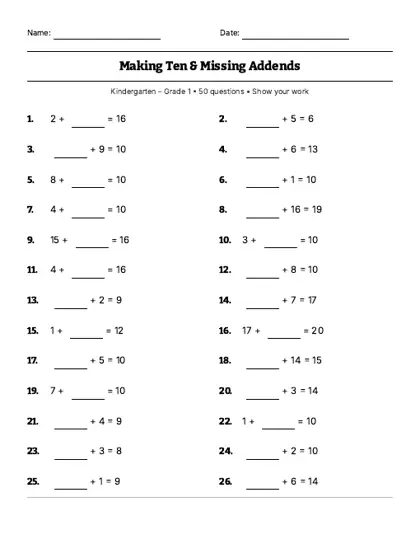 Number bonds
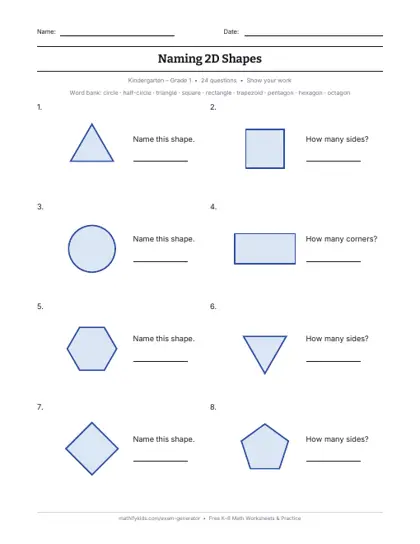 Naming 2D shapes
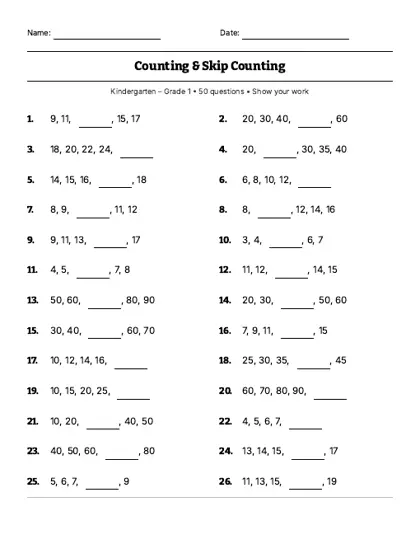 Skip counting
More kindergarten PDFs
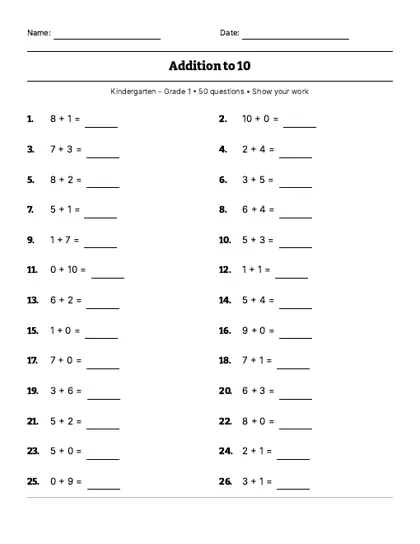 Addition to 10Kindergarten–grade 1
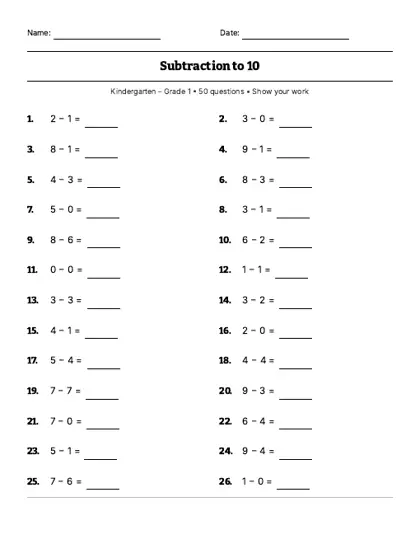 Subtraction to 10Kindergarten–grade 1
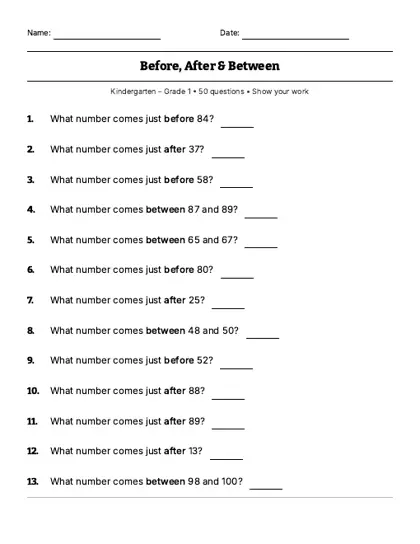 Before, after and betweenKindergarten–grade 1
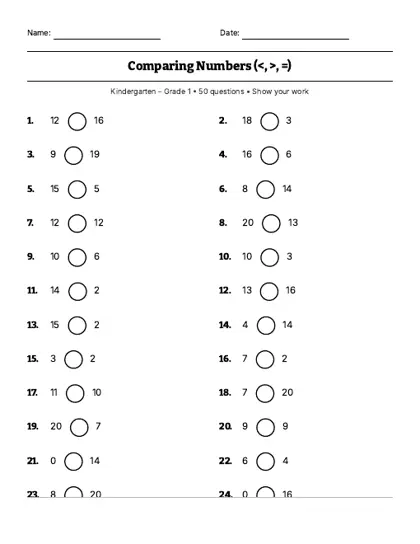 Comparing numbersKindergarten–grade 1
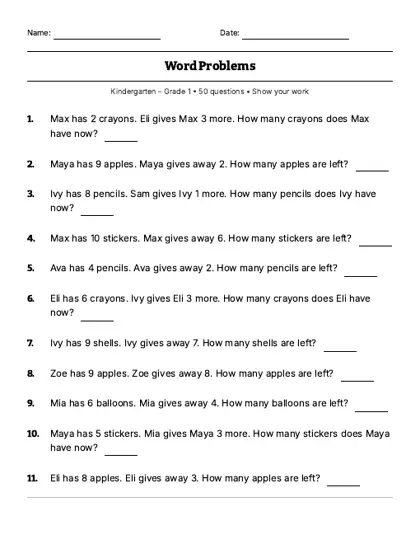 Word problems K–1Adding and taking away
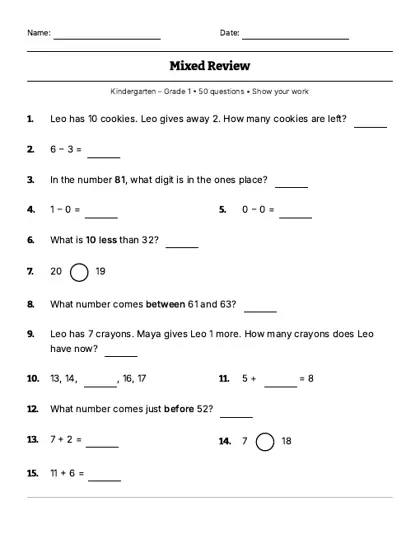 Mixed review K–1End-of-year check
Kindergarten math lessons and charts
- CountingHow to teach counting
- Number bondsPairs that make 10
- Number sense10 activities and a ten frame
- Shapes2D and 3D shapes with pictures
- Addition factsStrategies to 10 and 20
- Numbers chart1 to 100
- 2D shapes chartNames and sides
- Shapes around usReal-world shapes
How to help with kindergarten math at home
Count everything
Steps, grapes, cars, buttons. Ask “how many?” several times a day, and have your child touch each one as they count.
Play board games with dice
Snakes and ladders and similar games build counting on and recognizing dice patterns.
Make 10 with fingers
Hold up 7 fingers: how many are down? That is the pair that makes 10.
Go on a shape hunt
Find circles, squares, rectangles and triangles around the house or on a walk.
Next year: 1st grade math.
Last reviewed
Questions parents ask
What math should a kindergartner know?
Count to 100 by ones and tens, count up to 20 objects, write numbers to 20, compare groups, add and take away within 10, know the pairs that make 10, and name basic 2D and 3D shapes.
Should kindergartners do math worksheets?
A few are fine, but most kindergarten math should be hands-on: counting objects, playing games and building shapes. Worksheets work best as a short check after the real learning.
How high should a kindergartner count?
To 100 by ones and by tens by the end of the year (Common Core K.CC.A.1), and count a group of up to 20 objects.
How do I teach my kindergartner to add?
Start with real objects: 3 cars and 2 more cars. Then fingers, then drawings. Count on from the bigger number instead of counting everything from 1.
What shapes should kindergartners know?
Squares, circles, triangles, rectangles and hexagons, plus cubes, cones, cylinders and spheres, in any size or position.
My child is behind in kindergarten math. What should I do?
Count real objects together every day and play simple dice and card games. Most kindergarten gaps close quickly with short, regular, playful practice.