
Subtraction for kids
Subtraction is taking away, and also finding the difference between two numbers. Children start with objects in kindergarten and finish with multi-digit subtraction across zeros in grade 4. This page maps the whole path, shows the strategies and regrouping with pictures, has a step-by-step tool for any problem, and links every subtraction lesson and worksheet.
What kids learn about subtraction, grade by grade
- Kindergarten (K.OA.A.1, K.OA.A.2): take away within 10 using objects and drawings.
- Grade 1 (1.OA.C.6, 1.NBT.C.6): facts within 20 using strategies; subtract multiples of 10.
- Grade 2 (2.OA.B.2, 2.NBT.B.5, 2.NBT.B.7): facts to 20 from memory; within 100 with regrouping; within 1,000 using models.
- Grade 3 (3.NBT.A.2): 3-digit subtraction fluently, including across zeros.
- Grade 4 (4.NBT.B.4): multi-digit subtraction with the standard method.
The big idea behind subtraction
Subtraction has two meanings. Take away: 9 birds, 3 fly off, 6 are left. Difference: how much more is 9 than 3? Both give 6. Knowing both lets children pick the easiest strategy, and every subtraction can be checked by adding.
Subtraction strategies
- Count back for small take-aways: 15 − 3 → 14, 13, 12.
- Think addition: 13 − 8 is “8 + ? = 13”, which is 5.
- Count up when the numbers are close: 52 − 48 = 4.
- Subtract through 10: 14 − 6 = 14 − 4 − 2 = 8.
- Adjust both numbers: 503 − 198 = 505 − 200 = 305.
Regrouping (borrowing)
When a top digit is smaller than the one below it, trade 1 from the next place for 10. In 452 − 128, one ten becomes ten ones: 2 ones become 12, the 5 tens become 4. Then subtract each column.
Try any subtraction problem
Type a problem from homework and step through each column and borrow.
Where kids get stuck with subtraction
Smaller from bigger
52 − 18 = 46, because 8 − 2 = 6 in the ones. Fix: always top minus bottom; borrow when the top is smaller.
Zeros
503 − 178 is where most children stop. Fix: borrow from the hundreds, so 503 becomes 4 | 9 | 13.
Counting back slowly
Counting back 9 from 17 is slow and error-prone. Fix: think addition: 9 + ? = 17.
Not checking
Fix: add the answer to the number taken away. You should get the top number.
Subtraction lessons, in order
Subtraction worksheets
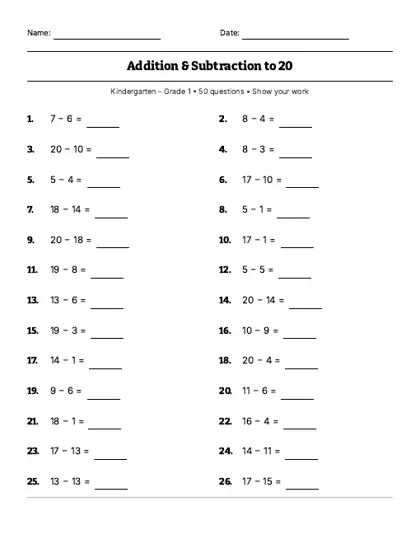 Subtraction facts
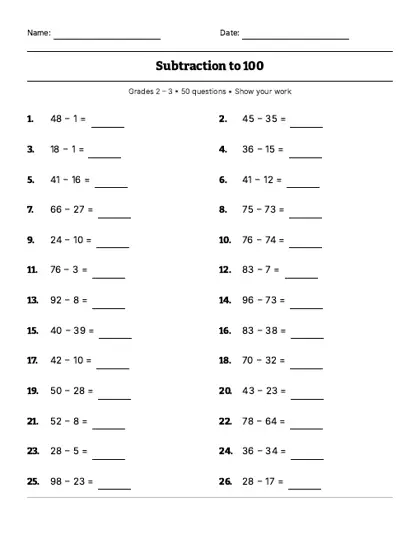 2-digit subtraction
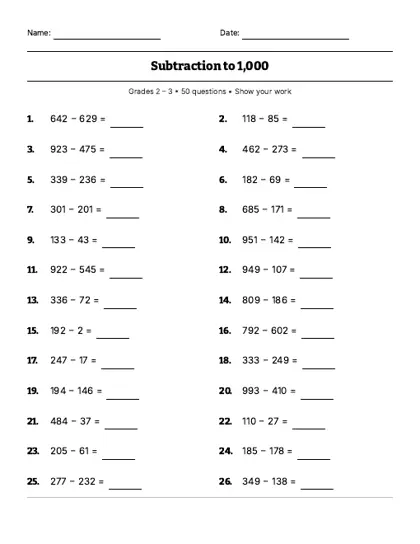 3-digit subtraction
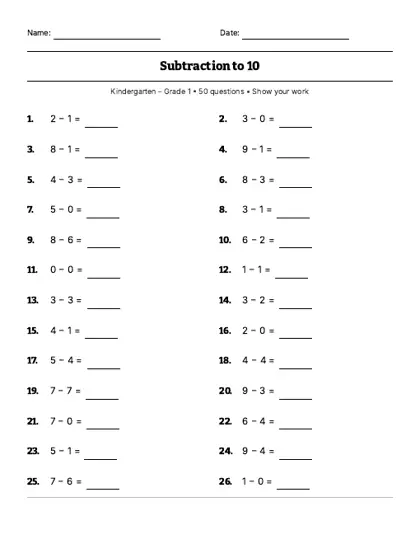 Subtraction to 10Kindergarten–grade 1
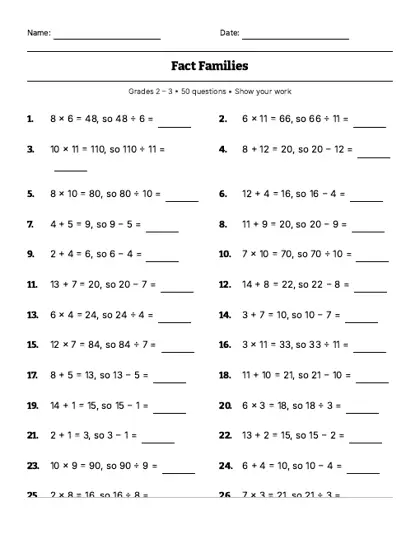 Fact familiesGrades 1–3
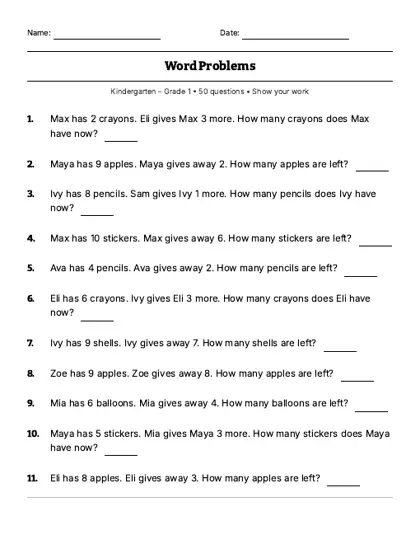 Word problems K–1Adding and taking away
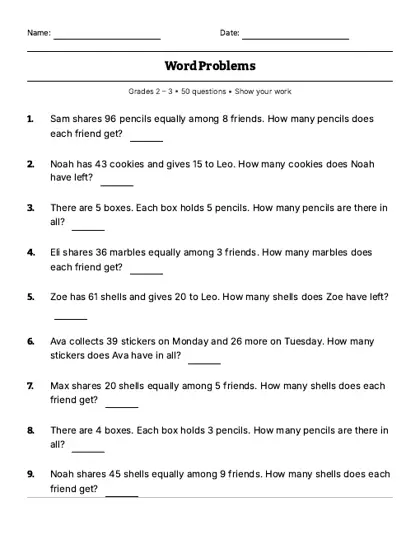 Word problems 2–3Mixed
Make a fresh 2-digit subtraction test · Make a 3-digit subtraction test
How to teach subtraction at home
Take-away snacks
Count out 12 crackers, eat 5, count what’s left. Then write it: 12 − 5 = 7.
How many more?
“You have 8 stickers and I have 13. How many more do I have?” That is subtraction as difference.
Make change
Pay with a $1 coin for something that costs 65¢. Count up the change: 70, 80, 90, $1, so 35¢.
Fact family triangles
Write 5, 8 and 13 at the corners of a triangle. Cover one number and ask for it. One triangle teaches four facts.
Last reviewed
Questions parents ask
How do I teach subtraction to my child?
Start with taking away real objects, then counting back on a number line, then thinking of subtraction as “how many more to get there” (counting up). Learn the facts to 20, then move to tens and ones.
What is regrouping in subtraction?
Trading 1 from the next place for 10 in the place you are working in, when the top digit is too small. In 52 − 18, one ten becomes ten ones, so 2 ones become 12. Borrowing is the older name.
What is the fastest way to learn subtraction facts?
Use addition: every subtraction fact is an addition fact backwards. 13 − 8 is “8 plus what makes 13?” Fact families (8 + 5 = 13, 13 − 8 = 5) make this easy.
Should kids count back or count up to subtract?
Both. Count back when taking away a small number (15 − 3). Count up when the numbers are close together (52 − 48: from 48, 2 more to 50, 2 more to 52, so 4).
How do you subtract across zeros?
Borrow from the first non-zero place to the left. In 503 − 178, 503 becomes 4 hundreds, 9 tens and 13 ones, then subtract column by column: 325.
What grade learns subtraction with regrouping?
Grade 1 subtracts within 20 and multiples of 10. Grade 2 subtracts within 100 with regrouping (2.NBT.B.5) and within 1,000 using models. Grade 3 subtracts within 1,000 fluently, and grade 4 uses the standard method for any size.