
Estimating differences
To estimate a difference, round each number to the nearest 10 or 100, then subtract the rounded numbers.
What estimating a difference means
An estimate is an answer that is close enough, found quickly. We estimate a difference when we only need roughly how much more or how many are left, or to check an exact answer.
To estimate 82 − 37: round 82 to 80 and 37 to 40. Then 80 − 40 = 40. The exact answer is 45, which is close, so the estimate did its job.
We write “about 40” or use the sign ≈: 82 − 37 ≈ 40.
See it: pictures to draw with your child
Copy these onto paper or a whiteboard. A quick sketch makes the idea concrete before any written method.
How to round
- Find the two tens (or hundreds) the number sits between. 37 is between 30 and 40.
- Look at the digit to the right of the place you round to.
- 5 or more rounds up; 4 or less rounds down. 37 has 7 ones, so it rounds up to 40.
Round both numbers to the same place before subtracting.
Round, then subtract
Change the numbers and the place. Compare the estimate with the exact answer.
Nearest 10 or nearest 100?
Rounding to a bigger place is quicker but less accurate. For 642 − 287:
- Nearest 100: 600 − 300 = 300 (exact answer 355, off by 55).
- Nearest 10: 640 − 290 = 350 (off by 5).
Subtraction estimates can be further off than addition estimates, because when one number rounds up and the other rounds down, the errors add together instead of cancelling. If an estimate seems far off, round to a smaller place.
A neat trick is to round only the number taken away: 642 − 287 ≈ 642 − 290 = 352. That is often very close and still easy.
When to estimate
- To check a written answer. If 82 − 37 comes out as 55 or 115, the estimate of 40 shows something went wrong.
- When “about” is enough. “About how much money will be left?” and “Roughly how many more pages?” rarely need exact answers.
- Before a word problem. An estimate tells your child what size of answer to expect.
In grade 3, the standards ask children to judge whether answers are reasonable using estimation (3.OA.D.8). “Estimate first” is one of the best habits to build.
Estimating in real life
Most real subtraction is estimation: how much money will be left after shopping, how many more days until a birthday, how much further to drive. Ask your child for an estimate first in these moments, then work out the exact answer together if it matters.
Quiz: estimate the difference
Round each number, then subtract the rounded numbers.
Where this fits: subtraction step by step
- What is subtraction
- Subtraction within 10
- Counting back
- Subtraction on a number line
- Counting up
- Fact families
- Make 10 subtraction strategy
- Subtraction within 20
- Subtracting tens and hundreds
- 2-digit subtraction
- Subtraction with regrouping
- 3-digit subtraction
- Subtracting across zeros
- Mental subtraction strategies
- Checking subtraction with addition
- Missing number subtraction
- Estimating differences (this page)
- Multi-digit subtraction
- Subtraction word problems
What to say to your child
A short script for teaching it the first time. Pause after each line and let your child do the next step.
- “About how much is 82 − 37? What ten is 82 close to?” (80.)
- “And 37?” (40.)
- “So about how much is the difference?” (80 − 40 = 40.)
- “Now work it out exactly.” (45.) “Is 45 close to 40?” (Yes!)
- “If you got 55, what would the estimate tell you?” (That it is wrong.)
More worked examples
Example 1: 2-digit: 91 − 48
91 rounds to 90 and 48 rounds to 50. 90 − 50 = 40. (Exact: 43.)
Example 2: 3-digit: 734 − 281
To the nearest 100: 700 − 300 = 400. To the nearest 10: 730 − 280 = 450. (Exact: 453.)
Example 3: checking an answer: 612 − 389 = 323?
Estimate: 600 − 400 = 200. 323 is far from 200, so check again. The correct answer is 223.
Example 4: money: ₹500 − ₹268
Round 268 to 270: 500 − 270 = 230. About ₹230 left. (Exact: ₹232.)
Practice questions (answers below)
Ask these out loud or write them down. Check each answer, and ask “how did you get that?” for one or two.
- Round 67 to the nearest 10.
- Estimate 78 − 33.
- Estimate 92 − 46.
- Round 451 to the nearest 100.
- Estimate 845 − 312 to the nearest 100.
- Estimate 703 − 498 to the nearest 100.
- Is 84 − 29 = 65 reasonable?
- A book has 312 pages. Raj has read 189. About how many are left?
- Stretch: estimate 5,280 − 1,960 to the nearest 1,000.
Show the answers
- 70
- 80 − 30 = 50
- 90 − 50 = 40
- 500
- 800 − 300 = 500
- 700 − 500 = 200
- No: about 80 − 30 = 50; exact 55
- About 300 − 200 = 100 (exact 123)
- 5,000 − 2,000 = 3,000
Common mistakes
How to teach it at home
How much is left?
At the shop, estimate the change before paying.
Distance left
On a trip, estimate how many kilometres are left from road signs.
Guess then check
Before every written subtraction, ask for an estimate and write it beside the problem.
By grade
- Grade 3 (3.NBT.A.1, 3.OA.D.8): round to the nearest 10 or 100 and use estimates to judge answers.
- Grade 4 (4.NBT.A.3, 4.OA.A.3): round multi-digit numbers to any place and check multi-step problems by estimating.
- Next: subtraction word problems and multi-digit subtraction.
More for each grade: Grade 3 math and the CBSE class 3 maths guide; Grade 4 math and the CBSE class 4 maths guide.
Worksheets and practice
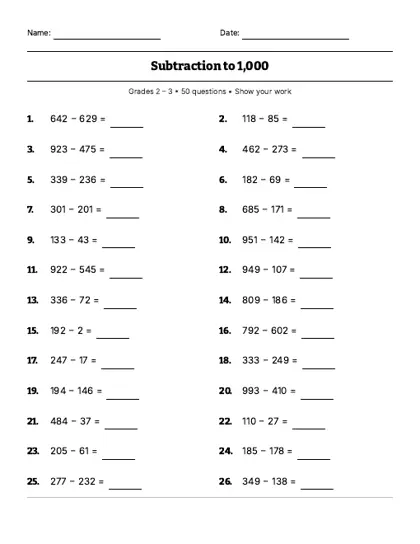
3-digit subtraction worksheet: printable PDF with an answer key. · Make a fresh test
Subtraction practice · subtraction speed test · subtraction chart · subtraction for kids
Last reviewed
Questions parents ask
How do you estimate a difference?
Round each number to the nearest 10 or 100, then subtract the rounded numbers. 82 − 37 is about 80 − 40 = 40.
Why is my estimate far from the exact answer?
When one number rounds up and the other rounds down, the errors add up. Round to a smaller place, or round only the number taken away.
Should you round to the nearest 10 or 100?
Round to the place that keeps the numbers easy. Nearest 10 is closer; nearest 100 is quicker for 3-digit numbers.
Why is estimating differences useful?
It checks whether an answer makes sense and answers everyday questions like how much money will be left.
What grade learns estimating differences?
Grade 3 rounds to 10 or 100 and estimates (3.NBT.A.1, 3.OA.D.8). Grade 4 rounds to any place (4.NBT.A.3).