
Addition for kids
Addition is the first operation children learn, and it carries on growing from counting objects in kindergarten to adding multi-digit numbers in grade 4. This page lays out the whole journey, the strategies that build speed, how regrouping works, where kids get stuck, and every addition lesson and worksheet.
What kids learn about addition, grade by grade
- Kindergarten (K.OA.A.1 to K.OA.A.5): add within 10 with objects and drawings, find pairs that make 10, and be fluent within 5.
- Grade 1 (1.OA.C.6, 1.NBT.C.4): add within 20 using strategies, be fluent within 10, and add 2-digit numbers using tens and ones.
- Grade 2 (2.OA.B.2, 2.NBT.B.5, 2.NBT.B.7): know all facts within 20 from memory, add within 100 fluently, and within 1,000 using models.
- Grade 3 (3.NBT.A.2): add within 1,000 fluently.
- Grade 4 (4.NBT.B.4): add multi-digit numbers with the standard written method.
Where to start with addition
With objects, not worksheets. A child who has pushed 3 blocks and 4 blocks together and counted 7 understands what “+” means. From there, the order is: counting on, facts to 10, making 10, facts to 20, then tens and ones.
The big idea behind addition
Addition puts amounts together. For small numbers that is counting. For bigger numbers it is place value: add ones to ones, tens to tens, hundreds to hundreds. When a place gets 10 or more, ten of them become one of the next place up.
Addition strategies that build speed
- Count on from the bigger number: for 2 + 9, start at 9 and count 2 more.
- Make 10: 8 + 5 = 8 + 2 + 3 = 13. The most useful strategy of all.
- Doubles and near doubles: 7 + 7 = 14, so 7 + 8 = 15.
- Add tens, then ones: 46 + 23 = 66 + 3 = 69.
- Round and adjust: 299 + 156 = 300 + 156 − 1 = 455.
The addition facts lesson teaches each strategy step by step, and mental math for addition covers the bigger-number ones.
Regrouping (carrying) in addition
When a column adds up to 10 or more, write the ones digit and carry the ten into the next column. In 478 + 256: ones 8 + 6 = 14, write 4 and carry 1. Tens 7 + 5 + 1 = 13, write 3 and carry 1. Hundreds 4 + 2 + 1 = 7. The answer is 734.
Try these addition problems
Tap to see the answer and the strategy.
What is 8 + 5? Use make 10.
13. Take 2 from the 5 to make 8 into 10, then 10 + 3 = 13.
What is 6 + 7? Use doubles.
13. 6 + 6 = 12, and one more is 13.
What is 47 + 38?
85. Ones: 7 + 8 = 15, write 5 and carry 1 ten. Tens: 4 + 3 + 1 = 8.
What is 299 + 156? Find a quick way.
455. Add 300 instead (456), then take 1 away.
Where kids get stuck with addition
Counting from 1 every time
For 9 + 3, counting “1, 2, 3 … 12” is slow and error-prone. Teach counting on from 9: “10, 11, 12”.
Forgetting to carry
47 + 38 written as 715 (7 + 8 = 15 in the ones column). Fix: one digit per column; the extra ten moves left.
Forgetting the carried 1
47 + 38 = 75. Fix: write the carried 1 above the next column every time, and add it first.
Lining up on the left
Adding 245 + 32 with the 3 under the 2. Fix: always line up the ones. Squared paper helps.
Addition lessons, in order
Addition worksheets
Printable PDFs with answer keys, from adding to 10 up to 3-digit addition. Make a fresh 2-digit addition test or a 3-digit addition test.
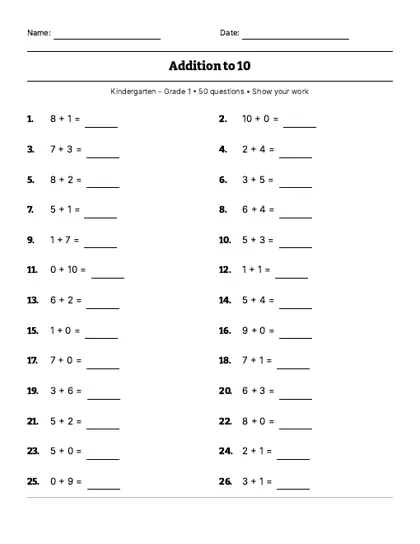 Addition to 10Kindergarten–grade 1
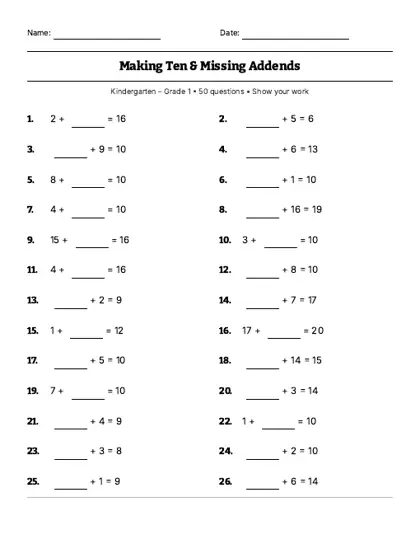 Number bondsKindergarten–grade 1
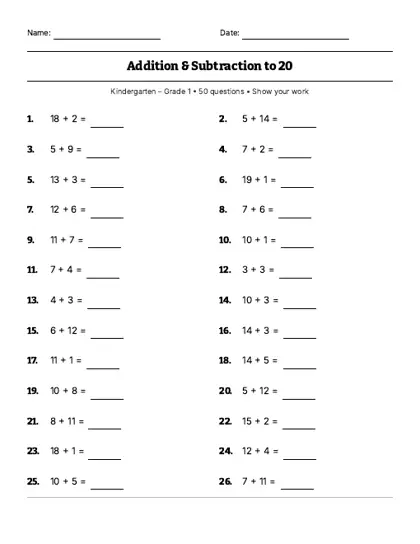 Addition facts to 20Grades 1–2
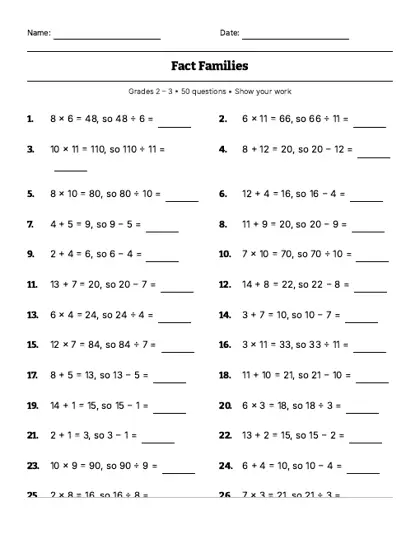 Fact familiesGrades 1–3
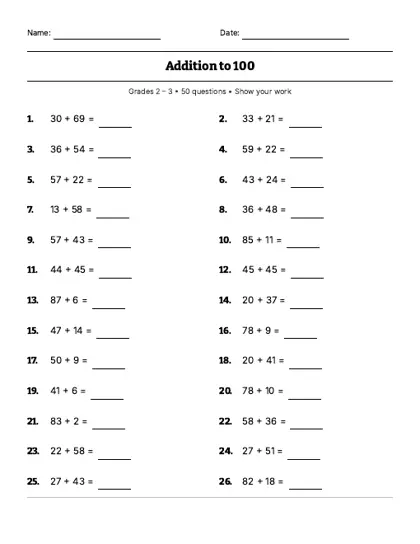 2-digit additionGrades 1–2
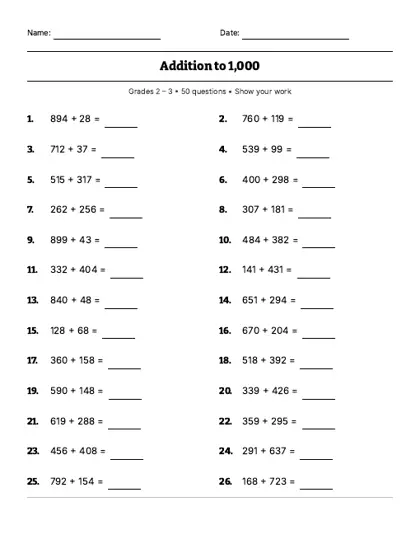 3-digit additionGrades 2–3
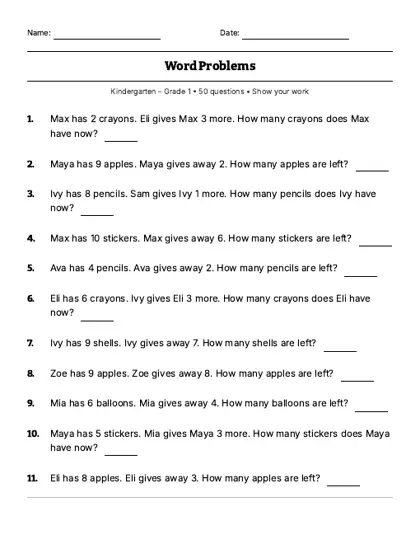 Word problems K–1Adding and taking away
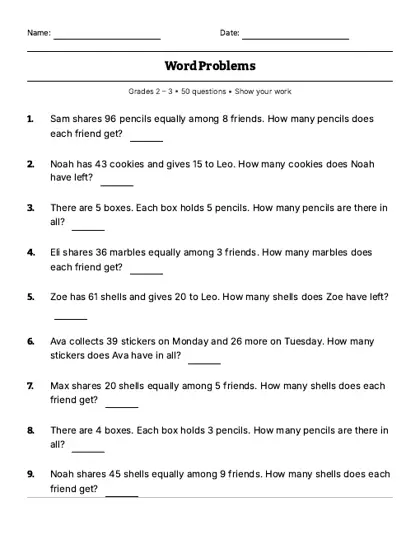 Word problems 2–3Mixed
Charts for the wall: addition chart · mental math strategies · math keywords for word problems
How to teach addition at home
Roll two dice
Roll, add, and say the strategy: “6 and 5, that’s double 5 plus 1, 11.” Use three dice for a challenge.
Play make 10
Deal cards (aces are 1, take out picture cards). Find pairs that make 10. These pairs are the key to every fact up to 20.
Add up the shopping
Round prices to whole dollars and keep a running total in the shop. Then check against the receipt.
Number plate sums
On car journeys, add the digits on number plates. First to say the total wins.
Last reviewed
Questions parents ask
How do I teach addition to my child?
Start with real objects: fingers, blocks, snacks. Move to counting on from the bigger number, then to strategies like making 10 and doubles. Only then move to written methods for bigger numbers.
What is regrouping in addition?
When a column adds up to 10 or more, the extra ten moves to the next column. In 47 + 38, 7 + 8 = 15: write 5 and carry 1 ten. Regrouping is the newer name for carrying.
When should kids know their addition facts?
By the end of grade 1, addition and subtraction within 10 should be fluent, and by the end of grade 2 all facts within 20 should be known from memory (Common Core 1.OA.C.6 and 2.OA.B.2).
What are the best addition strategies?
Counting on from the bigger number, making 10 (8 + 5 = 8 + 2 + 3), doubles and near doubles (6 + 7 = 6 + 6 + 1), and for bigger numbers, adding tens and ones separately.
My child counts on fingers. Is that a problem?
Not at first. Fingers are a fine tool in kindergarten and grade 1. If it continues into grade 2, practice make-10 and doubles facts so your child has faster strategies to use instead.
What grade learns 3-digit addition?
Grade 2 adds within 1,000 using models and place value (2.NBT.B.7). Grade 3 is expected to do it fluently, and grade 4 uses the standard written method for any size of number.