
Addition facts strategies: how to learn them
Addition facts are the 121 sums from 0 + 0 to 10 + 10. Children don’t need to memorize them one by one: a handful of strategies (counting on, making 10, doubles and near doubles) turns them into a few patterns. This page explains each strategy, the order to learn them, has a practice tool that gives a hint for every fact, and covers common mistakes.
The big idea: use what you know
Every fact can be worked out from an easier fact. 8 + 5 is hard to remember, but 8 + 2 = 10 is easy, and 10 + 3 = 13. Strategies are the bridge from counting to knowing: practice them enough and the answer comes instantly.
Six addition strategies, in teaching order
| Strategy | How it works | Use it for |
|---|---|---|
| Count on (+1, +2, +3) | Start at the bigger number and count on: 8 + 3 → 9, 10, 11. | 8 + 3, 2 + 9 |
| Make 10 | Fill the bigger number up to 10, then add what is left: 8 + 5 = 8 + 2 + 3 = 13. | 9 + 4, 8 + 6, 7 + 5 |
| Doubles | Learn 1 + 1 to 10 + 10 by heart. Doubles are easy to remember. | 6 + 6, 7 + 7 |
| Near doubles | Use a double and adjust: 6 + 7 = 6 + 6 + 1 = 13. | 6 + 7, 8 + 9 |
| Turn-arounds | 2 + 9 = 9 + 2. Every fact gives you a second one free. | 3 + 8 = 8 + 3 |
| +10 and +9 | Adding 10 just changes the tens: 10 + 6 = 16. Adding 9 is adding 10 then taking 1: 9 + 6 = 15. | 9 + 7, 9 + 5 |
With turn-arounds, doubles and making 10, almost every fact to 20 is covered.
The order to learn addition facts
- +0, +1, +2: counting on.
- Pairs that make 10: 1 + 9 to 5 + 5. See number bonds.
- Doubles, then near doubles.
- +10, then +9.
- Make 10 for the rest: 8 + 5, 7 + 6, 9 + 4.
Addition facts practice, with a strategy hint for every fact
Check your answers. Any you miss show the answer and the quickest strategy.
Common mistakes
How to teach it at home
Make 10 card game
Lay out cards (ace to 9) face up and take pairs that make 10.
Doubles everywhere
Egg cartons (6 + 6), spider legs (4 + 4), fingers (5 + 5).
Dice addition
Roll two dice and say the fact and the strategy.
Fact of the day
Pick one hard fact and ask it at random times all day.
By grade
- Kindergarten (K.OA.A.5): fluent within 5.
- Grade 1 (1.OA.C.6): add within 20 with strategies; fluent within 10.
- Grade 2 (2.OA.B.2): know all sums of two one-digit numbers from memory.
- Next: 3-digit addition and subtraction facts.
Worksheets and practice
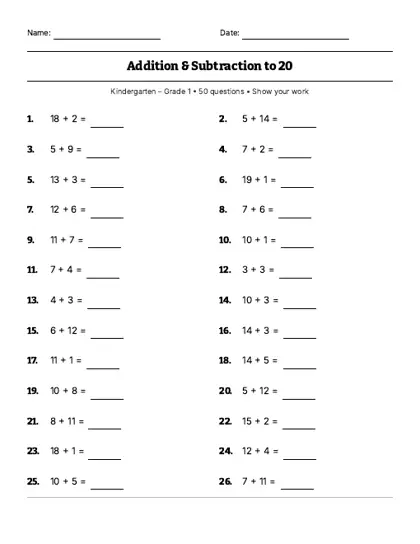
Addition facts worksheet: printable PDF with an answer key. · Make a fresh test
Last reviewed
Questions parents ask
What are addition facts?
The sums of two one-digit numbers, from 0 + 0 to 9 + 9 (or to 10 + 10). Knowing them quickly is the base for all later addition.
What is the make 10 strategy?
Add part of the second number to make the first number up to 10, then add the rest. 8 + 5 = 8 + 2 + 3 = 13.
What are near doubles?
Facts close to a double, like 6 + 7. Use the double you know (6 + 6 = 12) and add 1.
How long does it take to learn addition facts?
With a few minutes of practice each day, most children learn the facts within 20 over grade 1 and early grade 2.
Should my child use fingers for addition?
Fingers are fine early on. If they are still needed for every fact in grade 2, focus on make 10 and doubles so faster strategies take over.
When should kids know their addition facts?
Facts within 10 by the end of grade 1, and all facts within 20 by the end of grade 2 (Common Core 1.OA.C.6 and 2.OA.B.2).