
Geometry for kids
Geometry is the math of shape, size and space. Children start by naming circles and squares in kindergarten and finish grade 8 with the Pythagorean theorem. This page maps the whole path, explains the big ideas with pictures, includes an area and perimeter tool, and links every geometry lesson, chart and worksheet.
What kids learn about geometry, grade by grade
- Kindergarten to grade 2: name 2D and 3D shapes in any position, describe them by sides, corners and faces, and split shapes into halves, thirds and fourths. See shapes for kids.
- Grade 3: area by counting squares and multiplying, and perimeter; types of quadrilaterals.
- Grade 4: points, lines, rays and angles; measuring angles with a protractor; lines of symmetry.
- Grade 5: volume of rectangular prisms and plotting points on the coordinate plane.
- Grade 6: area of triangles and other polygons, surface area using nets, and volume with fractional edges.
- Grade 7: circles (area and circumference), angle relationships, and scale drawings.
- Grade 8: transformations, the angle sum of a triangle, the Pythagorean theorem, and volume of cylinders, cones and spheres.
Where to start with geometry
With real objects and drawing. Children who have built shapes, unfolded boxes and walked around a room learn the vocabulary and formulas far more easily. Start with 2D and 3D shapes, then area and perimeter.
The big ideas behind geometry
Shapes are defined by their properties, not by how they look: a square turned on its corner is still a square. Measurement grows with dimensions: length is measured in units, area in square units and volume in cubic units. Most mistakes in geometry come from mixing these up.
Area and perimeter of a rectangle
Drag the sliders. Watch how area (squares inside) and perimeter (the red edge) change differently.
Types of angles
An angle measures a turn, in degrees. A full turn is 360°, a quarter turn is a right angle of 90°.
Geometry formulas, by grade
| What | Formula | Learned in |
|---|---|---|
| Perimeter of a rectangle | 2 × (length + width) | Grade 3 |
| Area of a rectangle | length × width | Grade 3 |
| Volume of a rectangular prism | length × width × height | Grade 5 |
| Area of a triangle | ½ × base × height | Grade 6 |
| Circumference of a circle | 2 × π × radius | Grade 7 |
| Area of a circle | π × radius² | Grade 7 |
| Angles in a triangle | add up to 180° | Grade 8 |
| Volume of a cylinder | π × radius² × height | Grade 8 |
| Pythagorean theorem | a² + b² = c² | Grade 8 |
Every formula comes from counting. Area of a rectangle counts rows of squares; a triangle is half a rectangle; volume counts layers of cubes. Showing where a formula comes from makes it much easier to remember.
Where kids get stuck in geometry
Area or perimeter?
The most common mix-up. Perimeter is the fence around the garden; area is the grass inside. Try the tool above with the same perimeter but different areas.
Forgetting square and cubic units
Writing 24 cm for an area. Fix: ask “what did you count?” Squares give cm², cubes give cm³.
Reading the wrong protractor scale
An angle of 50° read as 130°. Fix: decide first whether the angle is acute or obtuse, then pick the scale that agrees.
Judging shapes by position
Calling a turned square a “diamond”, or thinking a triangle must point up. Fix: count sides and corners whatever way the shape faces.
Geometry lessons
- Shapes2D and 3D, K–2
- PerimeterGrades 2–3
- AreaGrades 3–4
- AnglesGrade 4
- VolumeGrade 5
- Coordinate planeGrades 5–6
Geometry charts
Geometry worksheets
Kindergarten to grade 5
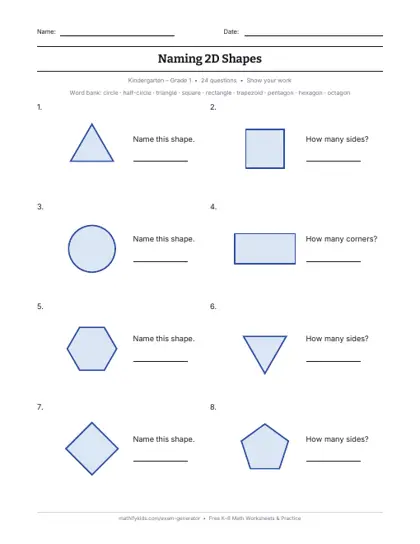 Naming 2D shapesKindergarten–grade 1
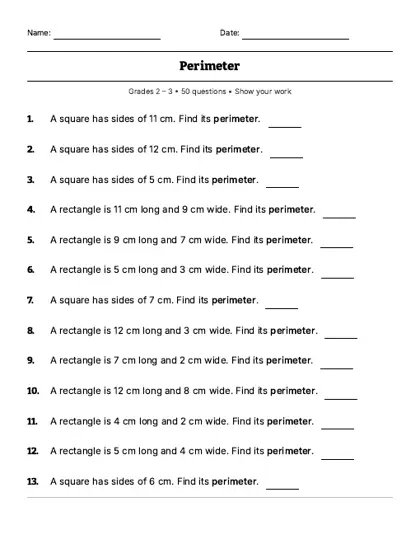 PerimeterGrades 2–3
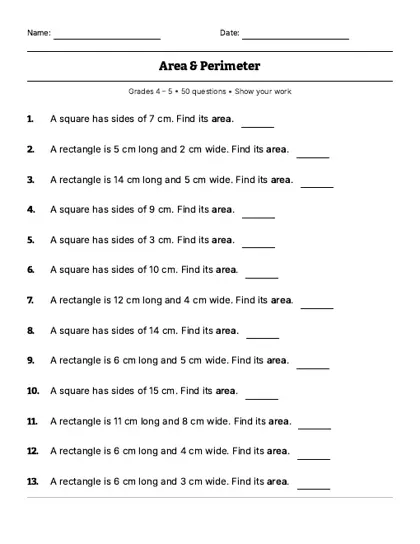 Area of rectanglesGrades 3–4
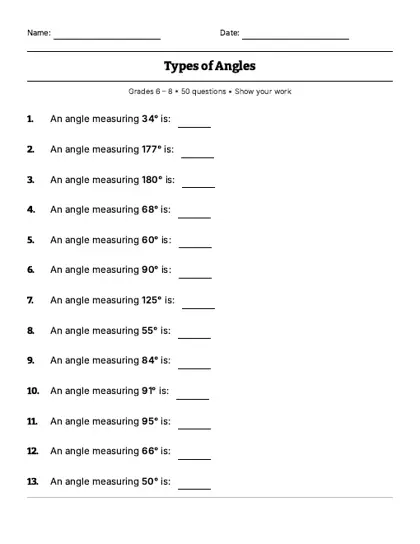 Types of anglesGrade 4
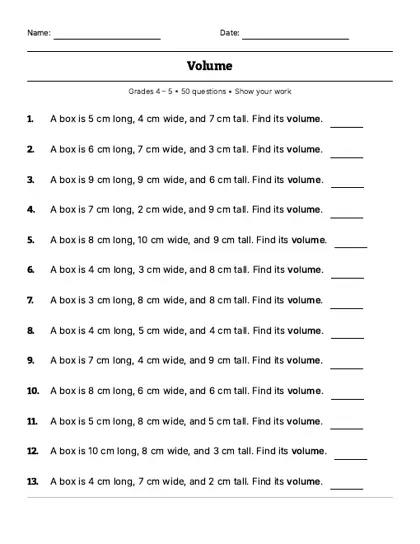 Volume of rectangular prismsGrade 5
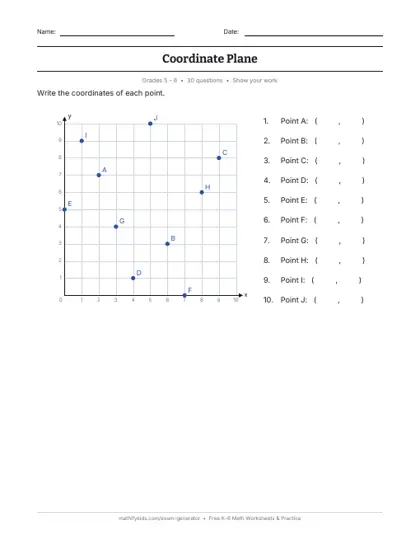 Coordinate planeGrades 5–6
Grades 6 to 8
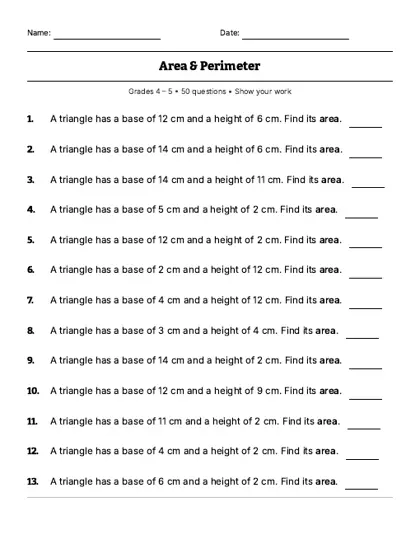 Area of trianglesGrade 6
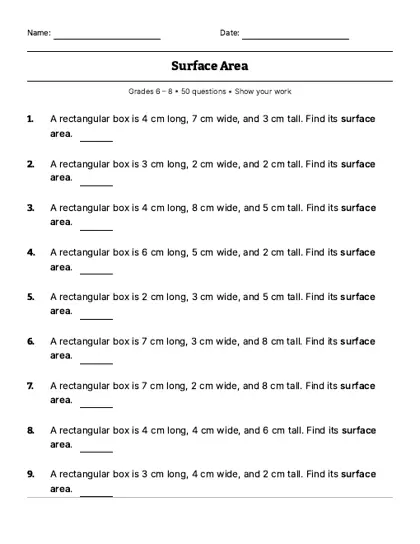 Surface areaGrade 6
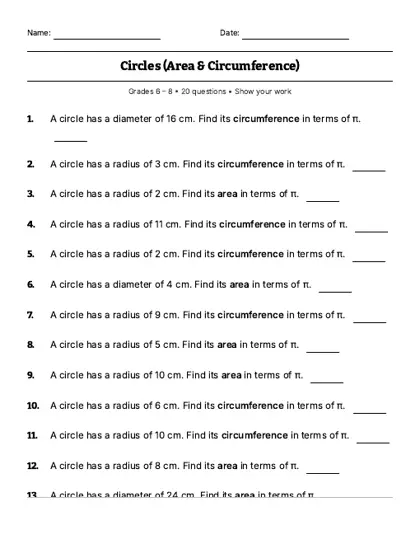 Circles: area and circumferenceGrade 7
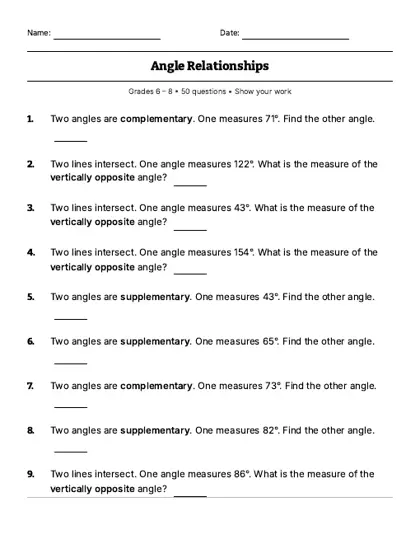 Angle relationshipsGrade 7
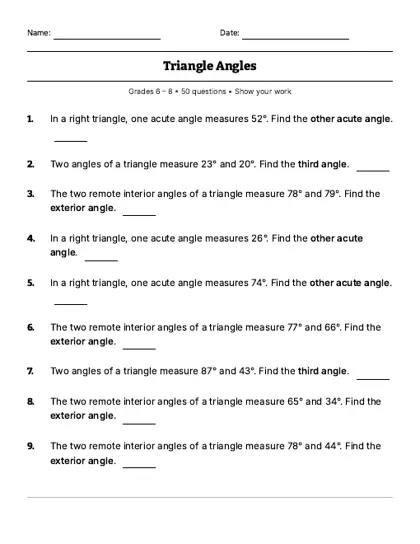 Triangle anglesGrades 7–8
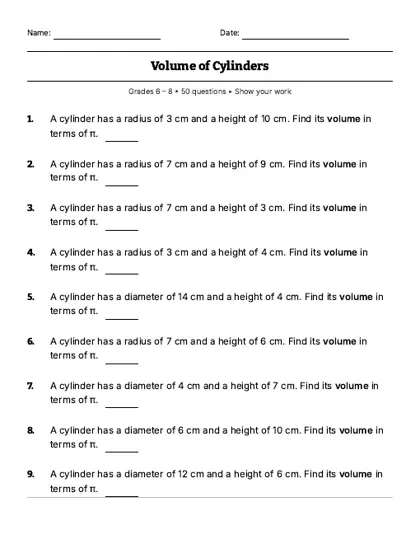 Volume of cylindersGrade 8
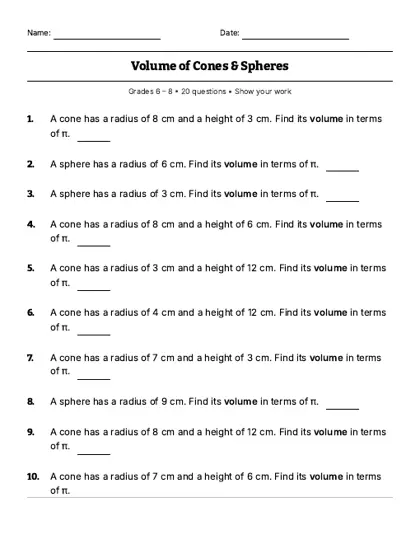 Volume of cones and spheresGrade 8
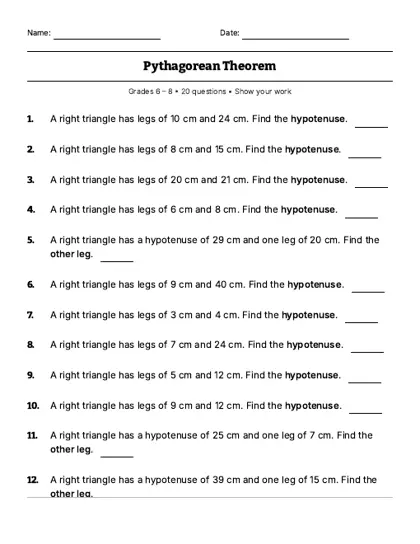 Pythagorean theoremGrade 8
Make a fresh area and perimeter test · Make an angles test
How to teach geometry at home
Measure a room
Measure a bedroom floor in feet. The perimeter tells you how much skirting board it needs; the area tells you how much carpet.
Unfold boxes
Cut a cereal box along its edges and lay it flat. That is a net: count the faces, and add up their areas for the surface area.
Find angles
Open a door or a laptop to make acute, right and obtuse angles. A book corner is a handy right-angle checker.
Fill and pour
Fill a box with sugar cubes or blocks to measure its volume, then check with length × width × height.
Last reviewed
Questions parents ask
What do kids learn in geometry?
Shapes and their properties in K–2, area and perimeter in grade 3, angles and lines in grade 4, volume and the coordinate plane in grade 5, area of triangles and surface area in grade 6, circles and angle relationships in grade 7, and the Pythagorean theorem and transformations in grade 8.
What is the difference between area and perimeter?
Perimeter is the distance around a shape, measured in units like cm. Area is the space inside, measured in square units like cm². A 6 by 4 rectangle has a perimeter of 20 cm and an area of 24 cm².
What are the types of angles?
Acute angles are less than 90°, right angles are exactly 90°, obtuse angles are between 90° and 180°, and straight angles are exactly 180°. Angles over 180° are called reflex angles.
How do you find the volume of a box?
Multiply length × width × height. A box 5 cm long, 3 cm wide and 2 cm high holds 5 × 3 × 2 = 30 cubic centimeters.
What is the area of a triangle?
Half of base × height. A triangle with a base of 8 cm and a height of 5 cm has an area of ½ × 8 × 5 = 20 cm².
What geometry formulas should my child know?
By the end of grade 8: perimeter and area of rectangles and triangles, area and circumference of circles, volume of prisms, cylinders, cones and spheres, the angle sum of a triangle (180°), and the Pythagorean theorem.