
Area model multiplication (box method)
The area model splits each number by place value, draws a box for every pair of parts, multiplies each box and adds. It is also called the box method.
How the area model works
It is also called the grid method. It shows exactly why multiplication works, and it is the bridge from the times tables to the standard written method.
- Split each number by place value. 34 = 30 + 4 and 26 = 20 + 6.
- Draw a box. One column for each part of the first number, one row for each part of the second.
- Multiply each box. 30 × 20 = 600, 4 × 20 = 80, 30 × 6 = 180, 4 × 6 = 24.
- Add the boxes. 600 + 80 + 180 + 24 = 884. So 34 × 26 = 884.
Each box is a small rectangle, and its area is a multiplication. Together they make the big rectangle, 34 by 26. That is why it is called the area model.
See it: pictures to draw with your child
Copy these onto paper or a whiteboard. A quick sketch makes the idea concrete before any written method.
Interactive area model
Type two numbers. The model splits them by place value and shows every box.
Why teachers use the area model
- It uses facts children already know: 30 × 20 is just 3 × 2 with two zeros.
- Nothing is hidden. In the standard method, carrying hides the tens. In the area model every part is written down.
- It grows. 3-digit by 2-digit needs 6 boxes; decimals and even algebra (x + 3)(x + 2) use the same picture later.
- It is the distributive property in a picture: 34 × 26 = (30 + 4) × (20 + 6).
- It is real area. The rectangle is how children first meet area in grade 3: rows × columns of squares.
Area model quiz
Find the missing box, then add all four boxes for the answer.
Bigger numbers: more boxes
The number of boxes is the number of parts on top times the number of parts on the side. 2-digit by 1-digit needs 2 boxes, 2-digit by 2-digit needs 4, and 3-digit by 2-digit needs 6.
For 213 × 14: split 213 into 200 + 10 + 3 and 14 into 10 + 4. The six boxes are 2,000, 100, 30, 800, 40 and 12, which add up to 2,982. Children can skip the drawing and just list the boxes. That list is the partial products method.
The model keeps working in grade 5 and beyond. 2.3 × 1.4 splits into 2 + 0.3 and 1 + 0.4, giving four boxes of 2, 0.8, 0.3 and 0.12. They add to 3.22, the same answer as multiplying decimals the usual way.
From the area model to the standard method
Add the boxes one row at a time and you get the rows of the standard written method. For 34 × 26: the bottom row (× 6) is 180 + 24 = 204, and the top row (× 20) is 600 + 80 = 680. 204 + 680 = 884, exactly the two lines of long multiplication. See 2-digit by 2-digit multiplication.
  34
× 26
────
 204
 680
────
 884
Where this fits: multiplying bigger numbers
What to say to your child
A short script for teaching it the first time. Pause after each line and let your child do the next step.
- “Let’s do 23 × 4. What is 23 made of?” (20 and 3.)
- “Draw a rectangle with two boxes: 20 and 3 on top, 4 on the side.”
- “What is 20 × 4?” (80.) “And 3 × 4?” (12.)
- “Add the boxes.” (92.) “So 23 × 4 = 92.”
- “Try 23 × 14. How many boxes now?” (Four.)
More worked examples
Example 1: 47 × 3
40 × 3 = 120, 7 × 3 = 21. 120 + 21 = 141.
Example 2: 52 × 18
50 × 10 = 500, 2 × 10 = 20, 50 × 8 = 400, 2 × 8 = 16. Total 936.
Example 3: 234 × 5
200 × 5 = 1,000, 30 × 5 = 150, 4 × 5 = 20. Total 1,170.
Example 4: 125 × 24
Six boxes: 2,000 + 400 + 100 + 400 + 80 + 20 = 3,000.
Practice questions (answers below)
Ask these out loud or write them down. Check each answer, and ask “how did you get that?” for one or two.
- 36 × 4
- 58 × 6
- 27 × 13
- 45 × 22
- 143 × 5
- 64 × 35
- 212 × 13
- How many boxes for 345 × 67?
Show the answers
- 120 + 24 = 144
- 300 + 48 = 348
- 200 + 70 + 60 + 21 = 351
- 800 + 100 + 80 + 10 = 990
- 500 + 200 + 15 = 715
- 1,800 + 120 + 300 + 20 = 2,240
- 2,000 + 100 + 20 + 600 + 30 + 6 = 2,756
- 6
Common mistakes
How to teach it at home
Graph paper rectangles
Draw 12 by 13 on squared paper, split it at 10, and count each part.
Box challenges
Give a problem; your child draws the empty box and labels the sides before multiplying.
Check with a calculator
After the box, check the answer on a calculator. Children love catching their own mistakes.
By grade
- Grade 4 (4.NBT.B.5): multiply up to 4 digits by 1 digit and 2 digits by 2 digits using place value and area models.
- Grade 5 (5.NBT.B.5): fluently use the standard algorithm, which the area model explains.
- Later: the same model multiplies decimals, fractions and algebraic expressions.
More for each grade: Grade 4 math and the CBSE class 4 maths guide; Grade 5 math and the CBSE class 5 maths guide.
Worksheets and practice
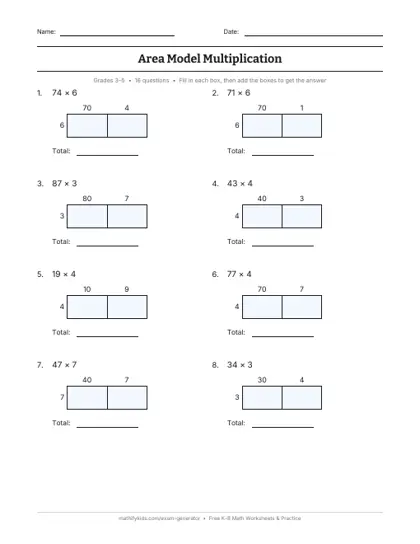
Area model multiplication worksheet: printable PDF with an answer key. · Make a fresh test
Lattice method · multi-digit multiplication · Multiplication practice trainer · 1-minute speed test
Last reviewed
Questions parents ask
What is the area model of multiplication?
A way to multiply by splitting numbers into place value parts, drawing a rectangle with a box for each pair, multiplying each box and adding. 23 × 4 = 80 + 12 = 92.
Is the box method the same as the area model?
Yes. The box method, grid method and area model all split the numbers into parts, multiply each part and add.
How do you do 2-digit by 2-digit with the area model?
Split both numbers into tens and ones, draw 4 boxes, multiply each, and add. 34 × 26 = 600 + 80 + 180 + 24 = 884.
Why do schools teach the area model?
It shows why multiplication works, uses facts children already know, makes mistakes easy to find, and leads to the standard method, decimals and algebra.
What grade uses the area model?
Mainly grade 4, with 2-digit by 2-digit and up to 4-digit by 1-digit numbers; grade 5 connects it to the standard algorithm.