
2-digit by 2-digit multiplication, step by step
To multiply two 2-digit numbers, split both into tens and ones and multiply every part by every part. The area model shows four partial products; the standard method writes them as two rows, with a placeholder zero in the second. 34 × 26 = 680 + 204 = 884. This page shows both, with a tool that steps through any problem.
The big idea: four parts
34 × 26 is (30 + 4) × (20 + 6). That makes four smaller multiplications: 30 × 20, 4 × 20, 30 × 6 and 4 × 6. The area model draws them as four rectangles.
The standard method
- Multiply by the ones digit (6): 34 × 6 = 204. This is row 1.
- Write a 0 in the ones place of row 2. You are now multiplying by the 2 tens, so everything is worth ten times more.
- Multiply by the tens digit (2): 34 × 2 = 68, written after the 0: 680.
- Add the rows: 204 + 680 = 884.
Long multiplication step by step
Type any 2-digit × 2-digit problem. Each row and the final addition are shown.
Worked examples
23 × 12
23 × 2 = 46; 23 × 10 = 230; 46 + 230 = 276.
47 × 35
47 × 5 = 235; 47 × 30 = 1,410; 235 + 1,410 = 1,645.
99 × 99
99 × 9 = 891; 99 × 90 = 8,910; total 9,801. Or 100 × 99 − 99 = 9,801.
Common mistakes
How to teach it at home
Grid on graph paper
Draw a 34 by 26 rectangle and split it into four parts. Count the big parts by multiplying.
Real totals
26 students each paying $34 for a trip: what is the total?
Check with a calculator
After working it out, check on a calculator. Find the row with the mistake if it differs.
By grade
- Grade 4 (4.NBT.B.5): multiply two 2-digit numbers using place value and the area model.
- Grade 5 (5.NBT.B.5): fluent multi-digit multiplication with the standard algorithm.
- Next: multi-digit multiplication.
Worksheets and practice
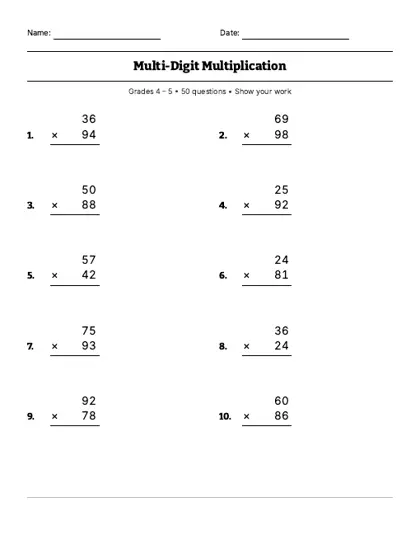
2-digit by 2-digit multiplication worksheet: printable PDF with an answer key. · Make a fresh test
Last reviewed
Questions parents ask
How do you multiply 2-digit by 2-digit numbers?
Multiply the top number by the ones digit, then by the tens digit (with a 0 placeholder), and add the two rows. 34 × 26 = 204 + 680 = 884.
Why do you put a zero in the second row?
Because the second row multiplies by the tens digit, which is worth ten times more. The 0 shifts the row one place left.
What is the box method?
Another name for the area model: draw a grid, multiply each part, and add the four boxes.
How do you check 2-digit multiplication?
Estimate by rounding (34 × 26 is about 30 × 25 = 750) or swap the numbers and multiply again.
What grade learns 2-digit by 2-digit multiplication?
Grade 4 with models (4.NBT.B.5); grade 5 with the standard algorithm (5.NBT.B.5).