
How to find area
Area is the amount of space inside a flat shape, measured in square units. For a rectangle, multiply length × width: a 6 cm by 4 cm rectangle has an area of 24 cm². This page shows why by counting squares, covers L-shaped areas and triangles, has a rectangle builder, and explains the area–perimeter mix-up.
Area: the big idea
Area counts how many unit squares cover a shape. Counting one by one is slow, so we count rows: a rectangle with 4 rows of 6 squares has 4 × 6 = 24 squares. That is why area = length × width.
Rectangle builder
Change the length and width and count the squares.
How to find the area of a rectangle
- Measure the length and width in the same unit.
- Multiply length × width.
- Write square units: cm², m², in², ft² or “square units”.
For a square, all sides are equal: side × side. A 5 m square has an area of 25 m².
Area of L-shapes and other composite shapes
Split the shape into rectangles, find each area, and add. An L-shaped room made of a 6 × 4 m part and a 3 × 2 m part has an area of 24 + 6 = 30 m² (3.MD.C.7d). Or find the big rectangle around it and subtract the missing corner.
Area of triangles and other shapes (grade 6)
- Triangle: ½ × base × height. A triangle is half of a rectangle.
- Parallelogram: base × height (cut off a triangle and move it to make a rectangle).
- Circle (grade 7): π × radius².
Common mistakes
How to teach it at home
Tile counting
Count floor tiles in a room, then check with rows × columns.
Plan a rug
Measure a room and work out the area of rug it needs.
Graph paper rooms
Draw a dream bedroom on graph paper and find its area.
By grade
- Grade 3 (3.MD.C.5 to 3.MD.C.7): area by counting squares, then multiplying; composite rectangles.
- Grade 4 (4.MD.A.3): area formula in real problems.
- Grade 6 (6.G.A.1): area of triangles and polygons.
- See also perimeter and volume.
Worksheets and practice
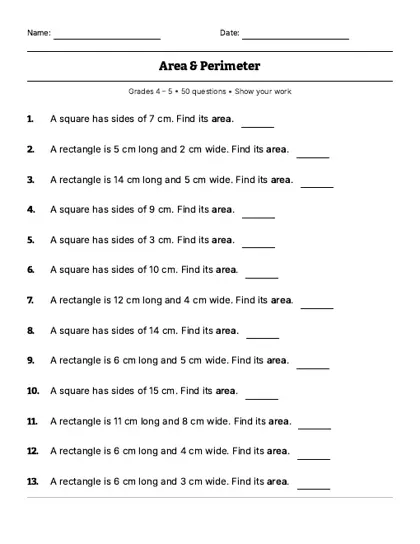
Area of rectangles worksheet: printable PDF with an answer key. · Make a fresh test
Last reviewed
Questions parents ask
How do you find the area of a rectangle?
Multiply the length by the width. A 6 cm by 4 cm rectangle has an area of 24 cm².
What units is area measured in?
Square units: cm², m², in², ft². Each one is a square with sides of 1 unit.
What is the difference between area and perimeter?
Area is the space inside a shape (square units); perimeter is the distance around it (plain units).
How do you find the area of an L-shaped room?
Split it into two rectangles, find each area, and add them.
How do you find the area of a triangle?
Half of base × height: a triangle with base 8 and height 5 has an area of 20 square units.