
Even and odd numbers
An even number can be split into pairs with none left over; an odd number always has one left over. The quick rule: even numbers end in 0, 2, 4, 6 or 8, and odd numbers end in 1, 3, 5, 7 or 9. This page shows why with a pairs tool, what happens when you add evens and odds, and whether 0 is even.
Even and odd: the pairs idea
Put objects in pairs, like socks. If every object has a partner, the number is even. If one is left alone, it is odd. Even numbers can also be split into two equal groups (2.OA.C.3): 12 = 6 + 6, but 13 can’t.
Make pairs
Slide to any number up to 30 and see if anyone is left over.
The last digit rule
Only the ones digit matters, because every ten splits into pairs. 347 ends in 7, so it is odd. 1,000,002 ends in 2, so it is even, however big it is.
Adding even and odd numbers
| even + even | = even | 4 + 6 = 10 |
| odd + odd | = even | 3 + 5 = 8 (the two leftovers pair up) |
| even + odd | = odd | 4 + 3 = 7 |
Is 0 even or odd?
0 is even. Zero objects leave nobody without a partner, and 0 sits between −1 and 1, which are both odd. On the number line, evens and odds alternate, so 0 must be even.
Common mistakes
How to teach it at home
Sock pairs
Pair up socks from the laundry. Any odd one out?
House numbers
Odd numbers are usually on one side of the street, even on the other.
Card game
Flip a card: even, clap; odd, stamp.
By grade
- Grade 2 (2.OA.C.3): decide whether a group up to 20 is odd or even by pairing or counting by 2s, and write even numbers as a sum of two equal addends.
- Next: skip counting.
Worksheets and practice
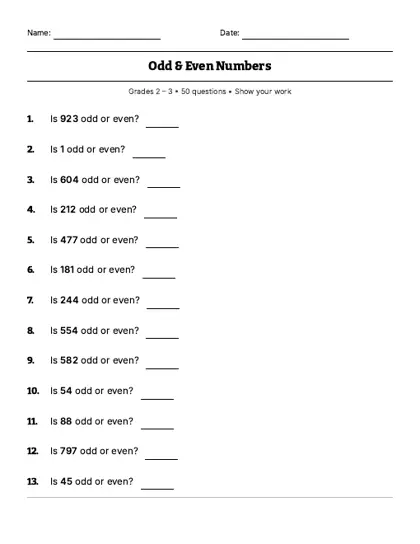
Even and odd numbers worksheet: printable PDF with an answer key. · Make a fresh test
Last reviewed
Questions parents ask
What is an even number?
A number that can be split into pairs or two equal groups with none left over. It ends in 0, 2, 4, 6 or 8.
What is an odd number?
A number that has one left over when put into pairs. It ends in 1, 3, 5, 7 or 9.
Is 0 an even number?
Yes. It has no leftover and sits between two odd numbers, −1 and 1.
What is odd + odd?
Always even: the two leftovers make a pair. 3 + 5 = 8.
When do kids learn even and odd?
Grade 2 (2.OA.C.3).