
Prime and composite numbers
A prime number has exactly two factors, 1 and itself: 2, 3, 5, 7, 11, 13… A composite number has more than two: 4, 6, 8, 9… And 1 is neither. This page explains the difference, has an interactive sieve that finds all 25 primes below 100, a factor finder for any number, and prime factorization with factor trees.
Prime vs composite
| Prime | Composite | |
|---|---|---|
| Factors | Exactly 2 | More than 2 |
| Examples | 2, 3, 5, 7, 11, 13, 17, 19 | 4, 6, 8, 9, 10, 12, 15 |
| As a rectangle | Only one long line | More than one rectangle |
2 is the only even prime. Every other even number has 2 as a factor. 1 is not prime: it has only one factor.
Sieve of Eratosthenes: find every prime below 100
Cross out the multiples of 2, 3, 5 and 7. What is left is prime.
How to check if a number is prime
- Is it 1? Then it isn’t prime.
- Use the divisibility rules for 2, 3 and 5.
- Try dividing by 7, 11, 13… You only need to test primes up to the square root: for 97, test up to 9 (2, 3, 5, 7). None divide, so 97 is prime.
Factor finder
Prime factorization and factor trees
Every composite number is a product of primes in exactly one way. Build a factor tree: split 60 into 6 × 10, then 6 into 2 × 3 and 10 into 2 × 5. The primes at the ends give 60 = 2 × 2 × 3 × 5.
Common mistakes
How to teach it at home
Rectangle test
Arrange counters in rectangles. Primes only make a single line.
Prime hunt
Spot primes on house numbers and number plates.
Factor tree race
Who can find the prime factors of 72 first?
By grade
- Grade 4 (4.OA.B.4): decide whether a number from 1 to 100 is prime or composite.
- Grade 6: prime factorization for GCF and LCM. See GCF and LCM.
Worksheets and practice
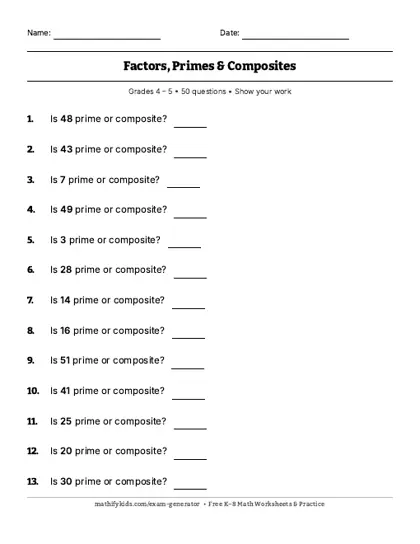
Prime numbers worksheet: printable PDF with an answer key. · Make a fresh test
Last reviewed
Questions parents ask
What is a prime number?
A whole number greater than 1 with exactly two factors: 1 and itself. Examples: 2, 3, 5, 7, 11, 13.
Is 1 a prime number?
No. It has only one factor, so it is neither prime nor composite.
Is 2 a prime number?
Yes, and it is the only even prime.
How many prime numbers are there below 100?
25: 2, 3, 5, 7, 11, 13, 17, 19, 23, 29, 31, 37, 41, 43, 47, 53, 59, 61, 67, 71, 73, 79, 83, 89 and 97.
What is a composite number?
A whole number with more than two factors, like 4, 6, 9 or 12. Every composite number can be written as a product of primes.