
Comparing decimals, step by step
To compare decimals, line up the decimal points and compare the digits from left to right: ones, then tenths, then hundredths. The first place where they differ tells you which is bigger. A longer decimal is not always bigger: 0.5 is more than 0.45. This page shows why with pictures, has a comparing game, and covers ordering decimals and the common mistakes.
Comparing decimals: the big idea
Each place after the decimal point is worth ten times less than the one before it. So a tenth beats any number of hundredths. 0.5 means 5 tenths; 0.45 means 4 tenths and 5 hundredths. Five tenths is more than four tenths, and the hundredths can’t catch up.
How to compare decimals, step by step
- Line up the decimal points, one number above the other.
- Add zeros to the end of the shorter decimal so both have the same number of places. 0.5 becomes 0.50.
- Compare from the left. Whole numbers first. If they are the same, compare tenths, then hundredths.
- The first different digit decides. Write >, < or =.
With equal places, comparing decimals is just comparing whole numbers: 0.50 vs 0.45 is 50 vs 45.
Comparing decimals game
Choose >, < or =. Every answer shows the same-places trick and both numbers as grids.
Worked examples: comparing decimals
Example 1: 0.7 and 0.65
Write 0.70 and 0.65. Tenths: 7 > 6, so 0.7 > 0.65.
Example 2: 3.05 and 3.5
Ones are the same (3). Tenths: 0 < 5, so 3.05 < 3.5. The zero in 3.05 is holding the tenths place.
Example 3: 0.09 and 0.1
Write 0.09 and 0.10. Tenths: 0 < 1, so 0.09 < 0.1. Nine hundredths is just short of one tenth.
Example 4: 2.400 and 2.4
Zeros at the end don’t change a decimal, so 2.400 = 2.4.
Example 5: 12.3 and 9.87
Compare the whole numbers first: 12 > 9, so 12.3 > 9.87, whatever the decimals say.
Ordering decimals from least to greatest
Order 0.4, 0.38, 0.415 and 0.04:
- Give them all three places: 0.400, 0.380, 0.415, 0.040.
- Order them like whole numbers: 40, 380, 400, 415.
- Write the originals in that order: 0.04, 0.38, 0.4, 0.415.
Common mistakes when comparing decimals
How to teach comparing decimals at home
Compare prices
$4.09 or $4.90? Money always has two decimal places, which makes the trick automatic.
Race times
Look up sprint results: 9.58, 9.63, 9.69 seconds. Who won, and by how much?
Measure and compare
Measure things in meters with a tape: 0.45 m, 0.5 m, 0.405 m. Line them up to see the order.
Decimal war
Write decimals on cards, deal them out, and both players flip one. The bigger decimal wins both cards.
Comparing decimals by grade
- Grade 4 (4.NF.C.7): compare two decimals to hundredths and explain the reasoning.
- Grade 5 (5.NBT.A.3b): compare decimals to thousandths using place value.
Next: rounding decimals and adding and subtracting decimals. See all of decimals.
Comparing decimals worksheets
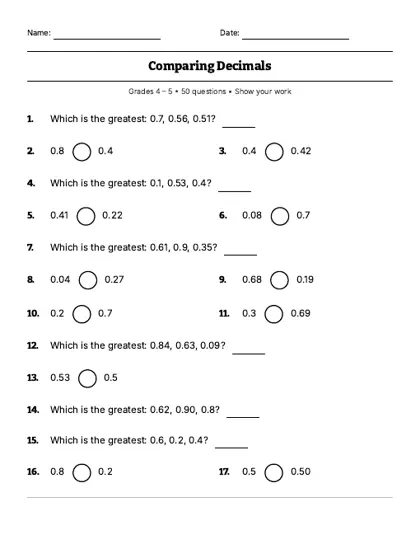
Comparing decimals worksheet: 50 problems with an answer key.
Last reviewed
Questions parents ask
How do you compare decimals?
Line them up by the decimal point and compare digit by digit from the left: whole numbers first, then tenths, then hundredths. The first place where the digits differ decides which number is bigger.
Is 0.5 bigger than 0.45?
Yes. Write 0.5 as 0.50: fifty hundredths is more than forty-five hundredths. Look at the tenths first: 5 tenths beats 4 tenths.
Does adding a zero to a decimal change it?
Not at the end. 0.3, 0.30 and 0.300 are equal. Adding zeros at the end makes decimals easier to compare. A zero between the point and the digits does change it: 0.03 is much smaller than 0.3.
How do you order decimals from least to greatest?
Give every number the same number of decimal places by adding zeros, then order them like whole numbers. 0.4, 0.38, 0.415 becomes 0.400, 0.380, 0.415, so the order is 0.38, 0.4, 0.415.
Why do kids think longer decimals are bigger?
With whole numbers, more digits means bigger: 415 > 4. Children carry that rule over to decimals, so 0.415 looks bigger than 0.5. Showing both on a hundred grid or number line breaks the habit.
What grade learns comparing decimals?
Grade 4 compares decimals to hundredths (4.NF.C.7). Grade 5 compares decimals to thousandths (5.NBT.A.3b).