
Adding and subtracting decimals
To add or subtract decimals, line up the decimal points, fill any gaps with zeros, then add or subtract like whole numbers and bring the point straight down. 3.5 + 1.25: write 3.50 + 1.25 = 4.75. This page explains why, has a tool for any two decimals, covers subtracting from whole numbers, and the common mistakes.
The big idea: line up the places
Just like whole numbers, you can only add ones to ones, tenths to tenths and hundredths to hundredths. Lining up the decimal points lines up all the places. Zeros added at the end (3.5 = 3.50) don’t change the value but fill the gaps so nothing gets lost.
How to add and subtract decimals, step by step
- Line up the decimal points, one under the other.
- Fill empty places with zeros so both numbers have the same number of decimal places.
- Add or subtract from right to left, carrying or borrowing as with whole numbers.
- Bring the decimal point straight down into the answer.
- Estimate to check: 3.5 + 1.25 is about 4 + 1 = 5.
Add or subtract any two decimals
The tool lines up the points and fills the gaps for you.
Worked examples
2.36 + 4.5
2.36 + 4.50 = 6.86.
8.4 − 3.75
8.40 − 3.75: borrow in the hundredths and tenths: 4.65.
5 − 1.38
Write 5 as 5.00: 5.00 − 1.38 = 3.62.
$12.99 + $7.45
Money always has two places: $20.44.
Common mistakes
How to teach it at home
Shopping totals
Add two prices and work out the change from $20.
Race times
How much faster was 12.85 seconds than 13.2 seconds? (0.35 s)
Measure and add
Add lengths in meters: 1.5 m + 0.75 m.
By grade
- Grade 5 (5.NBT.B.7): add and subtract decimals to hundredths.
- Grade 6 (6.NS.B.3): fluently add and subtract multi-digit decimals.
- Next: multiplying decimals.
Worksheets and practice
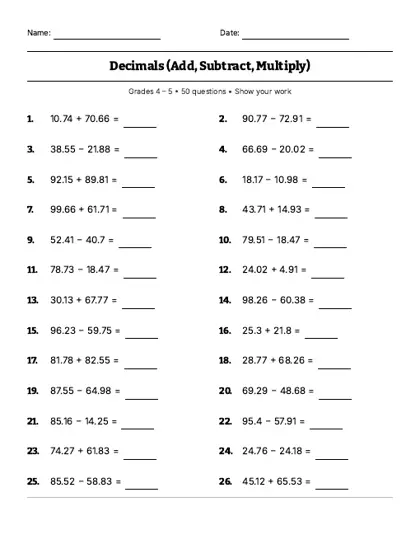
Adding and subtracting decimals worksheet: printable PDF with an answer key. · Make a fresh test
Last reviewed
Questions parents ask
How do you add decimals?
Line up the decimal points, fill gaps with zeros, add as whole numbers and bring the point straight down.
How do you subtract a decimal from a whole number?
Write the whole number with a decimal point and zeros: 5 = 5.00. Then subtract: 5.00 − 1.38 = 3.62.
Why do you line up the decimal points?
So that tenths line up with tenths and hundredths with hundredths. It is the same as lining up ones and tens.
Do zeros at the end change a decimal?
No. 3.5, 3.50 and 3.500 are equal. Adding them just fills the gaps.
What grade learns adding decimals?
Grade 5 to hundredths (5.NBT.B.7); grade 6 fluently (6.NS.B.3).