
Estimating with decimals
To estimate with decimals, round each number to a whole number or a friendly number, then do the easy calculation in your head.
Why estimating matters with decimals
Most decimal mistakes are about the decimal point: an answer ten times too big or ten times too small. An estimate catches these at once. If 4.8 × 3.1 should be about 15, then an answer of 1.488 or 148.8 must be wrong.
Estimating is also how adults really use decimals. “Have I got enough money?” and “Will this shelf fit?” need only a rough answer. A rough answer in two seconds often beats an exact one in two minutes.
See it: pictures to draw with your child
Copy these onto paper or a whiteboard. A quick sketch makes the idea concrete before any written method.
Round each number to the nearest whole number
The simplest estimate rounds every decimal to the nearest whole number. Look at the tenths digit: 5 or more rounds up, less than 5 rounds down. So 6.7 → 7 and 3.2 → 3.
For example, 6.7 + 3.2 ≈ 7 + 3 = 10, and the exact answer is 9.9. In the same way, 8.45 − 2.9 ≈ 8 − 3 = 5, and the exact answer is 5.55. See rounding decimals.
Use friendly numbers
Sometimes a friendlier number than the nearest whole gives an easier sum. For division, choose numbers that divide neatly: 17.8 ÷ 3.1 ≈ 18 ÷ 3 = 6. For money, round to the nearest dollar or to half dollars: $4.49 + $2.55 ≈ $4.50 + $2.50 = $7.
Compatible numbers like these are allowed to be a little further away, as long as the calculation becomes easy to do in your head.
Estimating products and quotients
For multiplication, round each factor: 4.8 × 3.1 ≈ 5 × 3 = 15, and the exact answer is 14.88. For decimals less than 1, think of fractions: 0.48 × 60 is about half of 60, which is 30.
For division, ask “about how many times?”: 9.6 ÷ 2.4 is about 10 ÷ 2.5 = 4, and the exact answer is 4. See dividing decimals.
Estimating at the shops
Rounding prices up gives a safe estimate. If every item is rounded up, you know you have enough money.
For example, $2.35, $4.80 and $1.15 round up to $3, $5 and $2, so $10 is plenty. The exact total is $8.30. See decimals and money.
Is the estimate over or under?
Good estimators know which way they rounded. If both numbers were rounded up, the estimate is too big.
If both were rounded down, it is too small. Asking “will the real answer be more or less than my estimate?” builds real number sense.
Tips for teaching estimating
Ask for an estimate before every decimal calculation, not just in estimating lessons. Write it in a box next to the working. After the exact answer, children circle whether it was close.
Praise good reasoning, not just closeness. “I rounded both up, so the real answer is a bit less” is a better answer than a lucky guess.
Quick-fire rounds work well as warm-ups. Show a sum like 5.9 × 3.1 for five seconds and ask for an estimate. Children soon learn to round without writing anything down.
Quiz: estimating with decimals
Choose the best estimate, or round to the nearest whole number.
Where this fits: decimals step by step
- What are decimals
- Tenths
- Hundredths
- Decimal place value
- Reading and writing decimals
- Thousandths
- Decimals on a number line
- Comparing decimals
- Ordering decimals
- Rounding decimals
- Estimating with decimals (this page)
- Decimals and money
- Adding decimals
- Subtracting decimals
- × and ÷ by 10, 100 and 1,000
- Decimals × whole numbers
- Multiplying decimals
- Dividing decimals by whole numbers
- Dividing decimals
- Decimals to fractions
- Fractions to decimals
- Decimal word problems
What to say to your child
A short script for teaching it the first time. Pause after each line and let your child do the next step.
- “A drink costs $1.95 and a sandwich $3.10. About how much?”
- “Round them: $2 and $3.” (About $5.)
- “Is the real answer more or less than $5?” (A tiny bit more: $5.05.)
- “What is 4.8 × 3.1 roughly?” (5 × 3 = 15.)
- “Someone says 148.8. Is that right?” (No, far too big.)
More worked examples
Example 1: addition
7.85 + 2.3 ≈ 8 + 2 = 10; exact 10.15.
Example 2: subtraction
9.1 − 4.75 ≈ 9 − 5 = 4; exact 4.35.
Example 3: multiplication
6.2 × 4.9 ≈ 6 × 5 = 30; exact 30.38.
Example 4: division
15.6 ÷ 3.9 ≈ 16 ÷ 4 = 4; exact 4.
Practice questions (answers below)
Ask these out loud or write them down. Check each answer, and ask “how did you get that?” for one or two.
- Round 4.6 to the nearest whole number
- Round 12.38 to the nearest whole number
- Estimate 3.8 + 5.1
- Estimate 9.7 − 2.2
- Estimate 5.9 × 4
- Estimate 19.8 ÷ 4.1
- Estimate $2.95 + $6.10
- Is 3.9 × 2.1 = 81.9 sensible?
- Estimate 0.52 × 80
- Stretch: estimate 48.7 ÷ 0.98
Show the answers
- 5
- 12
- About 9
- About 8
- About 24
- About 5
- About $9
- No: about 8, so 8.19
- About 40
- About 50
Common mistakes
How to teach it at home
Trolley total
Estimate the shopping total before the till does.
Fuel guess
Estimate the cost of fuel from the price per litre.
Over or under
After each estimate, ask whether the real answer is more or less.
By grade
- Grade 5 (5.NBT.A.4, 5.NBT.B.7): round decimals and estimate to check calculations.
- Grade 6 (6.NS.B.3): estimate before multi-digit decimal calculations.
- Next: decimals and money.
More for each grade: Grade 5 math and the CBSE class 5 maths guide; Grade 6 math and the CBSE class 6 maths guide.
Worksheets and practice
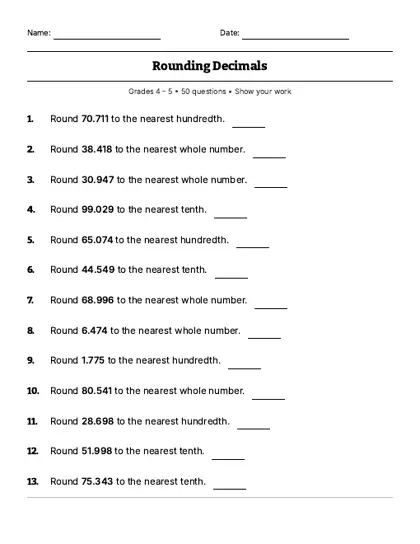
Rounding decimals worksheet: printable PDF with an answer key. · Make a fresh test
Decimal practice · decimal calculator · place value chart · decimals quiz · decimal levels · decimal games · decimals for kids
Last reviewed
Questions parents ask
How do you estimate with decimals?
Round each decimal to a whole number or a friendly number, then do the easy calculation: 6.7 + 3.2 ≈ 7 + 3 = 10.
Why should I estimate before calculating?
An estimate catches decimal point mistakes, like an answer ten times too big.
What are compatible numbers?
Numbers chosen because they are easy to calculate with, like 18 ÷ 3 for 17.8 ÷ 3.1.
How do you estimate a product of decimals less than 1?
Think of a fraction: 0.48 is about one half, so 0.48 × 60 is about 30.
What grade learns estimating with decimals?
Grade 5, alongside rounding decimals (5.NBT.A.4).