
Fractions for kids
Fractions are numbers that show equal parts of a whole. Children meet them as halves and quarters in grade 1 and finish dividing fractions in grade 6. This page maps the whole journey, explains the ideas with fraction bars, has an equivalent-fractions tool, shows where kids get stuck, and links every fraction lesson and worksheet.
What kids learn about fractions, grade by grade
- Grades 1–2 (1.G.A.3, 2.G.A.3): split circles and rectangles into halves, thirds and fourths, and see that equal shares can look different.
- Grade 3 (3.NF.A.1 to 3.NF.A.3): fractions as numbers, unit fractions like 1/4, fractions on a number line, simple equivalence, and comparing fractions with the same top or bottom number.
- Grade 4 (4.NF.A.1 to 4.NF.B.4): equivalent fractions, comparing with different denominators, adding and subtracting with like denominators and mixed numbers, and multiplying a fraction by a whole number.
- Grade 5 (5.NF.A.1 to 5.NF.B.7): adding and subtracting with unlike denominators, multiplying fractions and mixed numbers, and dividing with unit fractions.
- Grade 6 (6.NS.A.1): dividing fractions by fractions.
Where to start with fractions
With real things cut into equal parts: pizza, chocolate bars, folded paper. The word that matters most is equal. Then move to fraction bars and number lines, which make comparing and adding much easier to see than circles do.
The big idea behind fractions
The denominator names the size of the pieces; the numerator counts them. That is why a bigger denominator means a smaller piece, and why you can only add pieces of the same size: you add the counts, not the sizes.
Equivalent fractions explorer
Choose a fraction, then slide to multiply the top and bottom. The shaded amount never changes.
Where kids get stuck with fractions
“1/8 is bigger than 1/4 because 8 is bigger”
Whole-number thinking. Fix: use the fraction wall: more pieces means smaller pieces.
Adding the bottoms
1/4 + 1/4 = 2/8. Fix: “one quarter plus one quarter is two quarters”. Say the denominator as a word, like apples: you are counting quarters.
Unequal parts
Calling any piece of a cut shape “a third”. Fix: fractions need equal parts. Fold paper to check.
Forgetting to simplify, or simplifying wrongly
Leaving 6/8 or turning it into 3/8. Fix: divide top and bottom by the same number. See simplifying fractions.
Fractions lessons, in order
Fractions worksheets
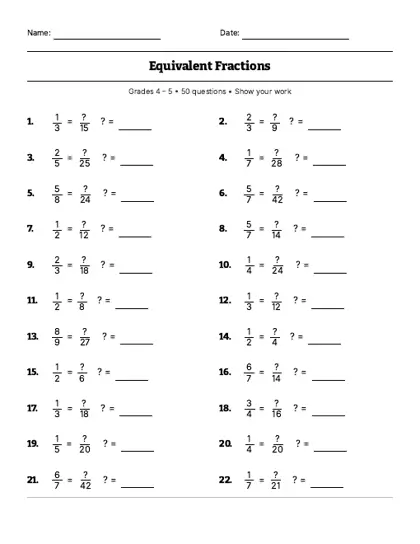 Equivalent fractionsGrades 3–4
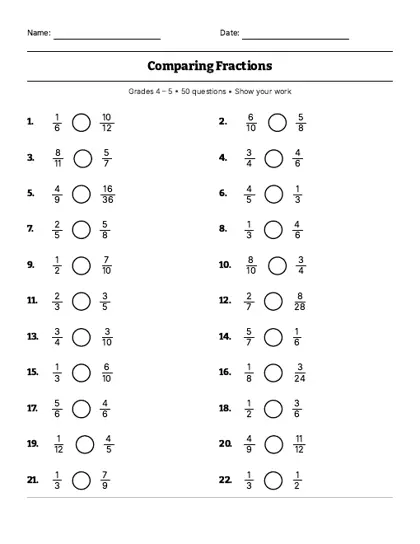 Comparing fractionsGrades 3–4
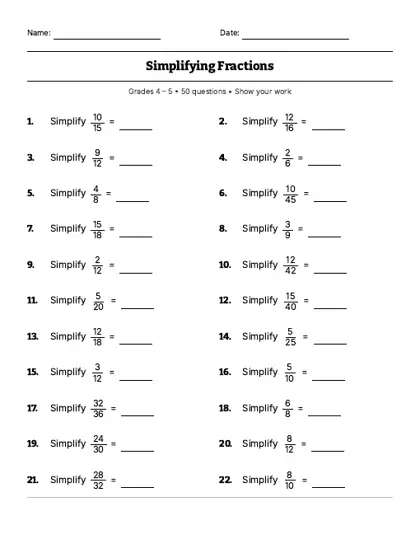 Simplifying fractionsGrades 4–5
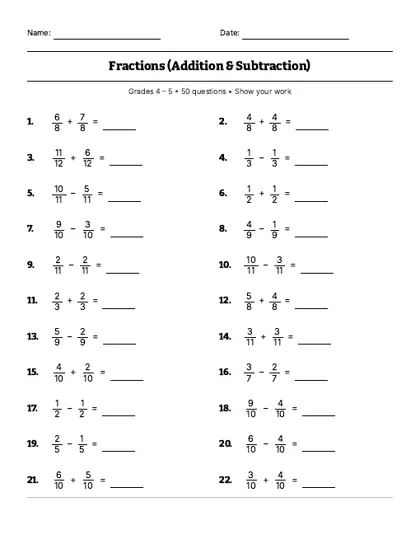 Adding and subtracting fractions with like denominatorsGrade 4
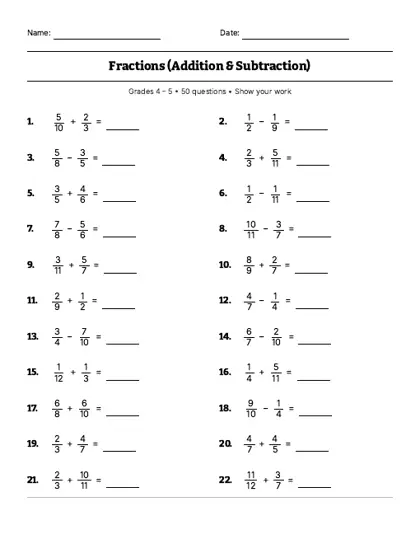 Adding and subtracting fractions with unlike denominatorsGrade 5
More fraction PDFs
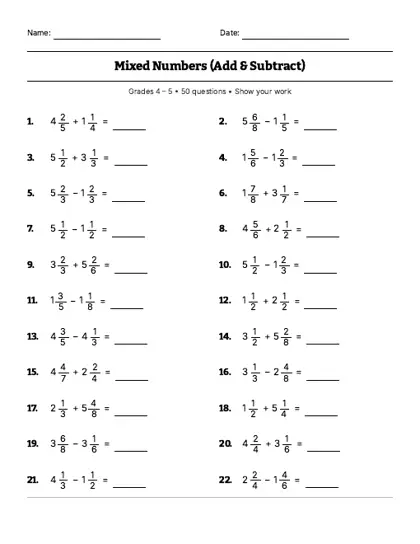 Adding mixed numbersGrades 4–5
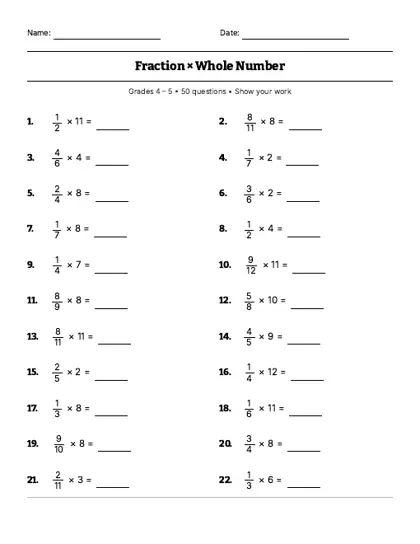 Fractions × whole numbersGrade 4
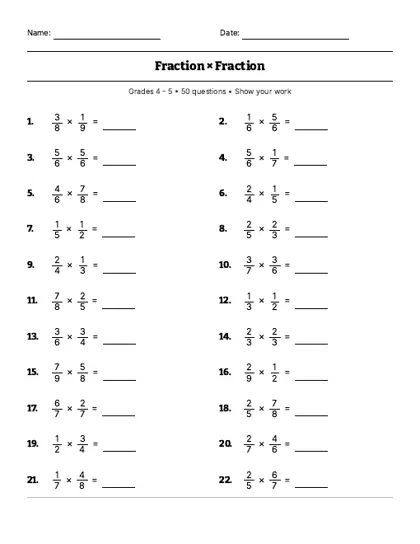 Multiplying fractionsGrade 5
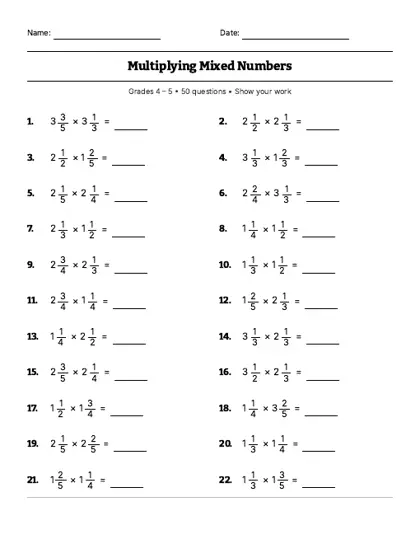 Multiplying mixed numbersGrade 5
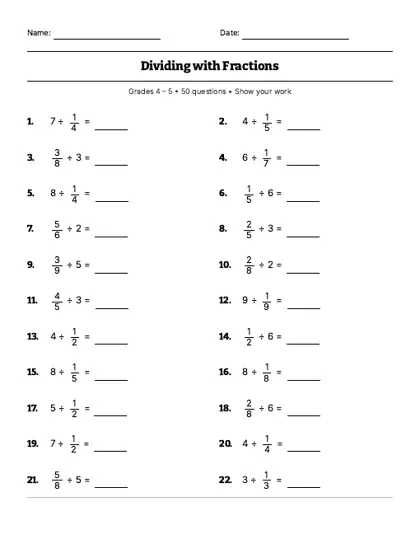 Dividing fractions and whole numbersGrade 5
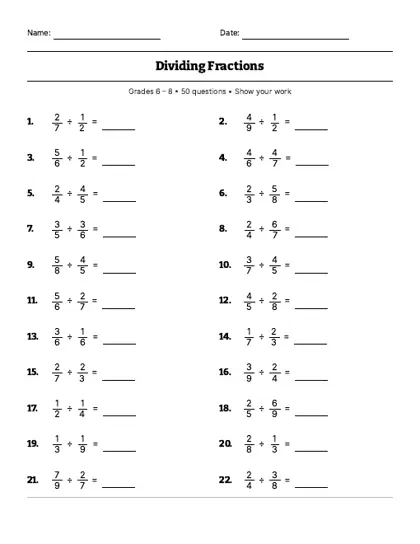 Dividing fractionsGrade 6
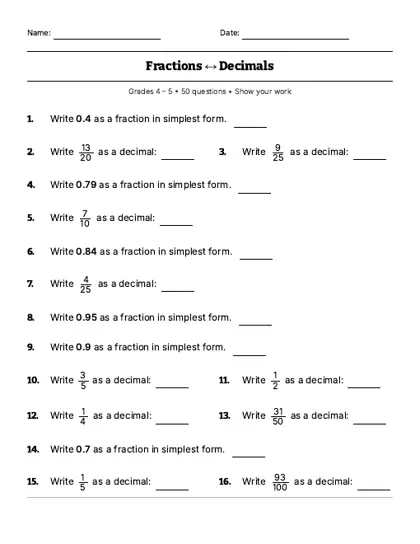 Fractions to decimalsGrades 4–5
Make a fresh fractions test · Fractions chart
How to teach fractions at home
Share food fairly
Cut pizza, sandwiches or chocolate bars into equal parts and name each part. Ask: would you rather have 1/3 or 1/4 of the pizza?
Fold paper strips
Fold strips into halves, quarters and eighths and lay them under each other. Children can see 2/4 and 1/2 line up.
Cook with measuring cups
“We need 3/4 of a cup but only have a 1/4 cup. How many scoops?” Recipes are full of real fraction problems.
Use a ruler
An inch ruler shows halves, quarters and eighths on a number line. Find 3/8 inch, then 1/2 inch: which is longer?
Last reviewed
Questions parents ask
What is a fraction?
A fraction is a number that shows equal parts of a whole. The bottom number (denominator) says how many equal parts the whole is cut into; the top number (numerator) says how many of those parts you have. 3/4 means 3 of 4 equal parts.
Which is bigger, 1/3 or 1/4?
1/3. When the top numbers are the same, the smaller bottom number gives bigger pieces: a cake cut into 3 pieces has bigger slices than one cut into 4.
How do you add fractions with different denominators?
Rewrite them with the same denominator first, then add the tops. 1/2 + 1/3 = 3/6 + 2/6 = 5/6. Never add the bottoms.
How do you find equivalent fractions?
Multiply or divide the top and bottom by the same number. 2/3 × 2/2 = 4/6. The pieces get smaller but there are more of them, so the amount stays the same.
What grade learns fractions?
Grade 1 and 2 split shapes into halves, thirds and fourths. Grade 3 treats fractions as numbers on a number line. Grade 4 does equivalence, comparing and adding with like denominators. Grade 5 adds with unlike denominators and multiplies. Grade 6 divides fractions.
Why are fractions so hard for kids?
Because some whole-number habits stop working: a bigger denominator means a smaller piece, and you don’t add the bottoms. Pictures like fraction bars and number lines fix most of this.