
Improper fractions and mixed numbers
An improper fraction like 11/4 is more than one whole. As a mixed number it is 2 3/4: two wholes and three quarters.
What improper fractions and mixed numbers are
An improper fraction has a numerator as big as, or bigger than, its denominator: 5/4, 11/4, 9/3. It is one whole or more. (“Improper” is just a name; there is nothing wrong with these fractions, and in algebra they are often the most useful form.)
A mixed number writes the same amount as whole numbers plus a proper fraction: 11/4 = 2 3/4. People usually say mixed numbers in everyday life: “two and three quarter cups”, “one and a half hours”.
See it: pictures to draw with your child
Copy these onto paper or a whiteboard. A quick sketch makes the idea concrete before any written method.
Improper fraction to mixed number
Divide the numerator by the denominator. The answer is the whole number, and the remainder is the new numerator.
- 11/4: 11 ÷ 4 = 2 remainder 3.
- 2 wholes, and 3 quarters left over.
- So 11/4 = 2 3/4.
Pictures make this clear: draw 11 quarters, fill whole circles 4 quarters at a time, and count 2 full circles and 3 quarters left. This is the same idea as fractions as division.
Mixed number to improper fraction
Multiply the whole number by the denominator, then add the numerator. Keep the same denominator.
- 2 3/4: 2 wholes are 2 × 4 = 8 quarters.
- Add the 3 quarters: 8 + 3 = 11.
- So 2 3/4 = 11/4.
Children need this direction for multiplying and dividing mixed numbers, which are much easier as improper fractions. The fraction calculator shows this step first.
Mixed numbers on a number line
On a line marked in quarters, 4/4 sits at 1, 8/4 at 2 and 12/4 at 3. So 11/4 is three quarters past 2, the same point as 2 3/4. Children who place a few improper fractions on a number line rarely forget how the two forms match. See fractions on a number line.
Whole numbers as fractions
Some improper fractions are whole numbers: 8/4 = 2, 15/5 = 3, 6/6 = 1. The division leaves no remainder. Any whole number can be written as a fraction with any denominator: 3 = 3/1 = 6/2 = 12/4. This is useful for adding a whole number to a fraction, and for multiplying fractions by whole numbers.
Try it the other way too: ask “how many quarters make 3 wholes?” (12) or “how many thirds make 5?” (15). Quick questions like these make converting between the two forms automatic.
Quiz: convert both ways
Write improper fractions as mixed numbers and mixed numbers as improper fractions.
Where this fits: fractions step by step
- Halves and quarters
- What are fractions
- Unit fractions
- Numerator and denominator
- Fractions on a number line
- Fractions of a set
- Equivalent fractions
- Simplifying fractions
- Comparing fractions
- Ordering fractions
- Improper fractions and mixed numbers (this page)
- Adding fractions
- Subtracting fractions
- Finding a common denominator
- Adding mixed numbers
- Subtracting mixed numbers
- Fraction of a number
- Fractions × whole numbers
- Multiplying fractions
- Fractions as division
- Dividing fractions by whole numbers
- Dividing fractions
- Fractions to decimals
- Fraction word problems
What to say to your child
A short script for teaching it the first time. Pause after each line and let your child do the next step.
- “Here are 7 half-sandwiches. How many whole sandwiches can we make?” (3.)
- “And any half left over?” (1.) “So 7 halves is 3 and a half.”
- “We write 7/2 = 3 1/2.”
- “Now go back. 3 1/2: how many halves in 3 wholes?” (6.) “Plus 1 more half?” (7 halves!)
- “Multiply, then add.”
More worked examples
Example 1: 13/5 to a mixed number
13 ÷ 5 = 2 r 3. So 13/5 = 2 3/5.
Example 2: 4 2/3 to an improper fraction
4 × 3 = 12, 12 + 2 = 14. So 4 2/3 = 14/3.
Example 3: a whole number
20/4: 20 ÷ 4 = 5 with no remainder, so 20/4 = 5.
Example 4: a measurement
9/2 cups of flour is 4 1/2 cups.
Practice questions (answers below)
Ask these out loud or write them down. Check each answer, and ask “how did you get that?” for one or two.
- 7/2 as a mixed number
- 9/4 as a mixed number
- 17/5 as a mixed number
- 12/3 as a whole number
- 1 3/4 as an improper fraction
- 2 2/5 as an improper fraction
- 5 1/3 as an improper fraction
- Which is bigger: 11/4 or 2 1/2?
- Write 3 as a fraction with denominator 5
- Stretch: 47/6 as a mixed number
Show the answers
- 3 1/2
- 2 1/4
- 3 2/5
- 4
- 7/4
- 12/5
- 16/3
- 11/4 (2 3/4)
- 15/5
- 7 5/6
Common mistakes
How to teach it at home
Snack halves
Count halves of sandwiches or apples and say them both ways.
Recipe check
Read 1 1/2 cups as 3/2 cups.
Number line
Mark a ruler or tape at quarters and find 5/4, 9/4 and 11/4.
By grade
- Grade 4 (4.NF.B.3): add and subtract mixed numbers, converting between forms.
- Grade 5 (5.NF.B.3): see fractions as division, so 11/4 = 11 ÷ 4.
- Grade 6: multiply and divide mixed numbers as improper fractions.
- Next: adding mixed numbers.
More for each grade: Grade 4 math and the CBSE class 4 maths guide; Grade 5 math and the CBSE class 5 maths guide.
Worksheets and practice
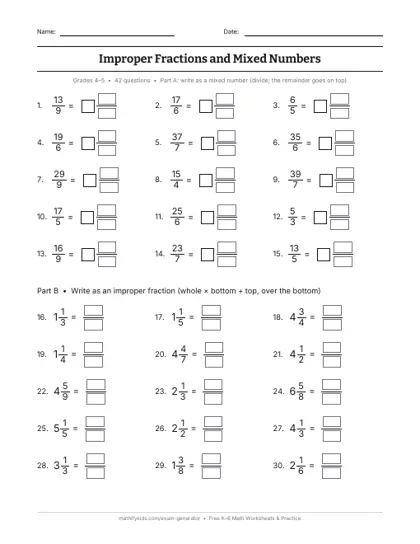
Improper fractions and mixed numbers worksheet: printable PDF with an answer key. · Make a fresh test
Fraction practice · fraction calculator · fraction wall · fractions quiz · fraction levels · fraction games · fractions for kids
Last reviewed
Questions parents ask
What is an improper fraction?
A fraction whose numerator is as big as or bigger than its denominator, like 7/4. It is one whole or more.
What is a mixed number?
A whole number and a proper fraction together, like 1 3/4. It is another way to write an improper fraction.
How do you change an improper fraction to a mixed number?
Divide the numerator by the denominator. The answer is the whole number and the remainder goes over the same denominator: 11/4 = 2 3/4.
How do you change a mixed number to an improper fraction?
Multiply the whole number by the denominator, add the numerator, and keep the denominator: 2 3/4 = (2 × 4 + 3)/4 = 11/4.
What grade learns mixed numbers?
Grade 4 starts mixed numbers, and grades 5 and 6 use them in every fraction operation.