
7th grade math
Seventh grade puts grade 6 ideas to work: proportional relationships, percent problems with tax, tips and discounts, all four operations with negative numbers, two-step equations, circles and probability. This page lists every skill in order, what mastery looks like, signs a child needs help, and free 7th grade worksheets and lessons.
What 7th graders learn in math
The Common Core focuses grade 7 on four areas: proportional relationships (including percent problems), operations with rational numbers (negatives, fractions and decimals together), expressions and two-step equations, and geometry with scale drawings, circles and angle relationships. Probability is introduced too.
7th grade math skills, in order
Ratios and proportional relationships
Unit rates with fractions, recognizing proportional relationships in tables and graphs, the constant of proportionality, and multi-step percent problems: tax, tips, discounts, interest and percent change.
The number system
Adding, subtracting, multiplying and dividing integers and other rational numbers, and converting fractions to decimals that end or repeat.
Expressions and equations
Simplifying expressions with like terms and the distributive property, and solving two-step equations and inequalities from word problems.
Geometry
Scale drawings, constructing triangles, angle relationships (supplementary, complementary, vertical), area and circumference of circles, and surface area and volume of prisms.
Statistics and probability
Random samples, comparing two groups using mean and spread, and probability of simple and compound events.
What mastery looks like by the end of the year
- Solves a two-step equation like 3x − 5 = 16 and checks it.
- Works out the price after a 20% discount and 8% sales tax.
- Adds and multiplies negative numbers correctly: −4 + 7 = 3 and −3 × −5 = 15.
- Finds the area and circumference of a circle from its radius.
- Uses angle facts to find a missing angle on a straight line or at a point.
- Finds the probability of rolling a sum of 7 with two dice (6/36 = 1/6).
Signs your child needs extra help
- Negative number rules get mixed up, like using “two negatives make a positive” for addition.
- Percent problems with more than one step fall apart.
- Solves equations by guessing rather than undoing operations.
- Can’t tell whether a table shows a proportional relationship.
- Fractions are still shaky, which makes rational number arithmetic hard.
If negative numbers are the problem, the number line on the integers page is the quickest fix. For percents, start with the three kinds of percent question on the percentages page.
Try a 7th grade math problem
Tap a question to see the answer and how to get it.
Solve 3x − 5 = 16.
x = 7. Add 5 to both sides (3x = 21), then divide by 3.
A $40 jacket is 25% off. What is the sale price?
$30. 25% of $40 is $10, and $40 − $10 = $30.
What is −3 × −5?
15. Two negatives multiplied give a positive.
A circle has a radius of 5 cm. What is its area?
About 78.5 cm². Area = π × 5² = 25π ≈ 78.5.
Two angles on a straight line; one is 65°. What is the other?
115°. Angles on a straight line add to 180°.
A price rises from $50 to $60. What is the percent increase?
20%. The change is $10, and 10 ÷ 50 = 0.2.
7th grade math worksheets
Each one is a free PDF with an answer key and its own page with a preview, tips and a button to make a new version.
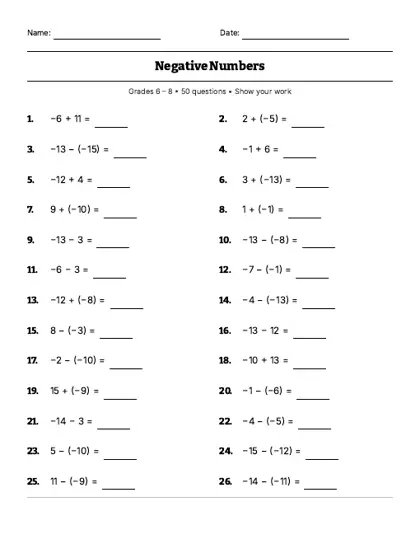 Adding and subtracting integersGrade 7
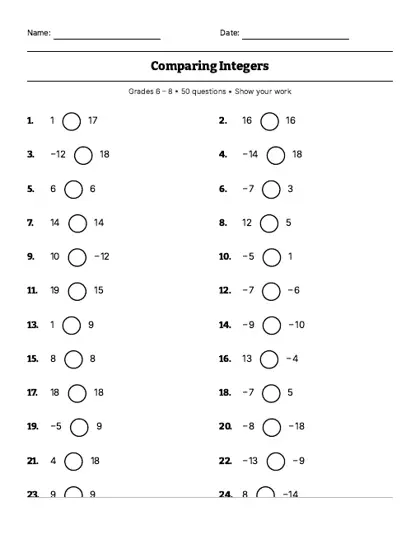 Comparing integersGrade 6
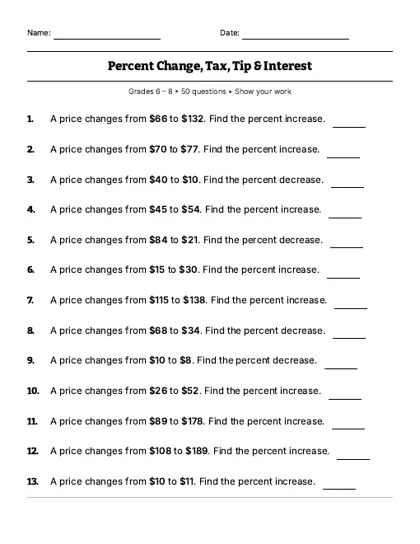 Percent changeGrade 7
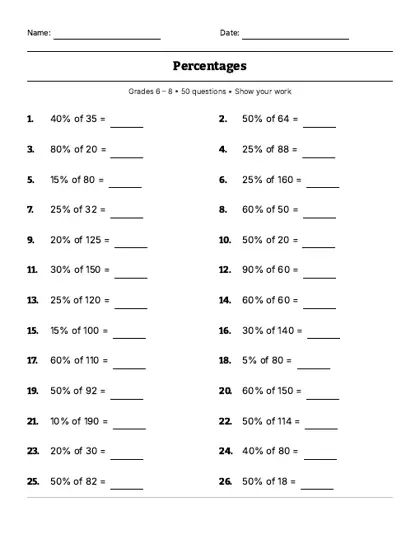 Percent of a numberGrade 6
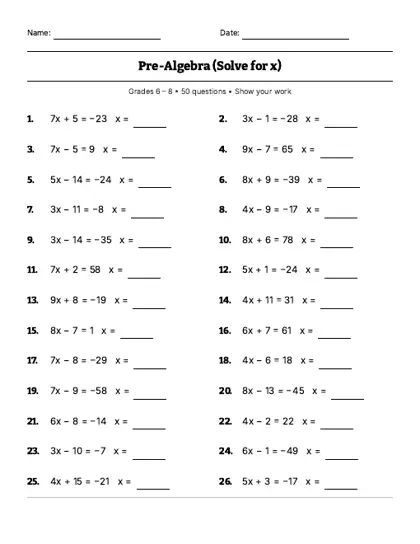 Solving equationsGrades 6–7
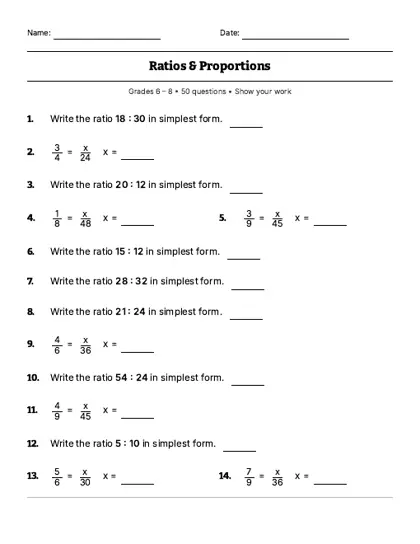 RatiosGrade 6
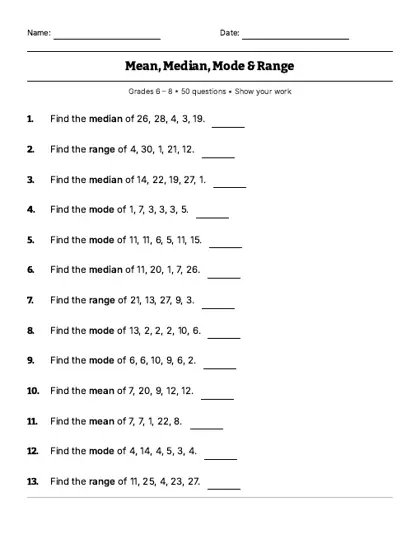 Mean, median, mode and rangeGrade 6
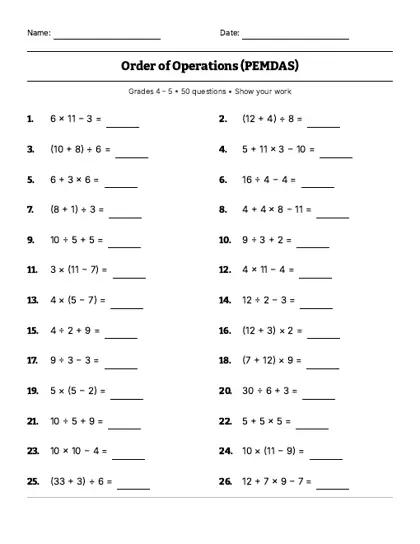 Order of operationsGrades 5–6
More 7th grade PDFs
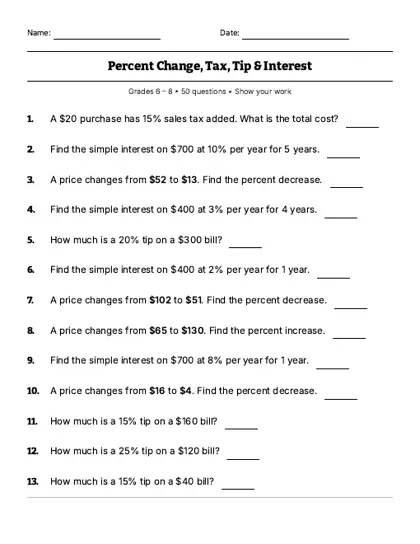 Tax, tip and interestGrade 7
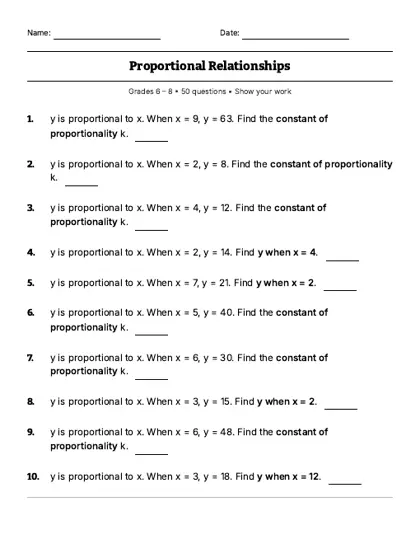 Proportional relationshipsGrade 7
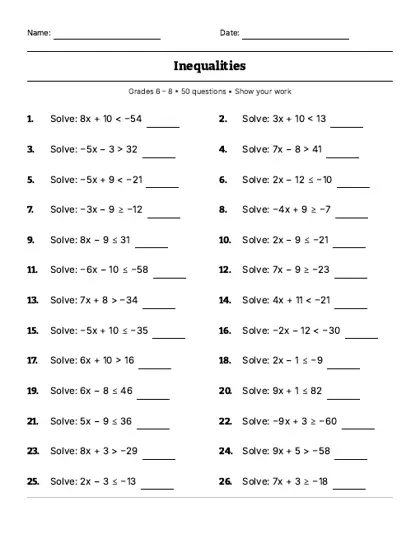 InequalitiesGrades 6–7
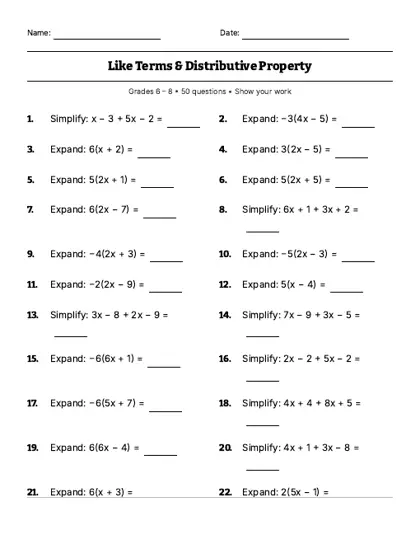 Like terms and distributive propertyGrades 6–7
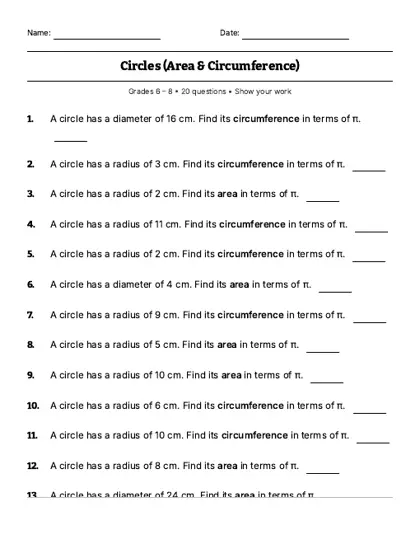 CirclesGrade 7 · 20 questions
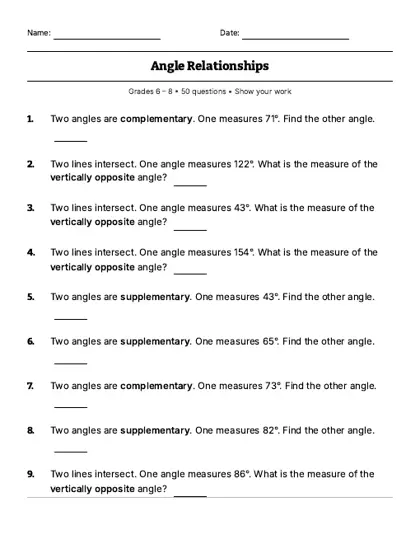 Angle relationshipsGrade 7
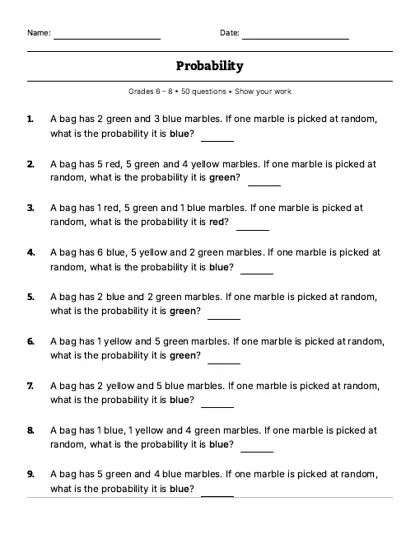 ProbabilityGrade 7
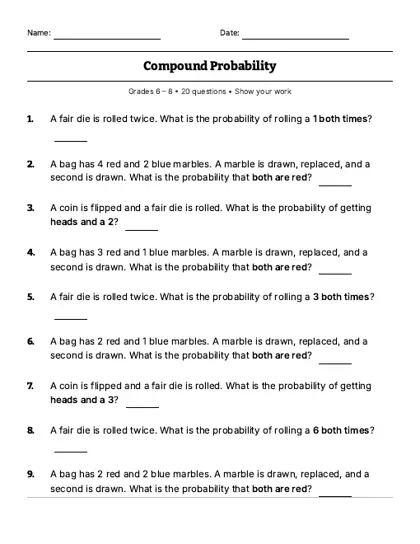 Compound probabilityGrade 7 · 20 questions
7th grade math lessons and charts
- IntegersNegative numbers
- PercentagesTax, tips and discounts
- EquationsTwo-step equations
- RatiosProportional relationships
- Percent changeIncrease and decrease
- GeometryCircles and angles
- StatisticsComparing groups
- Probability chartChance and outcomes
How to help with 7th grade math at home
Calculate the sale price
Discounts, sales tax and tips are real two-step percent problems. Let your teen work out the total before you pay.
Use temperatures and bank balances
Gains and losses, temperature changes and money owed are natural integer problems.
Measure round things
Measure the diameter and circumference of plates, cans and wheels. Dividing one by the other gives about 3.14 every time.
Play probability games
Roll two dice 50 times and record the sums. Which comes up most? Compare with the calculated probabilities.
See 6th grade math for the skills that lead into this year, and 8th grade math for what comes next.
Last reviewed
Questions parents ask
What math do 7th graders learn?
Proportional relationships, percent problems, operations with negative numbers and fractions, simplifying expressions, two-step equations and inequalities, scale drawings, circles, angle relationships, surface area and volume, and probability.
Is 7th grade math pre-algebra?
Yes, much of it. Grade 7 covers expressions, two-step equations, inequalities and proportional relationships, which are the core of pre-algebra.
What are proportional relationships in 7th grade?
Relationships where one quantity is always the same multiple of the other, like cost = 2.5 × pounds. They make a straight line through the origin on a graph.
How can I help my 7th grader with math?
Make sure negative numbers and fractions are solid, use real shopping for percent problems, and ask your teen to check equations by substituting the answer back.
What is the hardest part of 7th grade math?
For many students it is the rules for negative numbers and multi-step percent problems. Both get much easier with a number line and the three kinds of percent question.
My child is behind in 7th grade math. Where do I start?
Usually with fractions, ratios and one-step equations from grade 6. The grades 6–8 mixed review worksheet helps find the gap.