
Adding integers
To add integers, check the signs. Same signs: add and keep the sign. Different signs: subtract the sizes and keep the bigger one’s sign.
The idea: adding is moving on the number line
Start at the first number. Adding a positive number moves you right. Adding a negative number moves you left.
So 3 + 4 starts at 3 and moves 4 right to 7. And 3 + (−4) starts at 3 and moves 4 left to −1.
Every rule for adding integers is a short way of describing these moves. If a rule ever feels confusing, draw the number line and jump.
See it: pictures to draw with your child
Copy these onto paper or a whiteboard. A quick sketch makes the idea concrete before any written method.
Rule 1: same signs
When both numbers are positive or both are negative, add their sizes and keep the sign. For example, −4 + (−6): 4 + 6 = 10, and both are negative, so the answer is −10.
On the number line, both moves go the same way, so they add up. With chips, you put down 4 red chips and 6 more red chips: 10 red chips, or −10.
Rule 2: different signs
When one number is positive and one is negative, subtract the smaller size from the bigger size. Then give the answer the sign of the number with the bigger size.
For −9 + 5: 9 − 5 = 4. The 9 is bigger and it is negative, so the answer is −4.
With chips, 9 red and 5 yellow make 5 zero pairs. That leaves 4 red chips: −4. The zero pairs page shows this step by step.
Add two integers
Change the numbers or press ± to flip a sign. Watch the jump on the number line and the zero pairs.
Adding a number and its opposite
A number plus its opposite is always 0: 7 + (−7) = 0. The moves cancel out, just like zero pairs of chips.
This helps with longer sums. In 8 + (−3) + 3, the −3 and 3 cancel, so the answer is 8.
You can also add in any order. Group the positives, group the negatives, then add the two totals: 5 + (−2) + 6 + (−4) = 11 + (−6) = 5.
Key words
- Integer: a whole number, its negative or zero.
- Sum: the answer to an addition.
- Same signs: both numbers positive, or both negative.
- Different signs: one number positive and one negative.
- Size (absolute value): how far a number is from 0, ignoring its sign.
- Zero pair: +1 and −1 together, worth 0.
Mental strategies for adding integers
Make zero first. In −8 + 10, split 10 into 8 + 2. The −8 and 8 make 0, leaving 2.
Group by sign. In 4 + (−7) + 9 + (−3), add the positives (13) and the negatives (−10) separately. Then 13 + (−10) = 3.
Estimate the sign first. Before working out −27 + 15, ask which size is bigger. 27 is bigger and negative, so the answer must be negative. Then 27 − 15 = 12 gives −12.
Use a thermometer. Children often find temperature easier than abstract sums. −6 + 4 is “−6°C warms by 4 degrees”, which is −2°C.
How to check an integer sum
Swap the order: −9 + 5 should equal 5 + (−9). If the two answers differ, one of them has a sign mistake.
Or undo it: if −9 + 5 = −4, then −4 − 5 should give back −9.
Quiz: adding integers
Use the number line or the rules. Type a minus sign for negatives.
Where this fits: integers step by step
- What are integers
- Integers on a number line
- Opposite numbers
- Absolute value
- Comparing integers
- Negative numbers in real life
- Zero pairs
- Adding integers (this page)
- Subtracting integers
- Distance between integers
- Multiplying integers
- Dividing integers
- Integer rules
- Order of operations with integers
- The coordinate plane
- Rational numbers
- Integer word problems
What to say to your child
A short script for teaching it the first time. Pause after each line and let your child do the next step.
- “Start at 3 on the number line. Adding −4 means moving 4 to the left. Where do you land?” (−1.)
- “Now try −4 + (−6). Which way do both moves go?” (Left.)
- “So the sizes add: 4 + 6 = 10. What’s the answer?” (−10.)
- “For −9 + 5, the signs are different. What is 9 − 5?” (4.)
- “Which number has the bigger size, −9 or 5?” (−9.) “So the answer is −4.”
More worked examples
Example 1: same signs, positive
6 + 8 = 14. Both positive, so add and keep +.
Example 2: same signs, negative
−7 + (−5): 7 + 5 = 12, keep the minus: −12.
Example 3: different signs
12 + (−20): 20 − 12 = 8. The 20 is bigger and negative, so −8.
Example 4: three numbers
−3 + 10 + (−4): positives 10, negatives −7, so 10 + (−7) = 3.
Practice questions (answers below)
Ask these out loud or write them down. Check each answer, and ask “how did you get that?” for one or two.
- −5 + (−3)
- −5 + 3
- 5 + (−3)
- −12 + 12
- −8 + 15
- −20 + (−11)
- 14 + (−19)
- −6 + 2 + (−4)
- It is −7°C and warms 10 degrees. Temperature?
- Stretch: −45 + 18 + (−3) + 30
Show the answers
- −8
- −2
- 2
- 0
- 7
- −31
- −5
- −8
- 3°C
- 0
Common mistakes
How to teach it at home
Elevator game
Start on floor 0. Call out moves like “up 3” and “down 5” and say each new floor.
Chip sums
Use two colours of buttons. Make each number, cancel the pairs, read what is left.
Card sums
Draw two cards (red negative, black positive) and add them. Highest total wins.
By grade
- Grade 7 (7.NS.A.1a–b): adding integers on a number line and with opposites.
- Grade 7 (7.NS.A.1d): adding rational numbers with the same rules.
- In India, adding integers is part of class 6 and class 7.
- Next: subtracting integers.
More for each grade: Grade 7 math and the CBSE class 7 maths guide.
Worksheets and practice
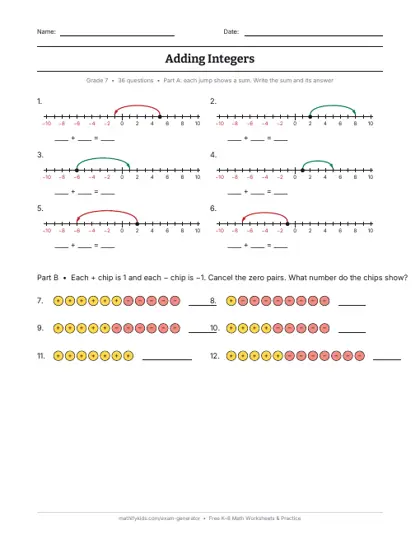
Adding integers worksheet: printable PDF with an answer key. · Make a fresh test
Integer practice · integer calculator · integer number line · integers for kids · ratios
Last reviewed
Questions parents ask
What are the rules for adding integers?
Same signs: add the sizes and keep the sign. Different signs: subtract the sizes and keep the sign of the bigger size.
What is a negative plus a negative?
A negative. −3 + (−4) = −7, because both moves go left.
What is a negative plus a positive?
It depends on the sizes. −9 + 5 = −4, but −5 + 9 = 4.
How do you add integers on a number line?
Start at the first number. Move right for a positive number and left for a negative number.
What grade learns adding integers?
Grade 7 under Common Core 7.NS.A.1. In India, class 6 and 7.