
Exponents for kids
An exponent says how many times to multiply a number by itself: 3⁴ means 3 × 3 × 3 × 3 = 81. This page explains exponents from the first powers of 10 in grade 5 to the exponent rules and scientific notation of grade 8, with pictures, an exponent explorer, the mistakes to watch for and printable worksheets.
What kids learn about exponents, grade by grade
- Grade 5 (5.NBT.A.2): powers of 10 written with exponents, like 10³ = 1,000, and what happens to digits when you multiply by them.
- Grade 6 (6.EE.A.1, 6.EE.A.2c): write and work out expressions like 4³ and 2⁵, and use exponents in the order of operations.
- Grade 8 (8.EE.A.1 to 8.EE.A.4): the exponent rules, zero and negative exponents, square and cube roots, and scientific notation for very big and very small numbers.
Where to start with exponents
Start with what an exponent means, using squares and cubes children can picture. Then powers of 10. Only after that move to the rules: a child who can write out 2³ × 2⁴ in full will never need to memorize “add the exponents”.
The big idea behind exponents
An exponent is shorthand for repeated multiplication, the way multiplication is shorthand for repeated addition. In 5³, 5 is the base and 3 is the exponent (or power). It means 5 × 5 × 5 = 125.
The second and third powers have special names because they describe real shapes: a number squared is the area of a square, and a number cubed is the volume of a cube.
Exponent explorer
Change the base and the exponent. Try 0, a negative base, and a negative exponent.
Powers of 10
Powers of 10 are where most children first meet exponents. The exponent tells you how many zeros follow the 1, and negative powers of 10 give the decimal places.
| Power | Number | Name |
|---|---|---|
| 10⁰ | 1 | one |
| 10¹ | 10 | ten |
| 10² | 100 | hundred |
| 10³ | 1,000 | thousand |
| 10⁴ | 10,000 | ten thousand |
| 10⁵ | 100,000 | hundred thousand |
| 10⁶ | 1,000,000 | million |
| 10⁻¹ | 0.1 | tenth |
| 10⁻² | 0.01 | hundredth |
This is why scientific notation works: the distance to the Sun, about 150,000,000 km, is 1.5 × 10⁸ km.
The exponent rules (grade 8)
Every rule comes straight from writing the powers out in full. Show the long version once and the rule makes sense.
| Rule | Example | Why |
|---|---|---|
| Multiply: add the exponents | 2³ × 2⁴ = 2⁷ | (2·2·2)(2·2·2·2) is seven 2s |
| Divide: subtract the exponents | 5⁶ ÷ 5² = 5⁴ | Two 5s on the bottom cancel two on top |
| Power of a power: multiply | (3²)⁴ = 3⁸ | Four lots of 3²: 2 + 2 + 2 + 2 = 8 |
| Zero exponent | 7⁰ = 1 | 7³ ÷ 7³ = 1 and also 7⁰ |
| Negative exponent | 10⁻² = 1/100 | Keep dividing by 10 below 10⁰ |
The rules only work when the bases are the same. 2³ × 3⁴ can’t be combined into one power.
Where kids get stuck with exponents
How to teach exponents at home
Fold a sheet of paper
Fold a sheet in half again and again, counting layers: 2, 4, 8, 16, 32. Each fold is one more power of 2. Most people can’t get past 7 folds, which is 2⁷ = 128 layers.
Build squares and cubes
Use sugar cubes, blocks or Lego. Build 2², 3² and 4² as flat squares, then 2³ and 3³ as cubes. Children see why “squared” and “cubed” have those names.
Tell the rice and chessboard story
One grain of rice on the first square, 2 on the next, 4, 8 and so on. By the last square it is 2⁶³ grains, more rice than has ever been grown. It shows how fast powers grow.
Count zeros
Say a power of 10 and have your child write it: 10⁴, 10⁶. Then go backwards: “1,000,000 is 10 to the what?”
Practice exponents: problems with answers
Exponents worksheets
Printable PDFs with answer keys. The first one has its own page with tips: exponents worksheet.
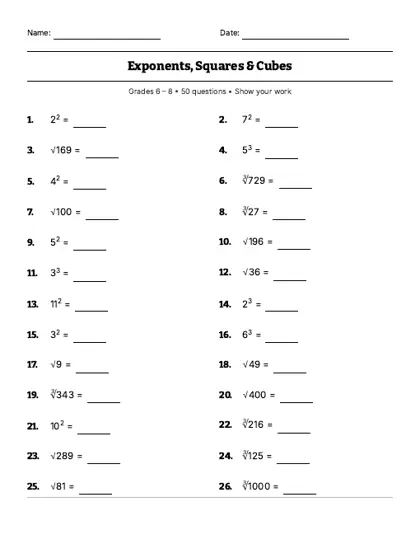 Exponents, squares and cubesGrade 6 · 50 questions + key
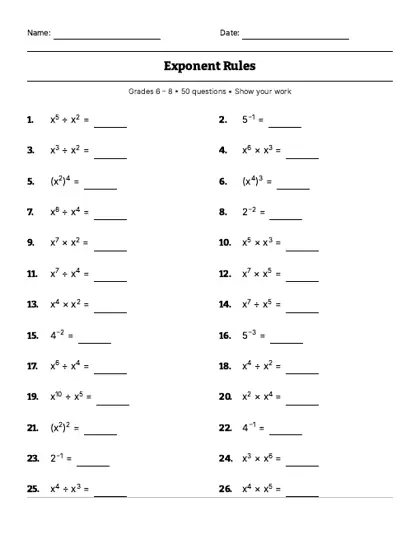 Exponent rulesGrade 8 · 50 questions + key
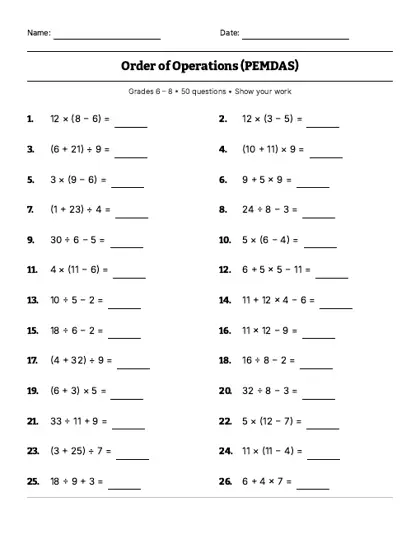 Order of operations with exponentsGrades 6–8 · 50 questions + key
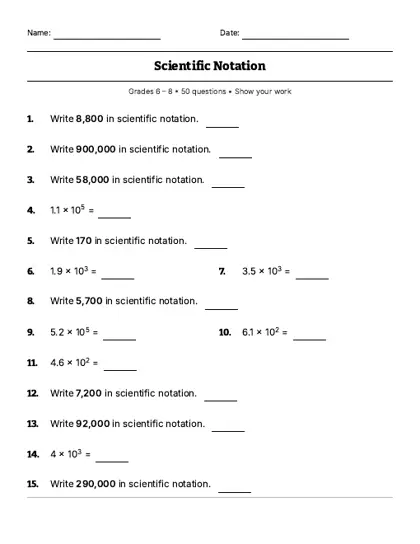 Scientific notationGrade 8 · 50 questions + key
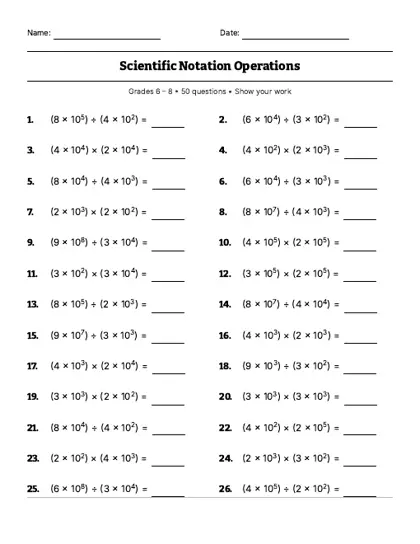 Scientific notation operationsGrade 8 · 50 questions + key
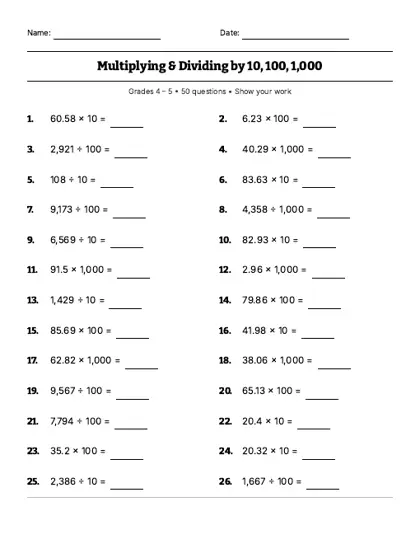 Multiply and divide by 10, 100, 1000Grades 3–5 · powers of 10
Make a fresh exponents test · Make an exponent rules test · Make a scientific notation test
Exponents charts and related lessons
- Multiplication chart: the perfect squares run down its diagonal.
- Place value chart: see what multiplying by powers of 10 does to each digit.
- Multiplying by 10, 100 and 1000 · Order of operations · 8th grade math
Last reviewed
Questions parents ask
What is an exponent?
An exponent is a small raised number that tells you how many times to use the base as a factor. In 2⁵, the base is 2 and the exponent is 5, so 2⁵ = 2 × 2 × 2 × 2 × 2 = 32.
What is 3 to the power of 4?
81. Multiply 3 by itself four times: 3 × 3 = 9, 9 × 3 = 27, 27 × 3 = 81.
Why is any number to the power of 0 equal to 1?
Each time the exponent goes down by 1, you divide by the base: 2³ = 8, 2² = 4, 2¹ = 2. Divide by 2 once more and you get 2⁰ = 1. The pattern only works if the answer is 1. (0⁰ is the exception and is left undefined in school math.)
Is −3² the same as (−3)²?
No. (−3)² means (−3) × (−3) = 9. Without brackets, −3² means −(3 × 3) = −9, because the exponent applies before the minus sign.
What grade learns exponents?
Grade 5 uses exponents for powers of 10 (5.NBT.A.2). Grade 6 writes and evaluates expressions with exponents (6.EE.A.1). Grade 8 learns the exponent rules, negative exponents and scientific notation (8.EE.A.1 to 8.EE.A.4).
What does a negative exponent mean?
Divide instead of multiply. 10⁻² = 1 ÷ 10² = 1/100 = 0.01. A negative exponent makes a small fraction, not a negative number.