
Exponent rules (the laws of exponents)
The exponent rules are shortcuts for multiplying and dividing powers of the same base. Each one comes from writing the factors out.
The idea: count the factors
Every exponent rule comes from one fact: an exponent counts factors. 2³ is three 2s multiplied, and 2⁴ is four.
So 2³ × 2⁴ is three 2s and then four more, which is seven 2s: 2⁷. Children who can write the factors out never need to memorise the rules. They can rebuild them.
See it: pictures to draw with your child
Copy these onto paper or a whiteboard. A quick sketch makes the idea concrete before any written method.
The exponent rules in one table
| Rule | In letters | Example |
|---|---|---|
| Product rule | aᵐ × aⁿ = aᵐ⁺ⁿ | 2³ × 2⁴ = 2⁷ |
| Quotient rule | aᵐ ÷ aⁿ = aᵐ⁻ⁿ | 3⁵ ÷ 3² = 3³ |
| Power of a power | (aᵐ)ⁿ = aᵐⁿ | (5³)² = 5⁶ |
| Power of a product | (ab)ⁿ = aⁿbⁿ | (2 × 3)² = 2² × 3² = 36 |
| Zero exponent | a⁰ = 1 | 7⁰ = 1 |
| Negative exponent | a⁻ⁿ = 1/aⁿ | 2⁻³ = 1/8 |
All of these need the same base. 2³ × 3² can’t be joined into one power: work it out as 8 × 9 = 72.
The product rule: add the exponents
When you multiply powers of the same base, add the exponents. 5³ × 5⁴ = 5⁷, because there are 3 + 4 = 7 factors of 5.
Keep the base the same. A very common slip is to multiply the bases too, writing 5³ × 5⁴ = 25⁷. That number is far too big.
The quotient rule: subtract the exponents
When you divide powers of the same base, subtract the exponents. 3⁵ ÷ 3² = 3³.
The picture shows why. Write five 3s on top and two underneath. Two pairs cancel, leaving three 3s on top.
Check a rule in the calculator
2³ × 2⁴ should equal 2⁷. Type base 2 and exponent 7 to see 128, then check that 8 × 16 = 128.
Powers of powers and products
A power of a power multiplies the exponents. (5³)² means 5³ × 5³, which is 3 + 3 = 6 factors of 5, so 5⁶. In general, (aᵐ)ⁿ = aᵐⁿ.
A power of a product shares the power with every factor. (2 × 3)² = 2² × 3² = 4 × 9 = 36. It matches 6² = 36.
Where zero and negative exponents come from
The quotient rule explains them. 4³ ÷ 4³ = 1, and the rule gives 4³⁻³ = 4⁰. So 4⁰ must be 1.
In the same way, 4² ÷ 4⁵ = 1/4³, and the rule gives 4⁻³. So a negative exponent means 1 over the power. The zero and negative exponents lesson goes further.
Key words
- Base: the number being multiplied, like the 2 in 2⁵.
- Exponent: how many factors of the base there are.
- Product: the answer to a multiplication.
- Quotient: the answer to a division.
- Same base: the rules only work when the bases match.
Teaching tip: write it out, then shortcut
For the first few questions, ask your child to write every factor out in full. 2³ × 2² becomes 2 × 2 × 2 × 2 × 2, and counting gives 2⁵.
After three or four of these, ask what shortcut they notice. Most children say “add the little numbers” on their own. A rule they discovered is a rule they keep.
If a rule is forgotten in a test, writing a small example out, like 2² × 2³, rebuilds it in ten seconds.
A week of practice
Ten minutes a day is plenty. Short, regular practice beats one long session at the weekend.
- Day 1: write out products like 2³ × 2² and count the factors.
- Day 2: the product rule with numbers and letters.
- Day 3: the quotient rule, with the cancelling picture.
- Day 4: powers of powers and powers of products.
- Day 5: the quiz on this page, then one round of product and quotient rules practice.
If one day goes badly, repeat it rather than moving on. Each day builds on the one before.
Quiz: the exponent rules
Same base, so what is the exponent?
Where this fits: exponents step by step
What to say to your child
A short script for teaching it the first time. Pause after each line and let your child do the next step.
- “What is 2³ written out?” (2 × 2 × 2.)
- “And 2³ × 2²?” (Five 2s: 2⁵.)
- “What did we do with the 3 and the 2?” (Added them.)
- “What about 2⁵ ÷ 2²?” (Two 2s cancel, leaving 2³.)
- “Can we join 2³ × 3²?” (No, the bases are different.)
More worked examples
Example 1: product rule
7² × 7⁶ = 7⁸.
Example 2: quotient rule
10⁹ ÷ 10⁴ = 10⁵, which is 100,000.
Example 3: power of a power
(x⁴)³ = x¹².
Example 4: mixed
(2³ × 2⁵) ÷ 2⁶ = 2⁸ ÷ 2⁶ = 2² = 4.
Practice questions (answers below)
Ask these out loud or write them down. Check each answer, and ask “how did you get that?” for one or two.
- 5³ × 5⁴
- 7⁸ ÷ 7⁵
- (2⁴)³
- x⁵ × x²
- 10⁶ ÷ 10²
- 2³ × 2²
- 6⁵ ÷ 6³
- (x²)⁵
- (3 × 2)²
- Stretch: 3² × 3⁻⁵
Show the answers
- 5⁷
- 7³
- 2¹²
- x⁷
- 10⁴ = 10,000
- 2⁵ = 32
- 6² = 36
- x¹⁰
- 36
- 3⁻³ = 1/27
Common mistakes
How to teach it at home
Write it out
Give a product like 3² × 3³. Your child writes every factor, counts them and then spots the rule.
Rule detective
Show a wrong answer like 2³ × 2⁴ = 4⁷. Your child finds and fixes the mistake.
Calculator check
Pick a rule example and check both sides in the exponent calculator.
By grade
- Grade 6 (6.EE.A.1): writing and evaluating powers, the groundwork for the rules.
- Grade 8 (8.EE.A.1): the properties of integer exponents, including zero and negative exponents.
- In India, the laws of exponents are in the class 8 chapter Power Play.
- Next: zero and negative exponents.
More for each grade: Grade 8 math and the CBSE class 8 maths guide.
Worksheets and practice
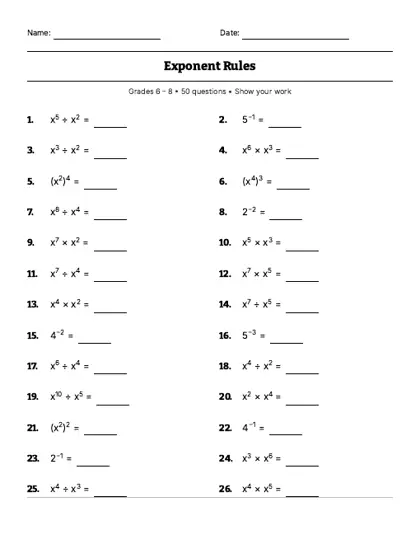
Exponent rules worksheet: printable PDF with an answer key. · Make a fresh test
Exponents practice · exponent calculator · exponents for kids · exponent rules worksheet · scientific notation worksheet · order of operations with exponents
Last reviewed
Questions parents ask
What are the exponent rules?
Product rule: add exponents when multiplying (aᵐ × aⁿ = aᵐ⁺ⁿ). Quotient rule: subtract when dividing. Power of a power: multiply. Any base to the power 0 is 1, and a⁻ⁿ = 1/aⁿ.
Why do you add exponents when multiplying?
Because exponents count factors. 2³ × 2⁴ is three 2s and four more 2s, which is seven 2s.
Can you use the rules with different bases?
Not to make one power. 2³ × 3² has to be worked out: 8 × 9 = 72.
What is (2³)²?
2⁶ = 64. A power of a power multiplies the exponents.
What grade learns the exponent rules?
Grade 8 under Common Core 8.EE.A.1. In India, class 8 (Power Play).