
Order of operations (PEMDAS) for kids
The order of operations is the rule for which part of a calculation to do first: brackets, exponents, multiplication and division, then addition and subtraction. 2 + 3 × 4 = 14, not 20. This page explains PEMDAS with worked examples, has a tool that shows every step for any expression, and covers the mistakes children make.
What kids learn about the order of operations, grade by grade
- Grade 3 (3.OA.D.8): two-step word problems, where children decide which operation comes first.
- Grade 5 (5.OA.A.1): use brackets in expressions and evaluate them.
- Grade 6 (6.EE.A.2c): the full order including exponents, with variables.
- Grade 7 and up: the same rules with negative numbers, fractions and algebra.
The big idea
Math needs one agreed answer. 2 + 3 × 4 could be 20 (left to right) or 14 (multiply first). Mathematicians agreed long ago that multiplication binds more tightly than addition, so the answer is 14. Brackets are how you override the order when you need to: (2 + 3) × 4 = 20.
PEMDAS, step by step
- Parentheses (brackets): work out anything inside brackets first, innermost first.
- Exponents: powers and square roots, like 2³ or 5².
- Multiplication and Division: together, from left to right.
- Addition and Subtraction: together, from left to right.
The left-to-right part is what most rhymes leave out. Think of it as four levels, not six letters: P, E, MD, AS.
Order of operations: show every step
Type any expression, such as a homework problem. Each step shows which rule is used and why.
Worked examples
Example 1: 2 + 3 × 4
Multiply first: 3 × 4 = 12. Then 2 + 12 = 14.
Example 2: (2 + 3) × 4
Brackets first: 2 + 3 = 5. Then 5 × 4 = 20.
Example 3: 12 ÷ 3 × 2
Same level, so left to right: 12 ÷ 3 = 4, then 4 × 2 = 8.
Example 4: 20 − 6 + 4
Same level, left to right: 20 − 6 = 14, then 14 + 4 = 18. (Adding first would give 10.)
Example 5: 3 + 4 × (6 − 2)² ÷ 8
Brackets: 6 − 2 = 4. Exponent: 4² = 16. Multiply and divide left to right: 4 × 16 = 64, 64 ÷ 8 = 8. Add: 3 + 8 = 11.
Where kids get stuck
Order of operations worksheets
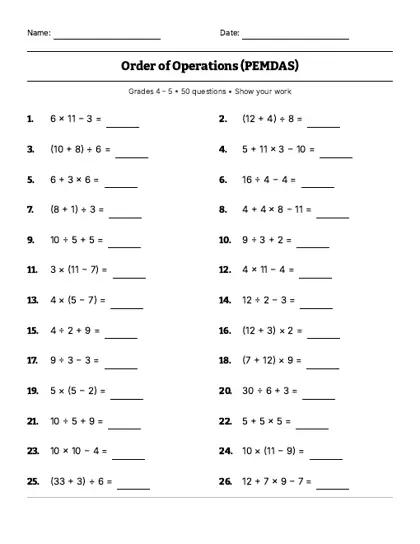 Order of operations
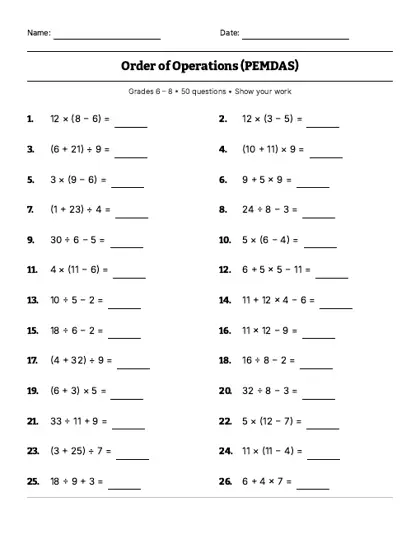 Order of operations with exponents
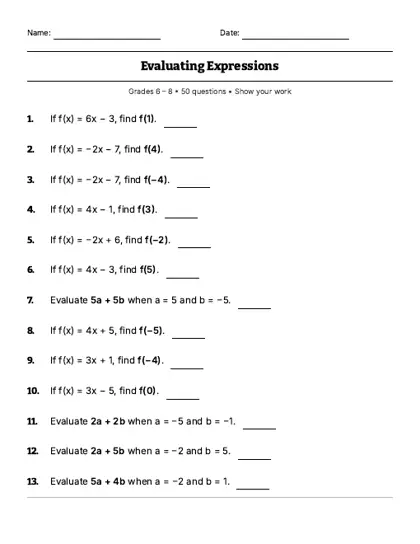 Evaluating expressions
Make a fresh order of operations test (grades 4–5) or a grades 6–8 version with exponents.
How to teach the order of operations at home
Start with a story
“You buy 2 cookies and then 3 bags with 4 cookies each. How many cookies?” Children naturally do 3 × 4 first. That is the rule.
Circle the next step
Before calculating anything, ask your child to circle the part to do first. Saying the reason (“brackets first”) is more important than the arithmetic.
Use a calculator to check
Type 2 + 3 × 4 into a phone calculator. It gives 14 too. Then try with brackets.
Make the target
Give four numbers, like 2, 3, 4 and 5, and a target like 14. Use any operations and brackets to hit it: 2 + 3 × 4 or (5 − 3) × 4 + 2…
Related: exponents · solving equations · 5th grade math · 6th grade math
Last reviewed
Questions parents ask
What is the order of operations?
The agreed order for working out an expression: brackets first, then exponents, then multiplication and division from left to right, then addition and subtraction from left to right.
What does PEMDAS stand for?
Parentheses, Exponents, Multiplication and Division, Addition and Subtraction. Many children remember it as “Please Excuse My Dear Aunt Sally”. In the UK and India it is often BODMAS or BIDMAS.
Does multiplication always come before division?
No. Multiplication and division have the same rank, so you do them in order from left to right. 12 ÷ 3 × 2 = 4 × 2 = 8, not 12 ÷ 6 = 2.
What is 2 + 3 × 4?
14. Multiply first: 3 × 4 = 12, then 2 + 12 = 14. Working left to right gives 20, which is wrong.
Why do we need an order of operations?
So that everyone gets the same answer. Without an agreed order, 2 + 3 × 4 could be 14 or 20. Calculators and spreadsheets follow the same rules.
What grade learns the order of operations?
Grade 5 uses brackets in expressions (5.OA.A.1). Grade 6 adds exponents (6.EE.A.2c), and the rules are used in every grade after that.