
Solving equations for kids
An equation says two things are equal, like a balanced scale. To solve it, do the same to both sides until the letter is on its own. This page covers one-step, two-step and multi-step equations from grade 6 to grade 8, with balance pictures, an equation solver that shows each step and the check, the common mistakes, and worksheets.
What kids learn about equations, grade by grade
- Grade 6 (6.EE.B.5 to 6.EE.B.7): what a solution is, and solving one-step equations like x + 9 = 15 and 4x = 36.
- Grade 7 (7.EE.B.4a): two-step equations like 3x + 7 = 22, including negative numbers and fractions.
- Grade 8 (8.EE.C.7, 8.EE.C.8): variables on both sides, brackets, and systems of two equations.
The big idea: keep the scale balanced
The equals sign means both sides weigh the same. Whatever you do to one side, do to the other, and it stays balanced. The goal is to get the letter alone on one side.
One-step equations
Undo the one thing that has been done to x, using the opposite operation.
| Equation | Undo it | Answer |
|---|---|---|
| x + 6 = 10 | subtract 6 from both sides | x = 4 |
| x − 4 = 9 | add 4 to both sides | x = 13 |
| 4x = 28 | divide both sides by 4 | x = 7 |
| x ÷ 3 = 5 | multiply both sides by 3 | x = 15 |
Two-step equations
Undo in reverse order: additions and subtractions first, then multiplications and divisions. It is like taking off your shoes before your socks.
- 3x + 7 = 22
- Subtract 7 from both sides: 3x = 15
- Divide both sides by 3: x = 5
- Check: 3 × 5 + 7 = 22 ✓
Equation solver: every step and the check
Type an equation with x, such as 3x + 7 = 22 or 5x − 3 = 2x + 9.
Equations with variables on both sides
Gather the x terms on one side first. For 5x + 4 = 2x + 19, subtract 2x from both sides to get 3x + 4 = 19. Now it is a two-step equation: 3x = 15, so x = 5. With brackets, multiply them out first: 2(x + 3) = 14 becomes 2x + 6 = 14.
Where kids get stuck
Equations worksheets
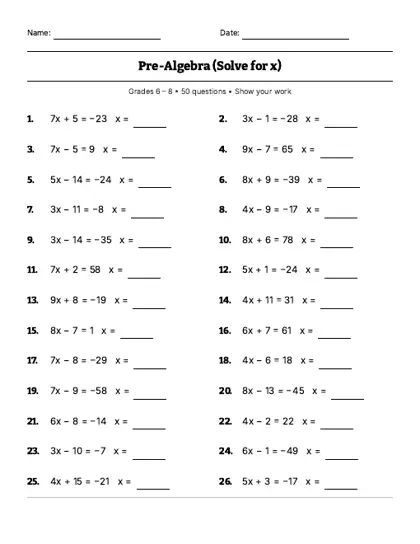 Solving equations
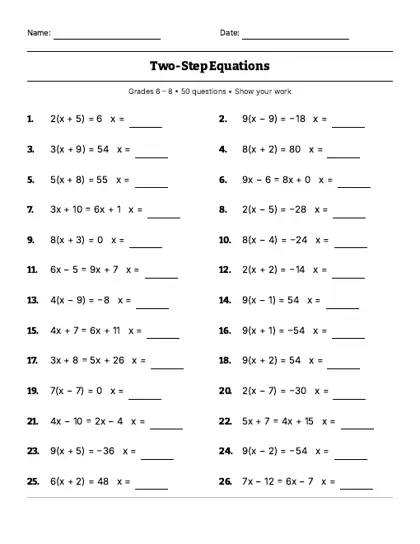 Multi-step equationsGrade 8
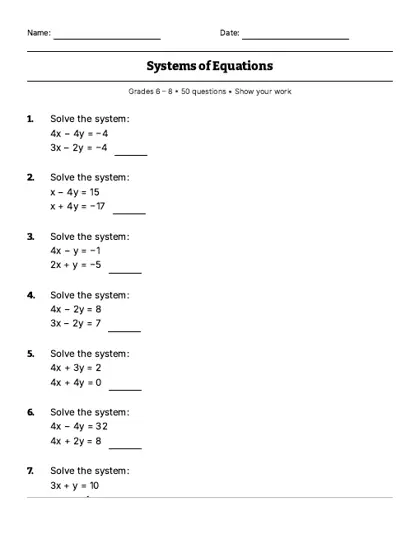 Systems of equationsGrade 8
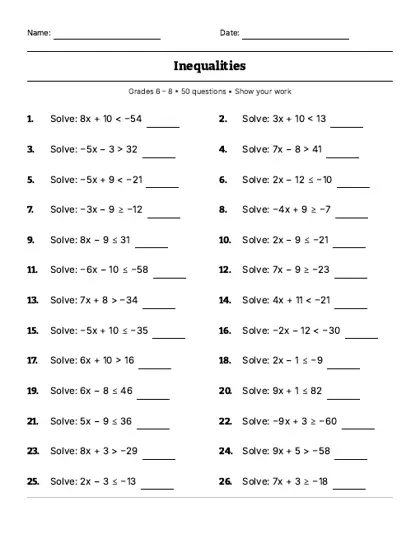 InequalitiesGrades 6–7
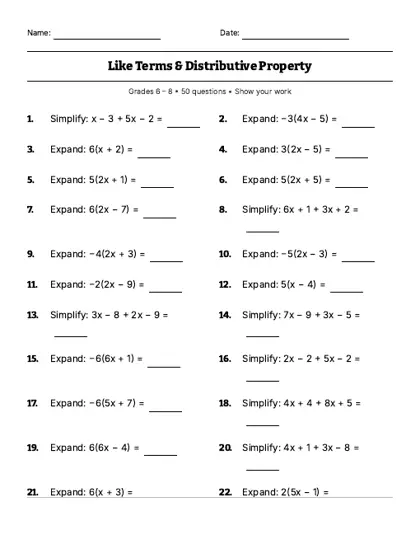 Like terms and distributive propertyGrades 6–7
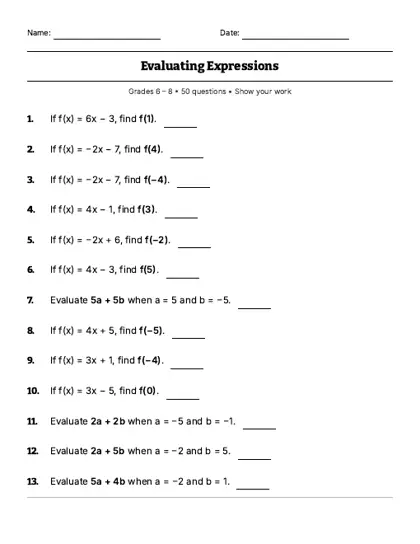 Evaluating expressionsGrade 6
How to teach equations at home
Mystery bag puzzles
Put some coins in a bag and 3 more on the table. “Bag plus 3 is 8. How many in the bag?” That is x + 3 = 8, and children solve it without any rules.
Think of a number
“I think of a number, multiply by 3 and add 7. I get 22. What was my number?” Working backwards is exactly how two-step equations are solved.
Always check together
Make substituting the answer back in a habit. It builds confidence and catches mistakes.
Related: integers · order of operations · 6th grade · 8th grade
Last reviewed
Questions parents ask
How do you solve an equation?
Do the same thing to both sides until the letter is on its own. Undo additions and subtractions first, then multiplications and divisions. For 3x + 7 = 22: subtract 7 from both sides (3x = 15), then divide both sides by 3 (x = 5).
What is a one-step equation?
An equation you can solve with one operation, like x + 6 = 10 (subtract 6) or 4x = 28 (divide by 4).
What is a two-step equation?
An equation that needs two operations, like 3x + 7 = 22. Undo the + 7 first, then the × 3.
How do you check the answer to an equation?
Put your answer back into the original equation. If both sides come out equal, it is right. For x = 5 in 3x + 7 = 22: 3 × 5 + 7 = 22 ✓.
What do you do when x is on both sides?
Move all the x terms to one side by adding or subtracting them from both sides, then solve as usual. 5x + 4 = 2x + 19 becomes 3x + 4 = 19, so 3x = 15 and x = 5.
What grade learns to solve equations?
Grade 6 solves one-step equations (6.EE.B.7). Grade 7 solves two-step equations (7.EE.B.4a). Grade 8 solves equations with variables on both sides and systems of two equations (8.EE.C.7, 8.EE.C.8).