
Systems of equations
A system of equations is two equations with the same two unknowns. Its solution is the pair x, y that makes both true.
The idea: two clues, two unknowns
One equation with two unknowns, like x + y = 10, has many answers. A second equation, like x − y = 2, narrows it down to one pair: x = 6, y = 4.
Each equation is a clue. Together they pin down both numbers, like two clues in a mystery.
See it: pictures to draw with your child
Copy these onto paper or a whiteboard. A quick sketch makes the idea concrete before any written method.
Method 1: graphing
Each equation is a straight line. The solution is the point where the lines cross, because that point is on both lines.
Graphing shows the idea clearly, but it is only exact when the crossing point lands on grid lines.
Method 2: substitution
If one equation says what y equals, put that into the other. For y = 2x and x + y = 12, replace y: x + 2x = 12, so 3x = 12 and x = 4.
Then find y from the easier equation: y = 2 × 4 = 8. Always check both equations: 4 + 8 = 12 (correct) and 8 = 2 × 4 (correct).
Method 3: elimination
Add or subtract the equations so one letter cancels. In x + y = 10 and x − y = 2, adding them cancels y: 2x = 12, so x = 6.
Then y = 10 − 6 = 4. If no letter cancels straight away, multiply one equation first so the coefficients match.
Key words
- System of equations: two or more equations with the same unknowns.
- Solution of a system: the values that make every equation true at once.
- Substitution: replacing one variable with an expression from the other equation.
- Elimination: adding or subtracting equations to cancel a variable.
- Point of intersection: where two lines cross on a graph.
One, none or infinitely many solutions
Two straight lines can cross once, never, or lie on top of each other. So a system has one solution, no solution, or infinitely many.
Parallel lines, like y = 2x + 1 and y = 2x + 5, never meet, so there is no solution. Algebra shows this as a false statement like 1 = 5.
If the equations are the same line, every point works. Algebra shows this as a true statement like 0 = 0.
Choosing the best method
Use substitution when one equation already starts y = … or x = …. Use elimination when a letter has the same or opposite coefficient in both equations.
Use graphing to see what is happening, or to check an answer. Graphing calculators and the coordinate plane make this quick.
Whichever method you use, the answer is the same. Pick the one with the fewest steps.
Systems of equations in real life
A school sells adult tickets for $5 and child tickets for $2. It sold 100 tickets and took $320. How many of each?
Write a + c = 100 and 5a + 2c = 320. Substitute c = 100 − a: 5a + 200 − 2a = 320, so 3a = 120, a = 40 and c = 60.
Mixtures, ticket sales and comparing plans all lead to systems. Two facts about two unknowns is the signal.
Quiz: systems of equations
Find x and y. Type each in its own box.
Where this fits: equations step by step
- What is an equation
- Variables
- Algebraic expressions
- Evaluating expressions
- Writing expressions
- Inverse operations
- One-step equations
- Combining like terms
- Distributive property with variables
- Two-step equations
- Equations with fractions and decimals
- Solving inequalities
- Multi-step equations
- Variables on both sides
- Systems of equations (this page)
- Equation word problems
What to say to your child
A short script for teaching it the first time. Pause after each line and let your child do the next step.
- “x + y = 10. Can you find x and y?” (Lots of answers.)
- “Now x − y = 2 as well.” (Only 6 and 4 work.)
- “What happens if we add the two equations?” (The y’s cancel: 2x = 12.)
- “So x = …?” (6.) “And y?” (4.)
- “Check both equations.” (6 + 4 = 10 (correct), 6 − 4 = 2 (correct).)
More worked examples
Example 1: elimination
x + y = 9 and x − y = 3. Add: 2x = 12, so x = 6 and y = 3.
Example 2: substitution
y = 3x and x + y = 16. So 4x = 16, x = 4 and y = 12.
Example 3: subtract to eliminate
2x + y = 11 and x + y = 7. Subtract: x = 4, so y = 3.
Example 4: word problem
Two numbers add to 20 and differ by 6. x + y = 20, x − y = 6, so x = 13 and y = 7.
Practice questions (answers below)
Ask these out loud or write them down. Check each answer, and ask “how did you get that?” for one or two.
- x + y = 8, x − y = 2
- x + y = 12, x − y = 4
- y = 2x, x + y = 9
- y = x + 1, x + y = 7
- 2x + y = 10, x + y = 6
- x + 2y = 7, x + y = 5
- 3x + y = 14, x − y = 2
- Where do y = x and y = 4 cross?
- Two numbers add to 15 and differ by 3
- Stretch: 2x + 3y = 13, x + y = 5
Show the answers
- x = 5, y = 3
- x = 8, y = 4
- x = 3, y = 6
- x = 3, y = 4
- x = 4, y = 2
- x = 3, y = 2
- x = 4, y = 2
- (4, 4)
- 9 and 6
- x = 2, y = 3
Common mistakes
How to teach it at home
Coins puzzle
“10 coins, all 2p or 5p, worth 32p. How many of each?” (6 and 4.)
Ticket prices
Adult and child tickets: 2 adults and 1 child cost $25, 1 adult and 1 child cost $15. (Adult $10, child $5.)
Graph it
Draw y = x and y = 6 − x on squared paper and find where they cross.
By grade
- Grade 8 (8.EE.C.8): solve systems of two linear equations by graphing, substitution and elimination, and use them in word problems.
- High school: systems with three unknowns and with inequalities.
- In India, pairs of linear equations are in class 10.
- Next: equation word problems.
More for each grade: Grade 8 math and the CBSE class 8 maths guide.
Worksheets and practice
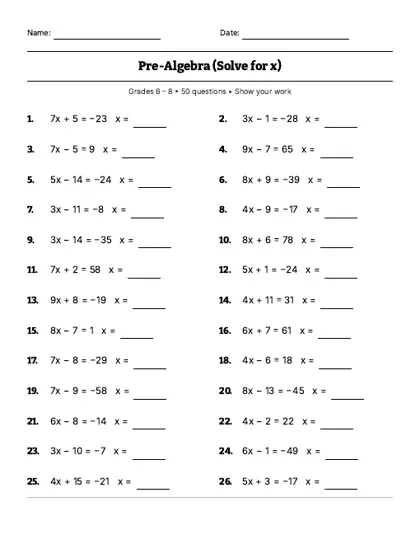
Solving equations worksheet: printable PDF with an answer key. · Make a fresh test
Equation practice · equation solver · balance scale · solving equations for kids · integers
Last reviewed
Questions parents ask
What is a system of equations?
Two or more equations with the same unknowns. The solution makes all of them true at once.
How do you solve a system of equations?
By graphing (where the lines cross), substitution (replace one letter) or elimination (add or subtract to cancel a letter).
Which method is best?
Substitution when one equation already says y = …; elimination when a letter cancels easily; graphing to see the idea.
Can a system have no solution?
Yes, if the lines are parallel. If the lines are the same, there are infinitely many solutions.
What grade learns systems of equations?
Grade 8 under Common Core 8.EE.C.8. In India, class 10.