
Two-step equations
To solve a two-step equation like 3x + 7 = 22, undo the + 7 first, then the × 3. Do each step to both sides.
The idea: undo in reverse order
In 3x + 7 = 22, two things happened to x: it was multiplied by 3, then 7 was added. To get x back, undo them in reverse order.
First subtract 7 from both sides: 3x = 15. Then divide both sides by 3: x = 5. Undoing in reverse order is like taking off shoes before socks.
See it: pictures to draw with your child
Copy these onto paper or a whiteboard. A quick sketch makes the idea concrete before any written method.
The two steps, every time
- Undo the adding or subtracting. Get the x term on its own on one side.
- Undo the multiplying or dividing. Get x on its own.
Then check by putting the answer back in. For 3x + 7 = 22 with x = 5: 3 × 5 + 7 = 22. It matches.
Check each step
Change the equation to see the steps. Try a negative number in front of x.
Two-step equations with negative numbers
The steps don’t change, but watch the signs. In −2x + 5 = 17, subtract 5 to get −2x = 12. Then divide by −2: x = −6.
In 4x − 9 = −1, add 9 to get 4x = 8, so x = 2. Writing every line helps keep track of each sign. See integer rules if the signs cause trouble.
Key words
- Coefficient: the number multiplying a variable: 3 in 3x.
- Constant: a number on its own, like 5 in 3x + 5.
- Two-step equation: an equation that needs two inverse operations, like 3x + 5 = 20.
- Undo in reverse: undo the last operation first, like taking off shoes before socks.
- Check: put the answer back into the equation to see if both sides match.
Why undo in reverse order?
Think of 3x + 5 as a recipe: start with x, multiply by 3, then add 5. To get back to x, undo the last step first.
So subtract 5, then divide by 3. It is like getting dressed: socks go on before shoes, but shoes come off first.
Children who solve by undoing the multiplication first must divide every term, which is harder. Undoing in reverse keeps the numbers whole for longer.
Teaching tip: cover-up method
For 3x + 5 = 20, cover 3x with a finger and ask: “something + 5 = 20. What is the something?” It is 15.
Then 3x = 15, so x = 5. The cover-up method builds number sense before the formal steps.
Move to written inverse operations once children can explain why the cover-up works. Both methods lead to the same answer.
Ask children to say which they prefer and why. Explaining a method out loud is a strong sign it is understood.
Two-step equations in real life
Two-step equations appear whenever there is a fixed cost plus a rate. A gym charges a $10 joining fee plus $15 a month. After how many months have you paid $70?
Write 10 + 15m = 70. Subtract 10 to get 15m = 60, then divide by 15: m = 4 months.
Taxi fares, phone bills, delivery charges and savings plans all follow this pattern. Ask your child to find one in a shop or online this week.
Then change one number and solve again. What if the joining fee were $25? Seeing how the answer moves helps children understand what each part of the equation means.
Quiz: two-step equations
Undo + or − first, then × or ÷. Type a minus sign for negatives.
Where this fits: equations step by step
- What is an equation
- Variables
- Algebraic expressions
- Evaluating expressions
- Writing expressions
- Inverse operations
- One-step equations
- Combining like terms
- Distributive property with variables
- Two-step equations (this page)
- Equations with fractions and decimals
- Solving inequalities
- Multi-step equations
- Variables on both sides
- Systems of equations
- Equation word problems
What to say to your child
A short script for teaching it the first time. Pause after each line and let your child do the next step.
- “In 3x + 7 = 22, what was done to x?” (Times 3, then plus 7.)
- “What do we undo first?” (The + 7.)
- “Subtract 7 from both sides.” (3x = 15.)
- “Now undo the × 3.” (x = 5.)
- “Check it: 3 × 5 + 7?” (22. It works.)
More worked examples
Example 1: adding
2x + 9 = 25. Subtract 9: 2x = 16. Divide by 2: x = 8.
Example 2: subtracting
5x − 4 = 31. Add 4: 5x = 35. Divide by 5: x = 7.
Example 3: dividing
x ÷ 3 + 2 = 8. Subtract 2: x ÷ 3 = 6. Multiply by 3: x = 18.
Example 4: negative coefficient
−3x + 1 = 13. Subtract 1: −3x = 12. Divide by −3: x = −4.
Practice questions (answers below)
Ask these out loud or write them down. Check each answer, and ask “how did you get that?” for one or two.
- 2x + 3 = 11
- 4x − 5 = 15
- 3x + 10 = 4
- x ÷ 2 + 6 = 9
- 6x − 1 = 29
- −2x + 3 = 9
- 5 + 2x = 19
- 7x + 4 = −10
- x ÷ 4 − 3 = 2
- Stretch: 0.5x + 1.5 = 4
Show the answers
- 4
- 5
- −2
- 6
- 5
- −3
- 7
- −2
- 20
- 5
Common mistakes
How to teach it at home
Number machine
Your child picks a secret number, doubles it and adds 3. You work backwards to find it, then swap.
Phone plan
A plan costs $10 plus $5 a gigabyte. A bill is $35. How many gigabytes? (5)
Two-step race
Write two-step equations on cards; first to solve and check wins the card.
By grade
- Grade 7 (7.EE.B.4a): solve equations px + q = r and p(x + q) = r, including with negatives and fractions.
- Grade 8: multi-step equations and x on both sides.
- In India, two-step equations are in class 7 and class 8.
- Next: equations with fractions and decimals.
More for each grade: Grade 7 math and the CBSE class 7 maths guide.
Worksheets and practice
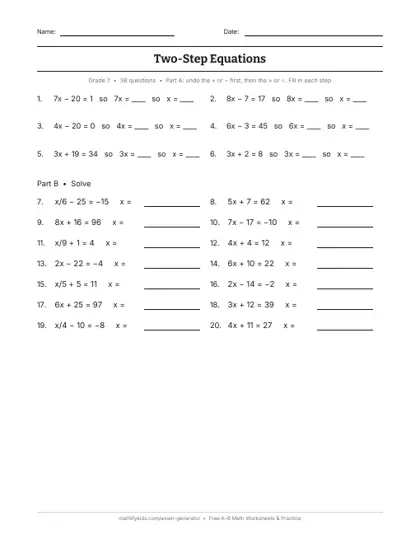
Two-step equations worksheet: printable PDF with an answer key. · Make a fresh test
Equation practice · equation solver · balance scale · solving equations for kids · integers
Last reviewed
Questions parents ask
How do you solve a two-step equation?
Undo the adding or subtracting first, then the multiplying or dividing. Do each step to both sides.
How do you solve 3x + 7 = 22?
Subtract 7 from both sides to get 3x = 15, then divide by 3: x = 5.
Why do you undo adding before multiplying?
Because the adding was done last. Undo steps in reverse order.
Can the answer be negative?
Yes. In 3x + 10 = 4, 3x = −6, so x = −2.
What grade learns two-step equations?
Grade 7 under Common Core 7.EE.B.4a. In India, class 7 and 8.