
Integer rules for adding, subtracting, multiplying and dividing
All four integer rules on one page: add, subtract, multiply and divide, with a chart, examples and a mixed quiz.
The integer rules chart
| Operation | Rule | Example |
|---|---|---|
| Add, same signs | Add the sizes, keep the sign. | −4 + (−6) = −10 |
| Add, different signs | Subtract the sizes, keep the sign of the bigger size. | −9 + 5 = −4 |
| Subtract | Add the opposite. | 3 − (−5) = 3 + 5 = 8 |
| Multiply or divide, same signs | The answer is positive. | −6 × (−3) = 18 |
| Multiply or divide, different signs | The answer is negative. | −18 ÷ 3 = −6 |
See it: pictures to draw with your child
Copy these onto paper or a whiteboard. A quick sketch makes the idea concrete before any written method.
Adding and subtracting: think about moves
For adding and subtracting, the sizes and the signs both matter. Picture each number as a move on the number line.
Subtraction always turns into addition first. Then decide: are the signs the same or different? See adding integers and subtracting integers for the details.
Multiplying and dividing: count the negatives
For multiplying and dividing, work out the sizes as normal. Then count the negative signs.
An even number of negatives gives a positive answer. An odd number gives a negative answer. So (−2) × (−3) × (−1) = −6, because there are three negatives.
See multiplying integers and dividing integers for why the rules work.
Try any operation
Pick + − × or ÷. The calculator shows which rule it used.
Which rule do I use?
The biggest mix-up is using a multiplying rule when adding. “Two negatives make a positive” is true for × and ÷, but not for +.
A quick check: −3 + (−4) moves left twice, so it must be negative (−7). But −3 × (−4) = 12, which is positive.
Say the operation out loud before using a rule. It takes two seconds and stops most sign mistakes.
Key words
- Operation: adding, subtracting, multiplying or dividing.
- Sign rule: a rule that tells you whether an answer is positive or negative.
- Product: the answer to a multiplication.
- Quotient: the answer to a division.
- Even and odd: used to count negative signs when multiplying several numbers.
Patterns behind the rules
The multiplication rules come from a pattern. 3 × (−2) = −6, 2 × (−2) = −4, 1 × (−2) = −2, 0 × (−2) = 0. Each answer goes up by 2.
Keep the pattern going: −1 × (−2) = 2 and −2 × (−2) = 4. That is why a negative times a negative is positive.
The adding rules come from the number line, and the subtracting rule comes from opposites. So every rule can be checked with a picture, not just remembered.
A good habit is to estimate the sign before the size. Ask “will this answer be positive or negative?” first. Then work out how big it is.
Use the mixed operations practice for ten quick questions that switch between the rules.
A good order for teaching the rules
- Adding with the same signs, on a number line.
- Adding with different signs, with chips and zero pairs.
- Subtracting as adding the opposite.
- Multiplying, using the pattern above.
- Dividing, as the reverse of multiplying.
- Mixed practice, naming the rule each time.
Spend a few days on each step before moving on. Children who rush to the mixed step often merge the rules together.
Keep the chart on the fridge for a few weeks, then take it down and see what your child remembers.
Check any answer with a picture
For adding and subtracting, sketch a number line and make the jumps. For multiplying, think of repeated jumps: 3 × (−4) is three jumps of −4 from 0, which lands on −12.
If the picture and the rule give different answers, one of them has a sign mistake. That quick check builds confidence as well as accuracy.
Quiz: mixed integer rules
Each question uses a different operation. Read the sign carefully.
Where this fits: integers step by step
- What are integers
- Integers on a number line
- Opposite numbers
- Absolute value
- Comparing integers
- Negative numbers in real life
- Zero pairs
- Adding integers
- Subtracting integers
- Distance between integers
- Multiplying integers
- Dividing integers
- Integer rules (this page)
- Order of operations with integers
- The coordinate plane
- Rational numbers
- Integer word problems
What to say to your child
A short script for teaching it the first time. Pause after each line and let your child do the next step.
- “Which operation is this: −3 + (−4)?” (Adding.)
- “Same signs, so add the sizes and keep the sign.” (−7.)
- “Now −3 × (−4). Which operation?” (Multiplying.)
- “Same signs, so the answer is positive.” (12.)
- “Why are the answers different signs?” (Different operations use different rules.)
More worked examples
Example 1: add
−15 + 6 = −9.
Example 2: subtract
−15 − 6 = −15 + (−6) = −21.
Example 3: multiply
−15 × 6 = −90.
Example 4: divide
−15 ÷ (−5) = 3.
Practice questions (answers below)
Ask these out loud or write them down. Check each answer, and ask “how did you get that?” for one or two.
- −8 + (−2)
- −8 − (−2)
- −8 × (−2)
- −8 ÷ (−2)
- 7 + (−12)
- 7 − 12
- 7 × (−12)
- −84 ÷ 7
- (−1) × (−1) × (−1)
- Stretch: (−2)⁴
Show the answers
- −10
- −6
- 16
- 4
- −5
- −5
- −84
- −12
- −1
- 16
Common mistakes
How to teach it at home
Rule detective
Write ten mixed questions. Your child names the rule before solving each one.
Integer dice
Roll two dice, make one negative, then add, subtract, multiply and divide them.
Teach it back
Ask your child to explain one rule to you as if you had never heard it.
By grade
- Grade 7 (7.NS.A.1 and 7.NS.A.2): adding, subtracting, multiplying and dividing integers and rational numbers.
- Grade 8: the rules are used in equations, exponents and slope.
- In India, all four operations with integers are in class 7.
- Next: order of operations with integers.
More for each grade: Grade 7 math and the CBSE class 7 maths guide.
Worksheets and practice
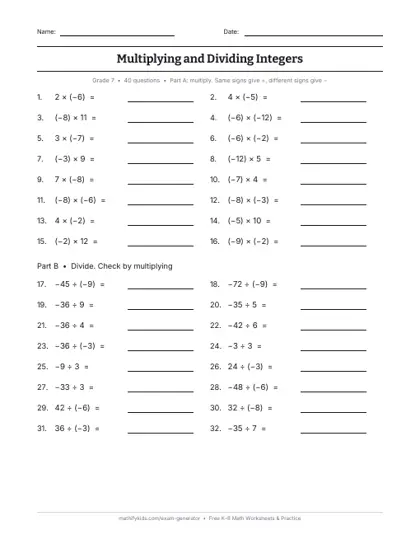
Multiplying and dividing integers worksheet: printable PDF with an answer key. · Make a fresh test
Integer practice · integer calculator · integer number line · integers for kids · ratios · Multiplication practice trainer · 1-minute speed test
Last reviewed
Questions parents ask
What are the integer rules?
Add: same signs add and keep the sign; different signs subtract and keep the bigger size’s sign. Subtract: add the opposite. Multiply and divide: same signs positive, different signs negative.
Do two negatives always make a positive?
Only when multiplying or dividing. When adding, two negatives make a bigger negative.
What is the rule for subtracting integers?
Add the opposite: a − b = a + (−b).
How do you know the sign when multiplying several integers?
Count the negatives. Even gives positive, odd gives negative.
What grade learns integer rules?
Grade 7 under Common Core 7.NS.A.1 and 7.NS.A.2. In India, class 7.