
Absolute value
Absolute value is a number’s distance from 0, so it is never negative: |−7| = 7. Pictures and a quiz for kids, parent help below.
🧒 Kids: how far from zero?
Count the steps from the number to 0. That count is the absolute value. Steps are never negative! Then try the quiz.
💡 Trick: |−7| means “how far is −7 from 0?” It is 7 steps, so |−7| = 7!
More integers: What are integers · Opposite numbers · Absolute value · Comparing integers · Integers on a number line · Zero pairs
This part is for grown-ups: the key idea, pictures to draw, what to say, common mistakes, questions with answers and a free worksheet.
The trick: count the steps to zero
Absolute value measures distance from 0, and a distance is never negative. The bars | | around a number mean “absolute value of”. For a positive number or 0 it stays the same; for a negative number, drop the minus sign.
- |9|: 9
- |−9|: 9
- |0|: 0
- |−3| + |2|: 3 + 2 = 5
Patterns to spot
- Absolute value is never negative.
- Opposites have the same absolute value: |5| = |−5| = 5.
- Only 0 has an absolute value of 0.
- For negative numbers, the bigger the absolute value, the smaller the number.
- Distance between two numbers is the absolute value of their difference: |8 − (−2)| = 10.
- −|4| is −4: the minus sign is outside the bars.
Key words
- Absolute value: a number’s distance from 0. It is never negative.
- | | bars: the symbol for absolute value: |−6| is read “the absolute value of −6”.
- Distance: how far apart two points are. It is always 0 or positive.
- Magnitude: the size of a number without its sign, another word for absolute value.
- Debt: money owed. A balance of −$20 is a debt of $20.
Why it matters: Absolute value lets children talk about size without direction: how deep, how far or how much is owed. It appears again in distance on the coordinate plane, in the rules for adding integers and in algebra.
See it: pictures to draw with your child
Draw these on paper or a whiteboard. A quick sketch makes the idea concrete before any rules.
What your child already knows
Children already know how to count steps on a number line and that distances are always positive. Absolute value just gives that distance from 0 a name and a symbol.
In real life: A diver at −12 m is 12 m deep. A temperature of −8°C is 8 degrees below freezing. A balance of −$25 is a debt of $25. Each time, the absolute value is the size without the direction.
Absolute value vs. order
A bigger absolute value does not always mean a bigger number. −20 has a bigger absolute value than 5, because it is further from 0. But −20 is less than 5.
In real life, ask “how big?” or “how far?” for absolute value. Ask “which is more?” for order.
A debt of $30 is a balance of −30. Its absolute value, 30, is the size of the debt. So a balance less than −30 means a debt greater than $30.
A quick test helps children keep the two ideas apart. Ask “Which number is further from 0?” for absolute value, then “Which number is further right?” for order. For −20 and 5, the answers are different: −20, then 5.
Worked examples
Example 1: Find it
- Find |−15|. −15 is 15 steps from 0.
- So |−15| = 15.
Example 2: Compare sizes
- Which has the greater absolute value, −11 or 8? |−11| = 11 and |8| = 8.
- So −11 has the greater absolute value, even though −11 is less than 8.
Example 3: Real life
- Ana’s account shows −$40.
- Ben’s shows −$15.
- Who owes more? |−40| = 40 and |−15| = 15, so Ana owes more.
Common mistakes
What to say to your child
A short script for your first session. Pause after each line and let your child answer.
- “Put your finger on −6. Count the steps to 0.” (6.)
- “So the absolute value of −6 is 6. We write |−6| = 6.”
- “What is |6|?” (6.)
- “Which is further from 0, −9 or 4?” (−9.)
- “Is −9 bigger than 4, though?” (No, it is less.)
Questions to try (answers below)
Ask these out loud or write them down. The last one is a stretch.
- |−18|
- |25|
- |0|
- |−4| + |−5|
- −|7|
- Which has the greater absolute value: −13 or 10?
- Two numbers have absolute value 6. What are they?
- A diver is at −35 m. How deep is she?
- Stretch: distance from −9 to 5
Show the answers
- 18
- 25
- 0
- 9
- −7
- −13
- 6 and −6
- 35 m
- 14
Games to play at home
Step count
Lay out a number line with tape. Your child stands on a negative number and counts steps to 0.
Deepest dive
Make up depths below sea level and ask who is deepest, using absolute value.
Same distance pairs
Call out an absolute value, like 8. Your child names both numbers with that absolute value.
A 5-day plan for absolute value
Ten minutes a day is enough. Short, regular practice works far better than one long session.
- Day 1: Learn it with real things: a thermometer, coins, a lift or a taped number line, like the pictures above.
- Day 2: Read the script together, then ask the first four questions.
- Day 3: Do the quiz at the top of the page and read the hints for anything missed.
- Day 4: Play one of the games at home for ten minutes.
- Day 5: Ask the rest of the questions, then do a round of the matching integer practice skill.
By grade
Grade 6 (Common Core 6.NS.C.7c and 7d) learns absolute value as distance from 0 and tells it apart from order. Grade 6 also finds distances between points (6.NS.C.8), and grade 7 uses absolute value in subtraction. In India, absolute value appears in class 6 and 7 integers.
More for each grade: Grade 6 math and the CBSE class 6 maths guide.
What comes next
Next, see comparing integers, where absolute value and order meet. Find distances on the integer number line.
Worksheet and more practice
Print a free worksheet with an answer key, or keep practicing online with integer practice.
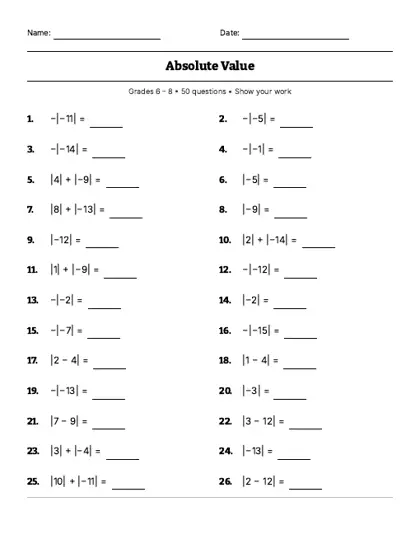 Absolute value
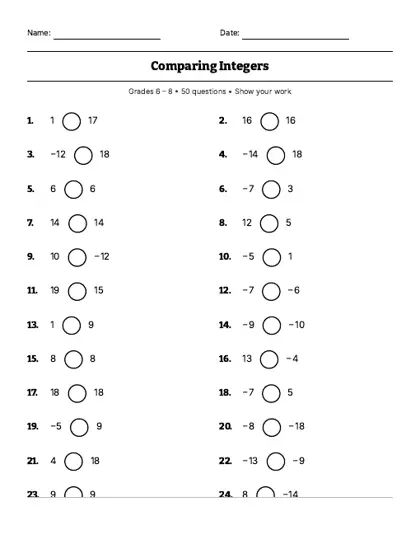 Comparing integers
Printable PDFs: comparing integers · absolute value · adding and subtracting integers · make a fresh integers test
More: integers for kids · integer calculator · integer number line · integer practice · multiplying integers · ratios for kids
Last reviewed
Questions parents ask
What is absolute value?
A number’s distance from 0 on the number line. |−7| = 7 and |7| = 7.
Can absolute value be negative?
No. A distance is never negative, so absolute value is 0 or positive.
What does |−5| mean?
The absolute value of −5, which is 5.
Is a bigger absolute value a bigger number?
Not for negatives. −20 has a bigger absolute value than 5, but −20 is less than 5.
What grade learns absolute value?
Grade 6 under Common Core 6.NS.C.7c. In India, class 6 and 7.