
Zero pairs and integer chips
A zero pair is one positive chip and one negative chip: together they make 0. Pictures and a quiz for kids, parent help below.
🧒 Kids: pair them up!
Yellow chips are +1. Red chips are −1. Ring each yellow with a red: that pair makes 0. Count what is left! Then try the quiz.
💡 Trick: 3 yellow and 5 red: ring 3 pairs, and 2 red are left. That shows −2!
More integers: What are integers · Opposite numbers · Absolute value · Comparing integers · Integers on a number line · Zero pairs
This part is for grown-ups: the key idea, pictures to draw, what to say, common mistakes, questions with answers and a free worksheet.
The trick: ring the pairs, count the rest
Each positive chip is worth +1 and each negative chip is worth −1. A positive and a negative together are worth 0, so you can remove them or add them freely. After removing all the zero pairs, the chips left over give the answer.
- 4 yellow, 1 red: 1 zero pair, 3 yellow left: 3
- 2 yellow, 6 red: 2 zero pairs, 4 red left: −4
- 5 yellow, 5 red: 5 zero pairs, nothing left: 0
- 0 yellow, 3 red: no pairs: −3
Patterns to spot
- Adding a zero pair never changes the value.
- The same number can be shown many ways: 2 yellow, or 3 yellow and 1 red, both show 2.
- When there are more red chips than yellow, the answer is negative.
- Equal numbers of yellow and red chips always show 0.
- Adding a negative is like adding red chips, so the total goes down.
- Subtracting a negative takes red chips away, so the total goes up.
Key words
- Integer chip: a counter worth +1 (yellow) or −1 (red).
- Zero pair: one +1 chip and one −1 chip. Together they are worth 0.
- Cancel: remove zero pairs, because they add nothing to the total.
- Model: a picture or object that shows how the maths works.
- Additive inverse: a number and its opposite, like 3 and −3, which add to 0.
Why it matters: Chips give children something to hold before the rules. Once they see why 3 + (−5) = −2 with chips, the sign rules for adding and subtracting stop being tricks to memorise and start making sense.
See it: pictures to draw with your child
Draw these on paper or a whiteboard. A quick sketch makes the idea concrete before any rules.
What your child already knows
Children already add and take away with counters. They also know that +1 and −1 move in opposite directions. Zero pairs combine those ideas into a model they can hold.
In real life: Earning $1 and spending $1 leaves you where you started: a zero pair. A team that scores 2 and gives away 2 is back to level. These are zero pairs in real life.
Subtracting with chips
To subtract, take chips away. For 5 − 2, start with 5 yellow chips and take 2 away, leaving 3.
Sometimes there are not enough chips to take. For 2 − 5, start with 2 yellow chips. Add 3 zero pairs, which does not change the value. Now take away 5 yellow chips, leaving 3 red chips: −3.
The same trick works for 3 − (−4): add 4 zero pairs, take away 4 red chips, and 7 yellow chips are left. That is why subtracting a negative is like adding.
Worked examples
Example 1: Add two negatives
- Find −2 + (−3).
- Put down 2 red chips, then 3 more red chips.
- There are no yellow chips, so no zero pairs. 5 red chips: −5.
Example 2: Add different signs
- Find 4 + (−7).
- Put down 4 yellow and 7 red chips.
- Ring 4 zero pairs. 3 red chips are left: −3.
Example 3: Subtract with zero pairs
- Find 1 − 4.
- Start with 1 yellow chip.
- Add 3 zero pairs so there are 4 yellow chips.
- Take 4 yellow away. 3 red chips are left: −3.
Common mistakes
What to say to your child
A short script for your first session. Pause after each line and let your child answer.
- “Each yellow chip is +1. Each red chip is −1.”
- “What is one yellow and one red together?” (0.)
- “Here are 3 yellow and 5 red. Ring the pairs.” (3 pairs.)
- “What is left?” (2 red.)
- “So the chips show −2.”
Questions to try (answers below)
Ask these out loud or write them down. The last one is a stretch.
- 5 yellow and 2 red chips
- 1 yellow and 6 red chips
- 4 yellow and 4 red chips
- −3 + 5 with chips
- 2 + (−6) with chips
- −4 + (−2) with chips
- Show 3 with 5 yellow chips. How many red?
- How many zero pairs in 7 yellow and 3 red?
- Stretch: 2 − (−3) with chips
Show the answers
- 3
- −5
- 0
- 2
- −4
- −6
- 2
- 3
- 5
Games to play at home
Coin chips
Use two kinds of coins or buttons as + and − chips and make zero pairs.
Chip race
Roll a die for yellow chips and another for red. Who has the biggest value after pairs cancel?
Build it three ways
Pick a number like −2 and show it with three different sets of chips.
A 5-day plan for zero pairs
Ten minutes a day is enough. Short, regular practice works far better than one long session.
- Day 1: Learn it with real things: a thermometer, coins, a lift or a taped number line, like the pictures above.
- Day 2: Read the script together, then ask the first four questions.
- Day 3: Do the quiz at the top of the page and read the hints for anything missed.
- Day 4: Play one of the games at home for ten minutes.
- Day 5: Ask the rest of the questions, then do a round of the matching integer practice skill.
By grade
Grade 7 (Common Core 7.NS.A.1a and 7.NS.A.1b) uses models like chips to show that a number and its opposite make 0, and to add and subtract integers. Some grade 6 classes meet chips early. In India, chips or counters are used in class 6 and 7 integers.
More for each grade: Grade 6 math and the CBSE class 6 maths guide; Grade 7 math and the CBSE class 7 maths guide.
What comes next
Next, add and subtract with the integer calculator, which draws chips and number line jumps. Then try zero pair practice.
Worksheet and more practice
Print a free worksheet with an answer key, or keep practicing online with integer practice.
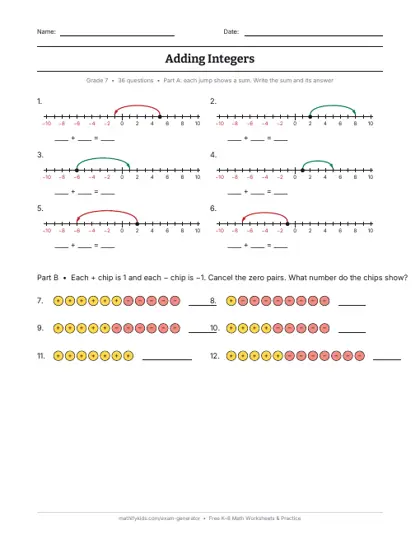 Adding integers
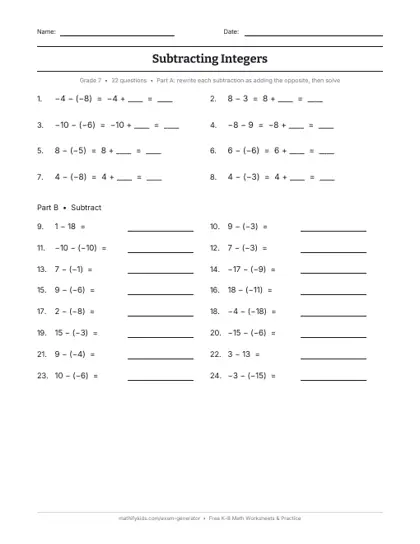 Subtracting integers
Printable PDFs: comparing integers · absolute value · adding and subtracting integers · make a fresh integers test
More: integers for kids · integer calculator · integer number line · integer practice · multiplying integers · ratios for kids
Last reviewed
Questions parents ask
What is a zero pair?
One positive and one negative counter. Together they are worth 0.
What are integer chips?
Two-colour counters: one colour is +1 and the other is −1. They model integers and integer sums.
How do zero pairs help you add integers?
Put down both numbers as chips, remove the zero pairs and count what is left.
Why can you add zero pairs when subtracting?
A zero pair is worth 0, so it doesn’t change the value. It gives you chips to take away.
What grade learns zero pairs?
Grade 7 under Common Core 7.NS.A.1. In India, class 6 and 7.