
Percentages for kids
A percent is a number out of 100. This page covers everything children learn about percentages in grades 6 and 7: what percent means, the three kinds of percent question, quick mental tricks, tax, tips, discounts and percent change, with pictures, a converter and printable worksheets.
What kids learn about percentages, grade by grade
- Grade 4 and 5: the groundwork. Fractions out of 100 and decimals to hundredths (4.NF.C.6).
- Grade 6 (6.RP.A.3c): percent as a rate per 100, finding a percent of a number, and finding the whole when you know a part and the percent.
- Grade 7 (7.RP.A.3): multi-step percent problems with sales tax, tips, discounts, markups, simple interest and percent increase and decrease.
Where to start with percentages
Start with 100 squares, money and the easy percents: 50% is half, 25% is a quarter, 10% is a tenth. Once those feel natural, every other percent can be built from them, and the formal methods make sense.
The big idea behind percentages
Percent means per hundred. A percent compares any amount to 100, so different-sized things can be compared fairly. 18 out of 24 and 30 out of 40 are hard to compare, but 75% and 75% are obviously the same.
The three kinds of percent question
Almost every percent problem is one of these three. Spotting which one it is solves half the problem.
| Question | You know | Method | Example |
|---|---|---|---|
| Find the part | Percent and whole | percent × whole | 25% of 80 = 0.25 × 80 = 20 |
| Find the percent | Part and whole | part ÷ whole × 100 | 18 of 24 = 18 ÷ 24 = 75% |
| Find the whole | Part and percent | part ÷ percent | 8 is 5% of 8 ÷ 0.05 = 160 |
Percent tricks for mental math
- 10%: move the decimal point one place left. 10% of 340 = 34.
- 5%: half of 10%. 5% of 340 = 17.
- 20%, 30%…: multiples of 10%. 30% of 340 = 3 × 34 = 102.
- 15% tip: 10% plus half of it. On a $40 bill: $4 + $2 = $6.
- Flip it: 8% of 25 is the same as 25% of 8, which is 2.
Percent converter
Type a percent or a decimal to see the other, the fraction and a shaded grid.
Where kids get stuck with percentages
Using the wrong number as the whole
In “18 out of 24”, the whole is 24. In percent change, the whole is always the original amount, not the new one. Ask: “percent of what?”
7% written as 0.7
Percent to decimal always moves two places: 0.07. See converting percents and decimals.
Adding percents that don’t add
A 20% rise then a 20% fall doesn’t get back to the start: 100 → 120 → 96. Each percent is of a different whole.
Mixing up “percent of” and “percent off”
20% of $50 is $10. 20% off $50 leaves $40. Underline the small word before working anything out.
Percentages lessons, in order
Percentages worksheets
Printable PDFs with answer keys, covering all three kinds of question and grade 7 word problems. Make a fresh percent test or a percent change test.
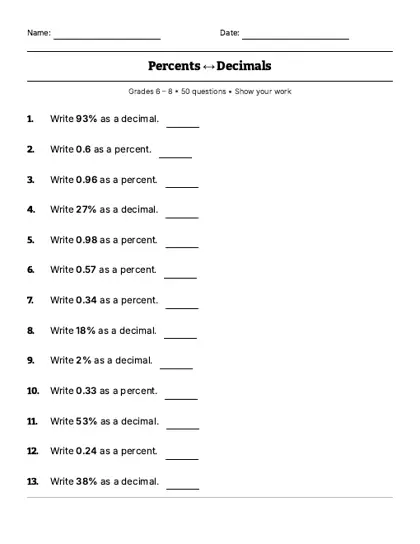 Percents and decimalsGrade 6 · converting
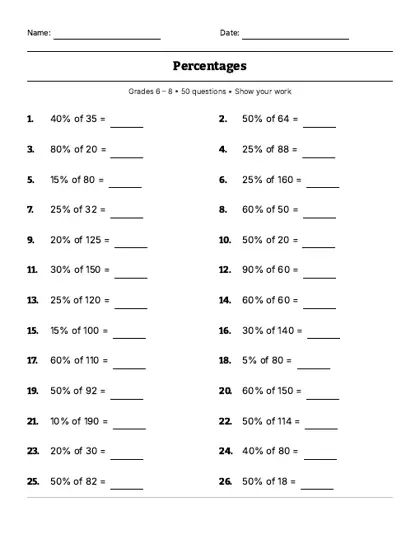 Percent of a numberGrade 6 · find the part
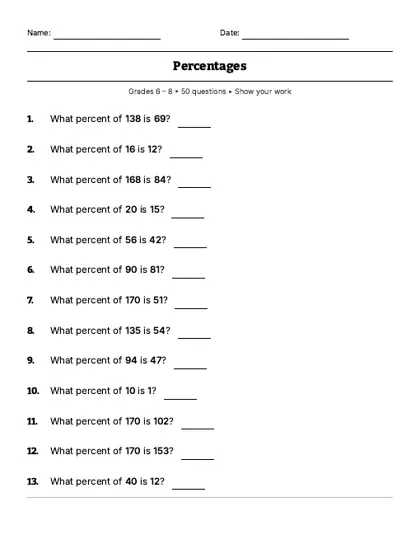 Finding the percentGrade 6 · what percent?
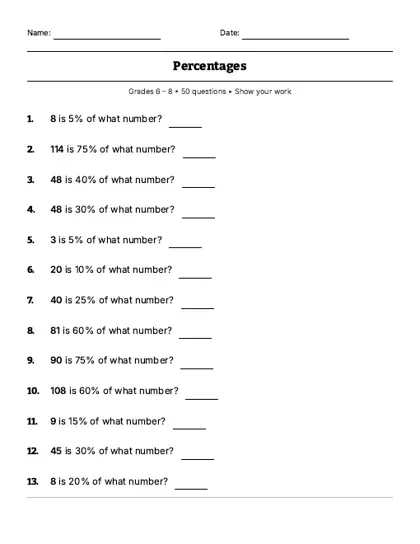 Finding the wholeGrade 6 · of what number?
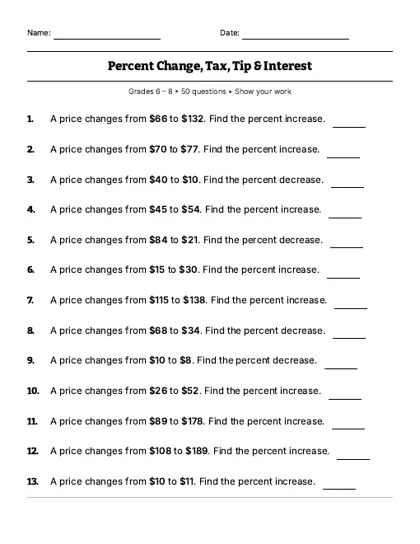 Percent changeGrade 7 · increase and decrease
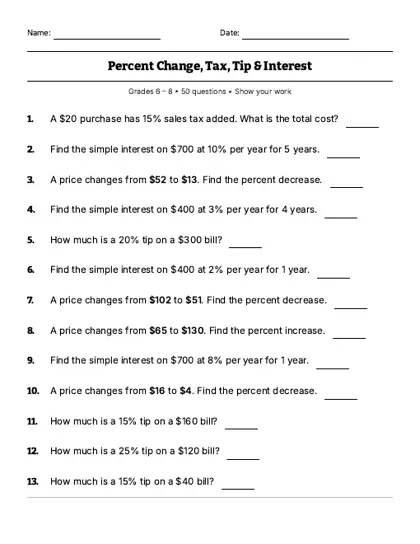 Tax, tip and interestGrade 7 · word problems
How to teach percentages at home
Shop the sales
Next time you see “30% off”, ask your child to work out the new price before you reach the till. Clothes and electronics give good round numbers.
Let them work out the tip
At a restaurant, the 10% and half-of-it trick gives a 15% tip in seconds. It is real, useful and quick.
Watch the battery
Phones and tablets show battery as a percent. “It’s at 60% and drops 5% an hour. How long until it’s at 20%?”
Score sports and tests
Free throws made, goals saved or test marks: turn each into a percent and compare. Was 9 out of 12 better than 14 out of 20? (75% vs 70%.)
Last reviewed
Questions parents ask
What does percent mean?
Percent means “out of 100”. 40% means 40 out of every 100, which is the same as 40/100 or 0.4.
How do you find a percent of a number?
Change the percent to a decimal and multiply. 25% of 80 = 0.25 × 80 = 20. For easy percents use fractions: 25% is a quarter, so a quarter of 80 is 20.
How do you work out what percent one number is of another?
Divide the part by the whole and multiply by 100. 18 out of 24 is 18 ÷ 24 = 0.75, which is 75%.
What is 10% of a number?
Move the decimal point one place left. 10% of 340 is 34. Then 20% is double that (68) and 5% is half (17), which makes most percents easy to work out in your head.
How do you calculate percent change?
Find the change, divide by the original amount, then multiply by 100. A price going from $50 to $60 changes by $10, and 10 ÷ 50 = 0.2, so it is a 20% increase.
What grade learns percentages?
Grade 6 introduces percent as a rate per 100 and finding a percent of a number (6.RP.A.3c). Grade 7 uses percents for tax, tips, discounts, interest and percent change (7.RP.A.3).