
Unit rates
A unit rate is the amount for 1, like 50 miles per hour or $2 per pound. Divide to find it. A quiz for kids, parent help below.
🧒 Kids: find the amount for 1!
A unit rate tells you how much for just one. Divide to share it out. Then try the quiz!
💡 Trick: 150 miles in 3 hours: 150 ÷ 3 = 50 miles in 1 hour!
More ratios: What is a ratio · Equivalent ratios · Simplifying ratios · Ratio tables · Tape diagrams · Unit rates
This part is for grown-ups: the key idea, pictures to draw, what to say, common mistakes, questions with answers and a free worksheet.
The trick: divide to find the amount for 1
A rate compares two different kinds of amount, like miles and hours. The unit rate is the amount for 1 of the second kind. Divide the first amount by the second.
- 150 miles in 3 hours: 50 miles per hour
- $12 for 4 pounds: $3 per pound
- 240 words in 4 minutes: 60 words per minute
- $7 for 2 kg: $3.50 per kg
Patterns to spot
- The word per means for each one.
- A unit rate is the row for 1 in a ratio table.
- Every rate has two unit rates: miles per hour and hours per mile.
- Multiply the unit rate to find any amount: 50 × 5 = 250 miles in 5 hours.
- A lower price per unit means a better buy.
- Unit rates can be decimals or fractions, like 2.5 pages per minute.
See it: pictures to draw with your child
Draw these on paper or a whiteboard. A quick sketch makes the idea concrete before any rules.
What your child already knows
Children already know division as sharing equally and have met ratios and ratio tables. A unit rate is the result of sharing one amount equally across units of another.
In real life: Speed limits, shelf labels, pay and data plans all use unit rates. Think of miles per hour, price per ounce and dollars per hour. Ask your child to find one on a shelf label next time you shop.
Using unit rates to compare
Unit rates make comparisons fair. Car A goes 150 miles in 3 hours, and car B goes 220 miles in 4 hours. Which is faster?
Car A: 150 ÷ 3 = 50 miles per hour. Car B: 220 ÷ 4 = 55 miles per hour. Car B is faster.
The same idea finds the best buy in a shop. The unit rate calculator compares any two deals.
Worked examples
Example 1: Speed
- A train goes 360 km in 4 hours.
- Divide: 360 ÷ 4 = 90.
- The unit rate is 90 km per hour.
Example 2: Unit price
- 5 notebooks cost $8.50.
- Divide: $8.50 ÷ 5 = $1.70.
- Each notebook costs $1.70.
Example 3: Use the unit rate
- Sam reads 12 pages in 3 days.
- That is 4 pages per day.
- In 10 days he reads 4 × 10 = 40 pages.
Common mistakes
What to say to your child
A short script for your first session. Pause after each line and let your child answer.
- “A car goes 150 miles in 3 hours. How far in 1 hour?” (50 miles.)
- “So the unit rate is 50 miles per hour. What does per mean?” (For each.)
- “How far in 5 hours?” (250 miles.)
- “4 pounds of apples cost $12. What is the price for 1 pound?” (3 dollars.)
- “Which is the better buy, $3 per pound or $2.50 per pound?” (The $2.50 one.)
Questions to try (answers below)
Ask these out loud or write them down. The last one is a stretch.
- 120 miles in 2 hours. Miles per hour?
- $15 for 5 pens. Price per pen?
- 300 words in 5 minutes. Words per minute?
- 18 litres in 6 minutes. Litres per minute?
- $9 for 2 pounds. Price per pound?
- A runner does 3 laps per minute. Laps in 8 minutes?
- $4 for 8 oz or $5 for 10 oz. Better buy?
- 45 pages in 9 days. Pages per day?
- Stretch: 1/2 mile in 1/4 hour. Miles per hour?
Show the answers
- 60
- $3
- 60
- 3
- $4.50
- 24
- Same price per ounce: 50 cents
- 5
- 2
Games to play at home
Shelf detective
Find the unit price label on three products and compare them.
Timed reading
Count words read in 2 minutes and find words per minute.
Walking speed
Time a walk around the block and work out metres per minute.
A 5-day plan for unit rates
Ten minutes a day is enough. Short, regular practice works far better than one long session.
- Day 1: Learn it with real things: counters, snacks, a recipe or a price label, like the pictures above.
- Day 2: Read the script together, then ask the first four questions.
- Day 3: Do the quiz at the top of the page and read the hints for anything missed.
- Day 4: Play one of the games at home for ten minutes.
- Day 5: Ask the rest of the questions, then do a round of the matching ratio practice skill.
By grade
Grade 6 (Common Core 6.RP.A.2 and 6.RP.A.3b) learns unit rates, unit prices and constant speed. Grade 7 (7.RP.A.1) finds unit rates from fractions. In India, the unitary method in classes 6 to 8 is the same idea: find the value of one, then of many.
More for each grade: Grade 6 math and the CBSE class 6 maths guide.
What comes next
Next, use unit rates for percents, which are rates per 100. Compare deals with the unit rate calculator, or practice with unit rate practice.
Worksheet and more practice
Print a free worksheet with an answer key, or keep practicing online with ratio practice.
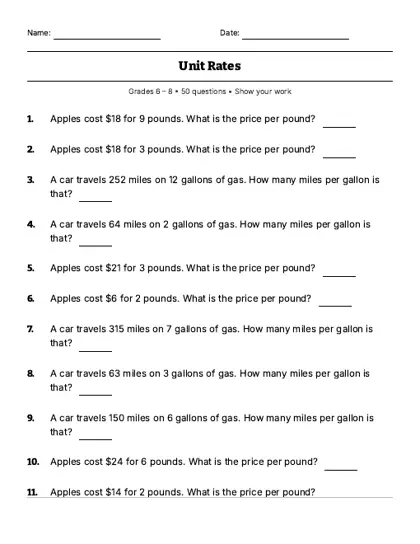 Unit rates
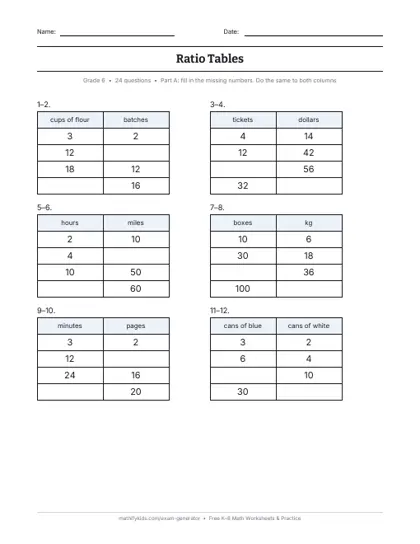 Ratio tables
Printable PDFs: ratios worksheet · unit rates worksheet · make a fresh ratio test
More: ratios for kids · ratio calculator · unit rate calculator · ratio practice · percentages for kids · fractions for kids
Last reviewed
Questions parents ask
What is a unit rate?
The amount for 1 of something, like 50 miles per hour or $3 per pound.
How do you find a unit rate?
Divide the first amount by the second. 150 miles ÷ 3 hours = 50 miles per hour.
What is a unit price?
A unit rate for money: the price for 1 item, 1 ounce or 1 kilogram.
How do you use unit rates to find the best buy?
Find the unit price of each option. The lower price per unit is the better buy.
What grade learns unit rates?
Grade 6 under Common Core 6.RP.A.2. In India, the unitary method in classes 6 to 8.