
6th grade math
Sixth grade is the start of middle school math: ratios and rates, percents, negative numbers, dividing fractions, and the first real algebra with expressions and one-step equations. This page lists every skill in order, what mastery looks like, signs a child needs help, and free 6th grade worksheets and lessons.
What 6th graders learn in math
The Common Core focuses grade 6 on four ideas: ratios and rates (including percents), dividing fractions and fluent decimal arithmetic, negative numbers on the number line, and expressions and equations with letters. It also covers area of triangles, surface area and statistics.
Fractions and times tables from elementary school carry the weight here. A child who is shaky with equivalent fractions will find ratios and percents much harder.
6th grade math skills, in order
Ratios and proportional relationships
Ratios and ratio tables, unit rates (like miles per hour and price per ounce), and percents as a rate per 100: finding a percent of a number and finding the whole.
The number system
Dividing fractions by fractions, fluent multi-digit division and decimal arithmetic, GCF and LCM, negative numbers on the number line, absolute value, and all four quadrants of the coordinate plane.
Expressions and equations
Exponents, the order of operations, writing and evaluating expressions with variables, equivalent expressions (the distributive property), and solving one-step equations and inequalities.
Geometry
Area of triangles, parallelograms and other polygons, volume with fractional edges, nets and surface area, and drawing polygons on the coordinate plane.
Statistics
Statistical questions, mean, median, mode and range, dot plots, histograms and box plots.
What mastery looks like by the end of the year
- Uses a ratio table to answer “if 3 notebooks cost $4.50, how much do 7 cost?”
- Finds 15% of 60 and works out what percent 18 is of 24.
- Divides fractions, such as 3/4 ÷ 1/8 = 6, and explains what the answer means.
- Places −3 and 2 on a number line and knows −3 is less than 2.
- Solves one-step equations like x + 7 = 15 and 4x = 36.
- Finds the area of a triangle as half of base × height.
Signs your child needs extra help
- Fractions are still guesswork, so ratios and percents feel random.
- Uses the wrong number as the whole in percent problems.
- Thinks −8 is bigger than −3.
- Can follow the order of operations only with a rhyme and gets 2 + 3 × 4 = 20.
- Avoids word problems or can’t say what a unit rate means.
Most grade 6 trouble traces back to fractions and division. The grades 4–5 mixed review, or the fractions section, is the quickest way to find and fix the gap.
Try a 6th grade math problem
Tap a question to see the answer and how to get it.
3 notebooks cost $4.50. How much do 7 cost?
$10.50. One costs $1.50 (the unit rate), so 7 cost 7 × $1.50.
What is 15% of 60?
9. 10% is 6 and 5% is 3, so 15% is 9.
What is 3/4 ÷ 1/8?
6. Six eighths fit into three quarters.
Which is smaller, −8 or −3?
−8. It is further left on the number line.
Solve 4x = 36.
x = 9. Divide both sides by 4.
What is 2 + 3 × 4?
14. Multiply before adding: 3 × 4 = 12, then 2 + 12.
6th grade math worksheets
Each one is a free PDF with an answer key and its own page with a preview, tips and a button to make a new version.
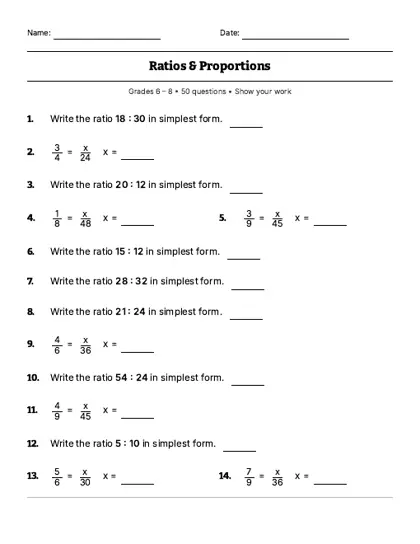 RatiosGrade 6
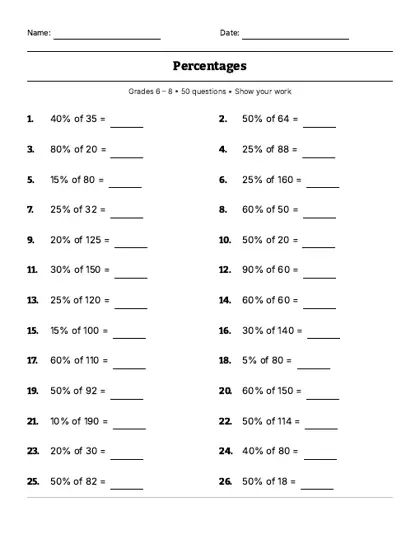 Percent of a numberGrade 6
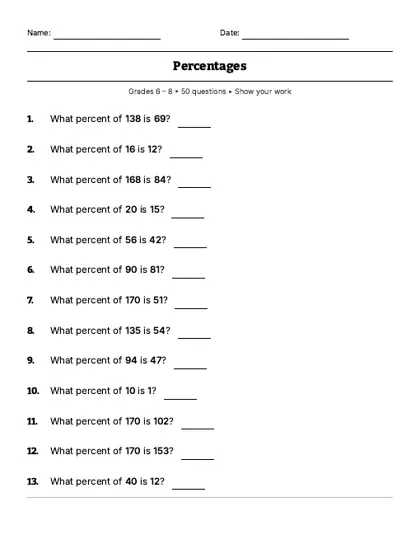 Finding the percentGrade 6
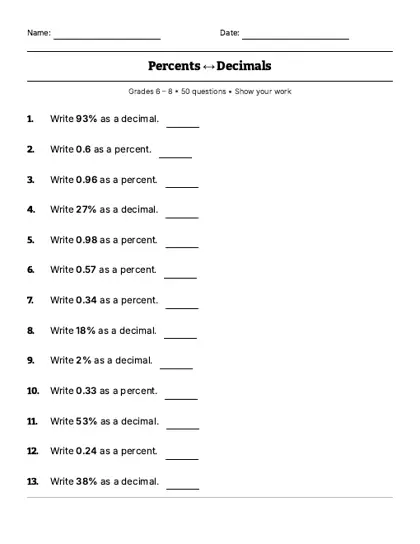 Percent to decimalGrade 6
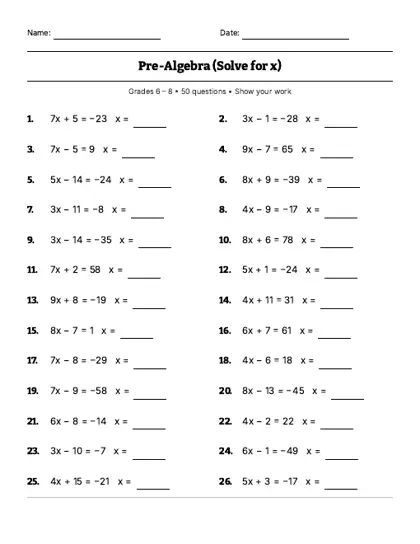 Solving equationsGrades 6–7
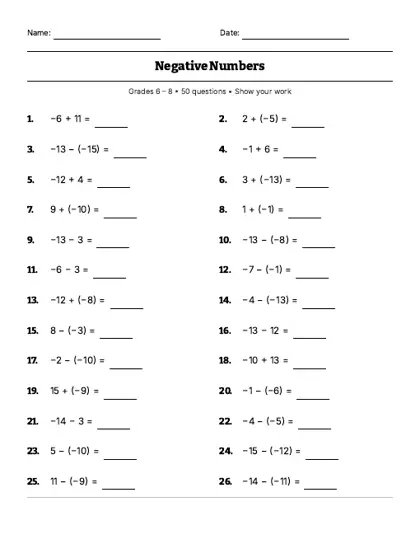 Adding and subtracting integersGrade 7
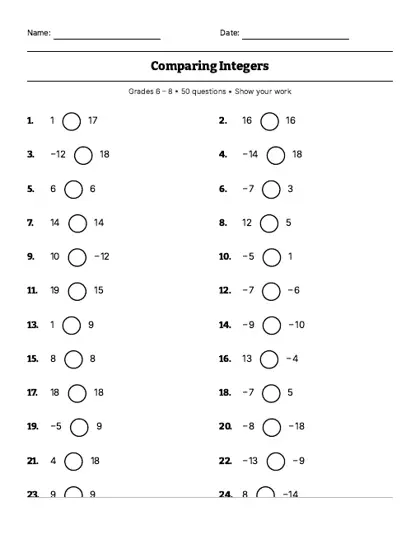 Comparing integersGrade 6
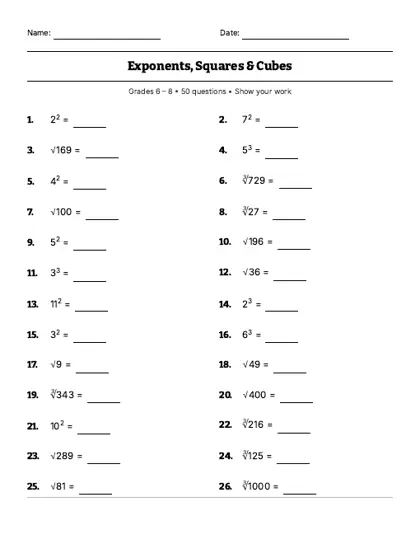 ExponentsGrade 6
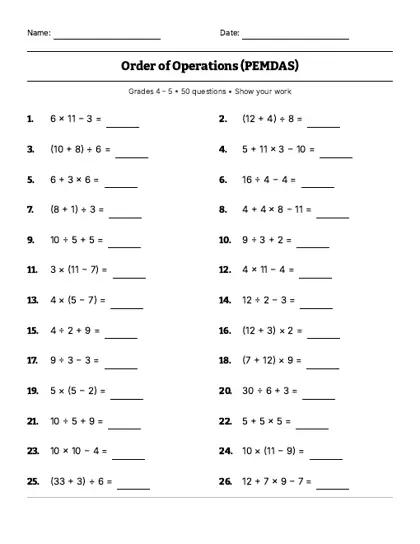 Order of operationsGrades 5–6
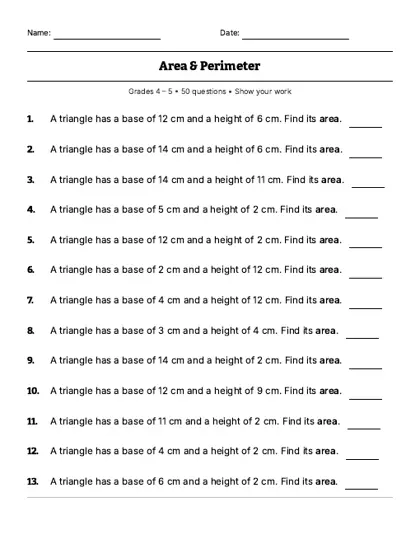 Area of trianglesGrade 6
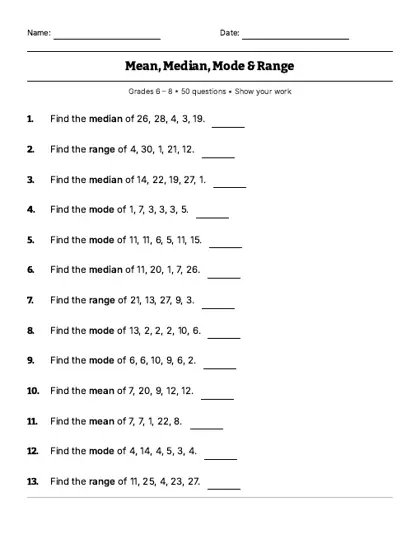 Mean, median, mode and rangeGrade 6
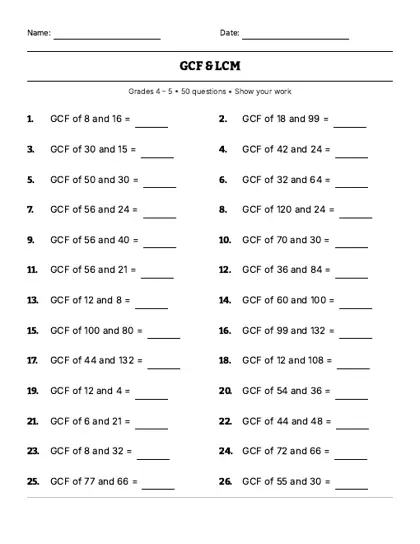 Greatest common factorGrade 6
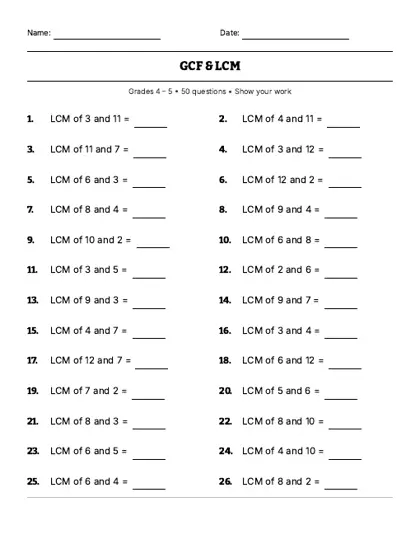 Least common multipleGrade 6
More 6th grade PDFs
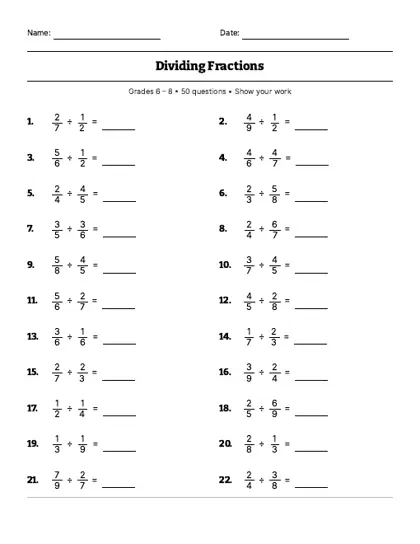 Dividing fractionsGrade 6
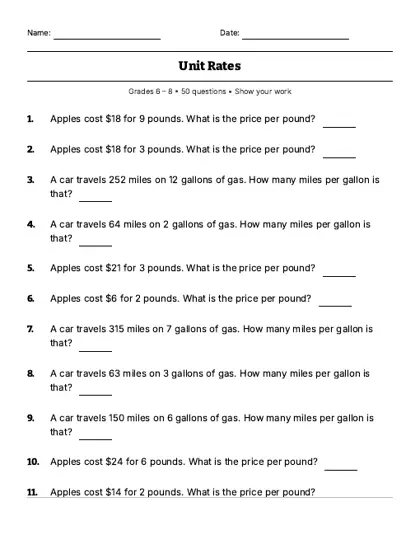 Unit ratesGrade 6
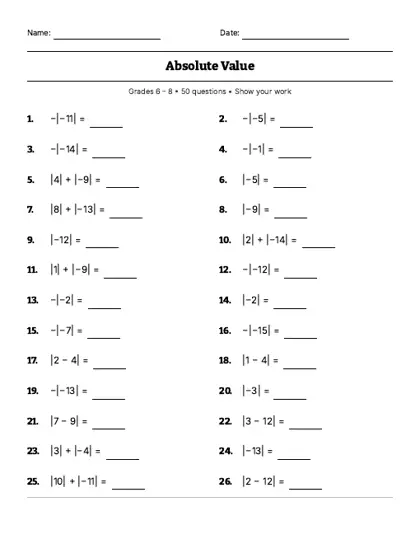 Absolute valueGrade 6
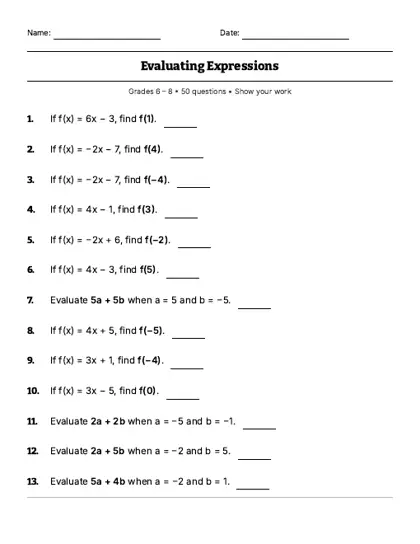 Evaluating expressionsGrade 6
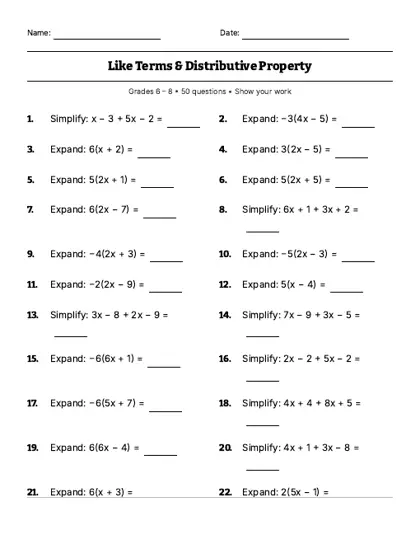 Like terms and distributive propertyGrades 6–7
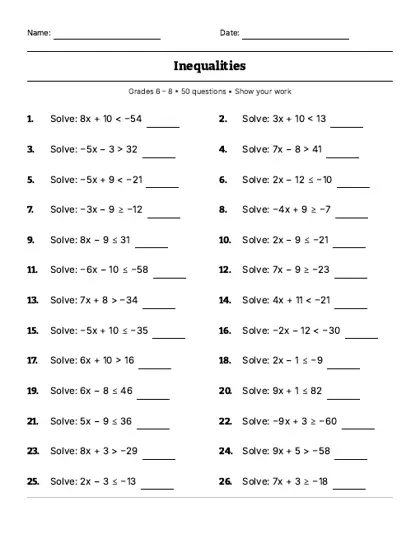 InequalitiesGrades 6–7
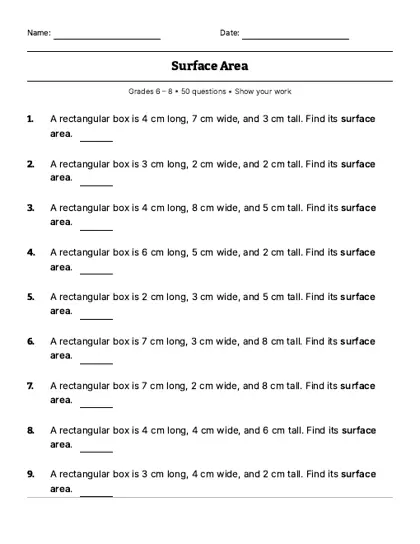 Surface areaGrade 6
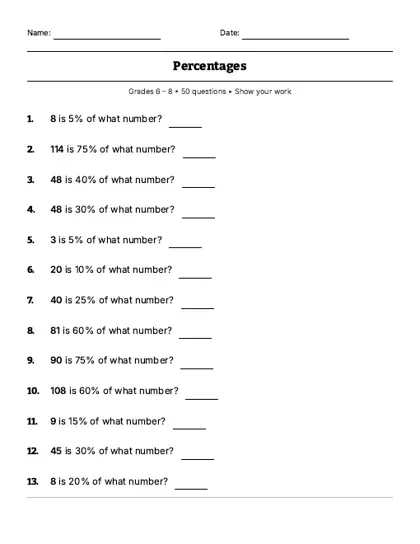 Finding the wholeGrade 6
6th grade math lessons and charts
- Ratios and ratesRatio tables and unit rates
- PercentagesThe three kinds of question
- IntegersNegative numbers
- EquationsOne-step and two-step
- ExponentsPowers and squares
- Order of operationsPEMDAS
- Mean, median, modeDescribing data
- Coordinate planeFour quadrants
How to help with 6th grade math at home
Compare prices per unit
At the store, compare a 12 oz box for $3.60 with an 18 oz box for $4.86. Which is cheaper per ounce? (30¢ vs 27¢.)
Work out discounts and tips
Use the 10% trick for sales and restaurant tips. It turns percents into something useful.
Talk about temperatures
Below-zero temperatures and sea level are natural ways into negative numbers.
Write rules with letters
“Each pizza costs $12, so p pizzas cost 12p.” Turning everyday rules into expressions is the heart of grade 6 algebra.
See 5th grade math for the skills that lead into this year, and 7th grade math for what comes next.
Last reviewed
Questions parents ask
What math do 6th graders learn?
Ratios, rates and percents, dividing fractions, negative numbers and absolute value, expressions and one-step equations, exponents and the order of operations, area and surface area, and statistics.
Is 6th grade math pre-algebra?
Partly. Grade 6 starts algebra with expressions, variables and one-step equations. Full pre-algebra topics like multi-step equations and slope come in grades 7 and 8.
What is a ratio in 6th grade math?
A comparison of two amounts, like 3 cups of flour to 2 cups of sugar (3:2). Grade 6 uses ratio tables and unit rates to solve problems with them.
How can I help my 6th grader with math?
Make sure fractions are secure, use real prices and recipes for ratios, and ask your child to explain their steps out loud.
What is the hardest part of 6th grade math?
For many students it is ratios and percents, because they combine fractions, division and reasoning. Dividing fractions is a close second.
My child is behind in 6th grade math. Where do I start?
Usually with fractions and division from grades 4 and 5. The grades 4–5 mixed review is a quick way to find the gap.