
Integers for kids
Integers are whole numbers and their negatives: …, −3, −2, −1, 0, 1, 2, 3, … This page explains negative numbers with the number line, shows how to compare them and how to add, subtract, multiply and divide them, where kids get stuck, and has an interactive number line and printable worksheets.
What kids learn about integers, grade by grade
- Grade 6 (6.NS.C.5 to 6.NS.C.7): what negative numbers mean in real life, placing them on a number line, comparing and ordering them, and absolute value as distance from zero.
- Grade 7 (7.NS.A.1, 7.NS.A.2): adding, subtracting, multiplying and dividing integers, and using them in word problems.
- Grade 8 and beyond: integers appear everywhere, from solving equations to slope and the coordinate plane.
Where to start with integers
Start with real situations children already know: temperatures below zero, floors below ground in a lift, money owed. Then draw the number line with zero in the middle. Every rule for integers can be seen as a movement on that line.
The big idea behind integers
Negative numbers are the mirror image of positive numbers on the other side of zero. −5 is as far from zero as 5, just in the opposite direction. Adding moves right; subtracting moves left.
Comparing integers and absolute value
On a number line, the number further to the right is always bigger. So 2 > −5, and −3 > −8. That second one surprises children: −8 has a bigger digit, but it is further below zero, like −8 °C being colder than −3 °C.
Absolute value is the distance from zero, ignoring direction. |−6| = 6 and |6| = 6. A diver 6 m below the surface and a bird 6 m above it are the same distance from sea level.
Integer number line: see any sum or difference
Choose a start, add or subtract, and a number (it can be negative). The line shows the jump and explains it.
The rules for adding, subtracting, multiplying and dividing integers
| Operation | Rule | Example |
|---|---|---|
| Add, same signs | Add and keep the sign | −4 + −3 = −7 |
| Add, different signs | Subtract, keep the sign of the bigger number | −9 + 4 = −5 |
| Subtract | Add the opposite | 5 − (−2) = 5 + 2 = 7 |
| Multiply or divide, same signs | Answer is positive | −6 × −2 = 12 |
| Multiply or divide, different signs | Answer is negative | −12 ÷ 3 = −4 |
Learn the number line first and the rules second. A child who pictures −9 + 4 as “start at −9, move 4 right” doesn’t need to remember which sign to keep.
Where kids get stuck with integers
How to teach integers at home
Read the thermometer
Weather apps show negative temperatures in winter. Ask how much warmer tomorrow will be if it goes from −4 °C to 3 °C (7 degrees).
Play the elevator game
Ground floor is 0, basements are negative. “You’re on floor −2 and go up 5. Where are you?” Children love being the lift.
Money in, money out
Keep a pretend bank balance with chips: earnings are positive, spending and debts are negative. Cancelling a debt shows why subtracting a negative adds.
A number line on the stairs
Tape numbers on stairs or floor tiles with zero in the middle and walk the problems.
Integers worksheets
Printable PDFs with answer keys. The first two have their own pages: comparing integers and adding and subtracting integers.
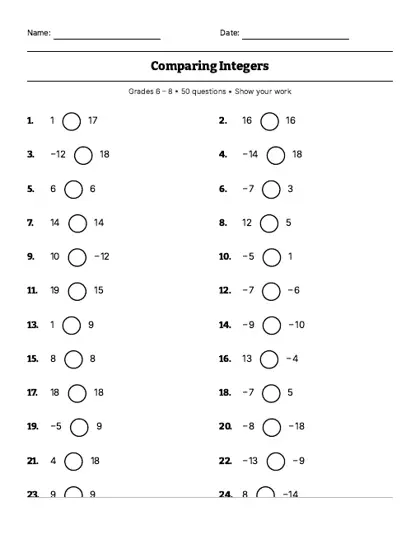 Comparing integersGrade 6 · 50 questions + key
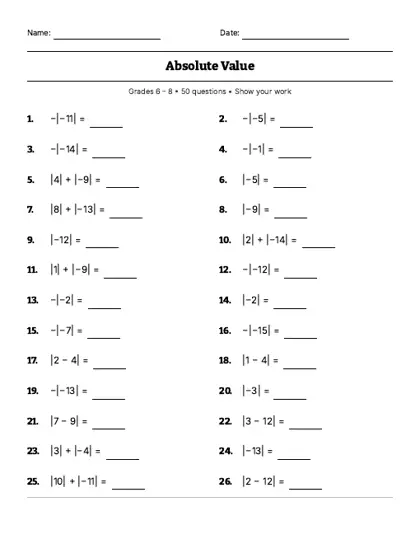 Absolute valueGrade 6 · 50 questions + key
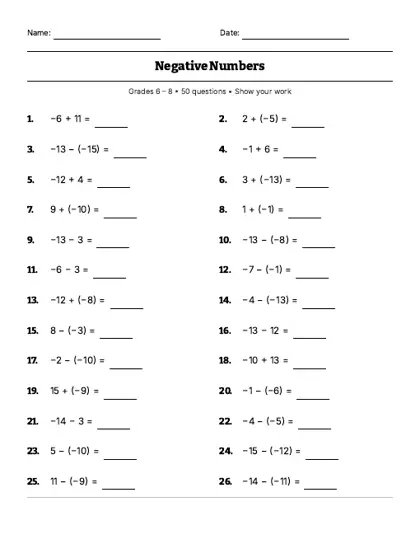 Adding and subtracting integersGrade 7 · 50 questions + key
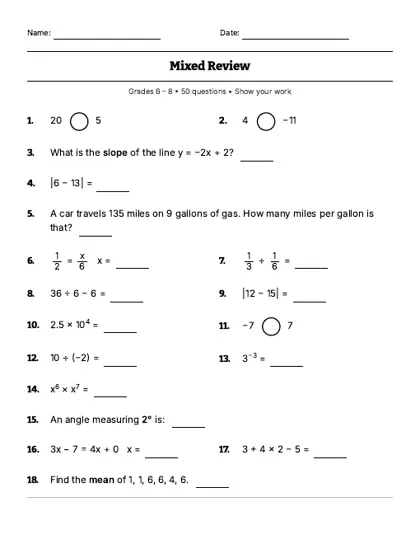 Mixed review, grades 6–8Check for gaps
Make a fresh integers test · Make a comparing integers test · Make an absolute value test
Related topics
Last reviewed
Questions parents ask
What are integers?
Integers are the whole numbers, their negatives and zero: …, −3, −2, −1, 0, 1, 2, 3, … They don’t include fractions or decimals.
Is −8 bigger than −3?
No. −3 is bigger, because it is further to the right on the number line. For negative numbers, the one closer to zero is the larger one: −3 °C is warmer than −8 °C.
What is −3 − 5?
−8. Start at −3 and move 5 to the left. Subtracting a positive number always moves left on the number line.
Why is subtracting a negative the same as adding?
Taking away a debt leaves you better off. If you owe $5 and the debt is cancelled, you are $5 up: 2 − (−5) = 2 + 5 = 7.
What is the rule for multiplying negative numbers?
Same signs give a positive answer and different signs give a negative answer: −4 × −3 = 12, but −4 × 3 = −12. The same rule works for division.
What grade learns negative numbers?
Grade 6 introduces negative numbers, ordering, the number line and absolute value (6.NS.C.5 to 6.NS.C.7). Grade 7 adds, subtracts, multiplies and divides them (7.NS.A.1 and 7.NS.A.2).