
Multiplication for kids
Multiplication is counting equal groups quickly. Children meet it as arrays in grade 2, learn the times tables in grade 3, and multiply multi-digit numbers in grades 4 and 5. This page lays out the whole path, explains the ideas with arrays and area models, has an array explorer, shows where kids get stuck, and links every multiplication lesson and worksheet.
What kids learn about multiplication, grade by grade
- Grade 2 (2.OA.C.3, 2.OA.C.4): equal groups, odd and even, and arrays up to 5 × 5 written as repeated addition.
- Grade 3 (3.OA.A.1 to 3.OA.C.7): what multiplication means, its properties, and all times tables to 10 × 10 from memory. Also multiplying by multiples of 10.
- Grade 4 (4.NBT.B.5): up to 4 digits by 1 digit and 2 digits by 2 digits, using place value and the area model.
- Grade 5 (5.NBT.B.5): multi-digit multiplication with the standard method, plus decimals and fractions.
Where to start with multiplication
With equal groups of real things: 3 plates of 4 cookies, egg cartons, pairs of socks. Count them by adding, then show the shortcut: 3 × 4. Only start memorizing facts once the meaning is clear.
The big idea behind multiplication
4 × 6 means 4 equal groups of 6. Arranged in rows, that is an array: 4 rows of 6 dots. Arrays show three things at once: why 4 × 6 = 6 × 4 (turn the picture), how multiplication and division are linked, and later why area is length × width.
Array explorer
Drag the sliders to build any times table fact up to 12 × 12. Press “Turn it” to see the same dots the other way.
Learning the times tables
There are 100 facts up to 10 × 10, but far fewer to learn than it seems:
- × 1, × 2, × 5 and × 10 follow easy patterns: same number, doubles, ends in 0 or 5, add a zero.
- Turn-arounds: 3 × 8 = 8 × 3, so every fact you learn gives you another one.
- × 4 is double-double; × 8 is double-double-double.
- × 9: the digits add to 9 (9 × 7 = 63), and one less than the multiplier is the tens digit.
- That leaves only a handful of hard facts: 6 × 7, 6 × 8, 7 × 8 and their turn-arounds.
Five minutes a day beats an hour on Sunday. The times tables lesson has the full plan.
Multiplying bigger numbers
Bigger numbers are split into tens and ones, multiplied in parts and added. The area model shows every part, and the written method is a shorthand for the same steps.
Where kids get stuck with multiplication
Counting instead of knowing
Skip-counting up to 7 × 8 every time is slow and error-prone. Fix: learn the hard facts with a strategy (7 × 8: 5, 6, 7, 8 → 56), then practice them daily.
Losing the zero in bigger numbers
34 × 26 worked as 34 × 2 instead of 34 × 20. Fix: say the place value: “34 times 2 tens is 68 tens, which is 680.”
Mixing up multiplication and addition
3 × 4 answered as 7. Fix: go back to groups. Three plates of four is not seven cookies.
Forgetting carried digits
In 47 × 6, 7 × 6 = 42: write 2, carry 4. Fix: write the carried digit small above the next column and add it after multiplying.
Multiplication lessons, in order
Multiplication worksheets
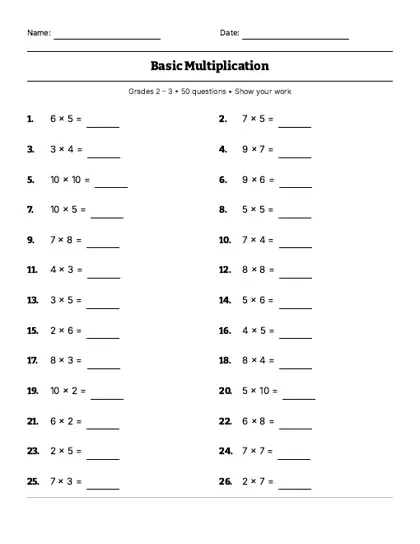 Multiplication factsGrade 3
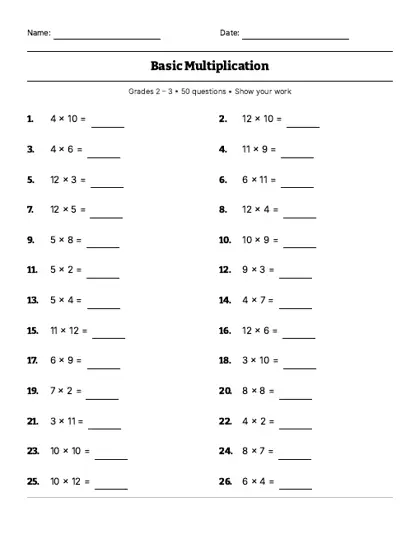 Mixed times tablesGrades 3–4
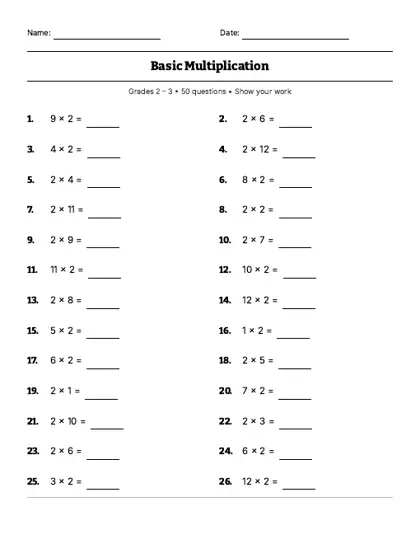 2 times tableGrade 3
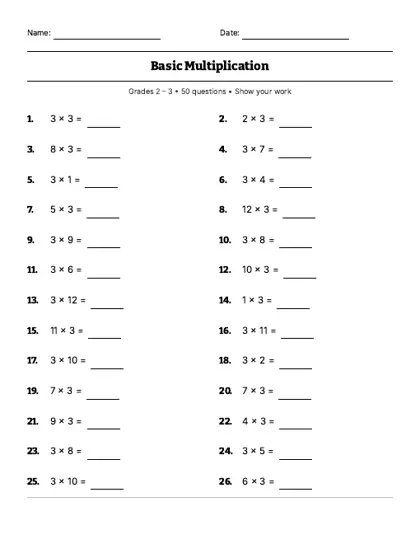 3 times tableGrade 3
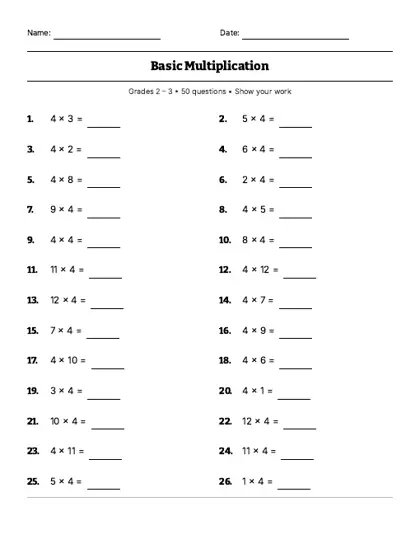 4 times tableGrade 3
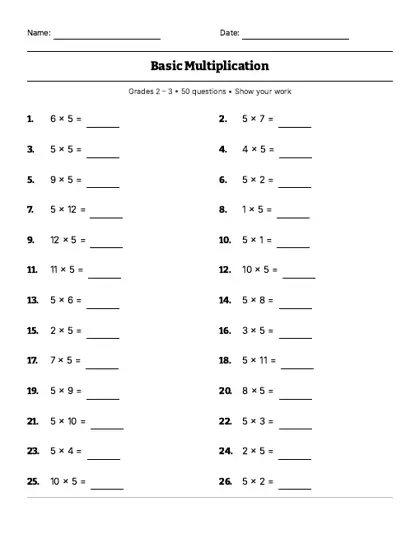 5 times tableGrade 3
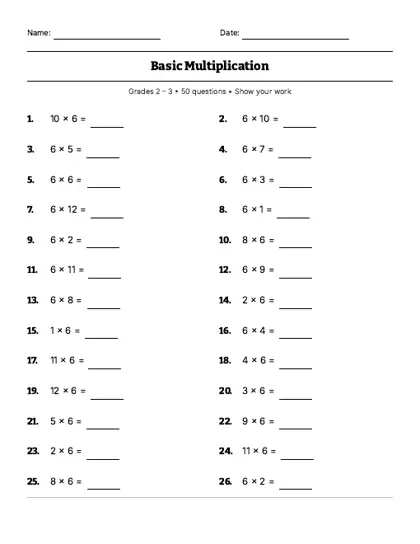 6 times tableGrade 3
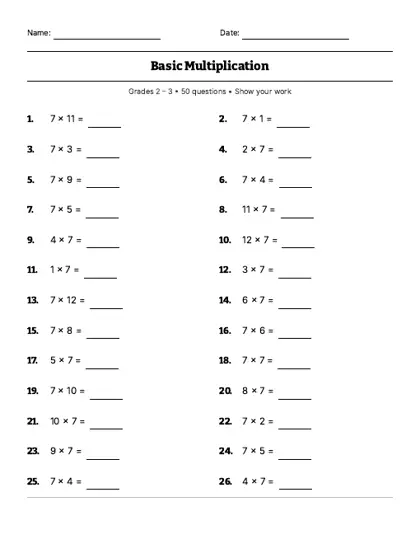 7 times tableGrade 3
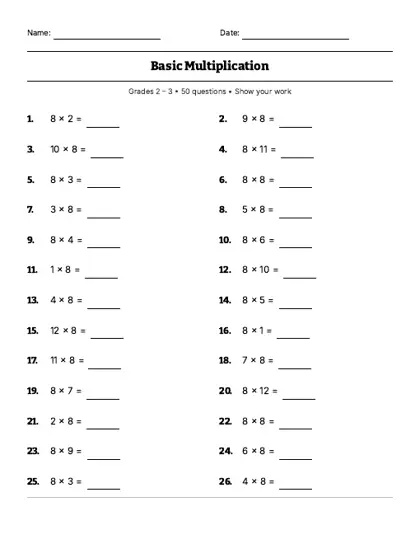 8 times tableGrade 3
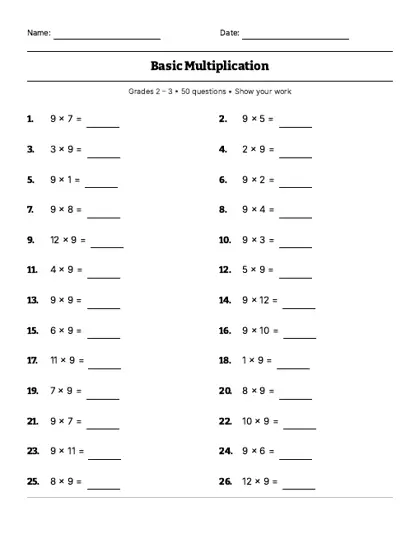 9 times tableGrade 3
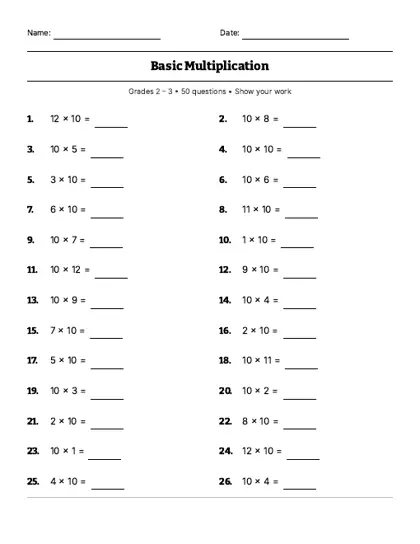 10 times tableGrade 3
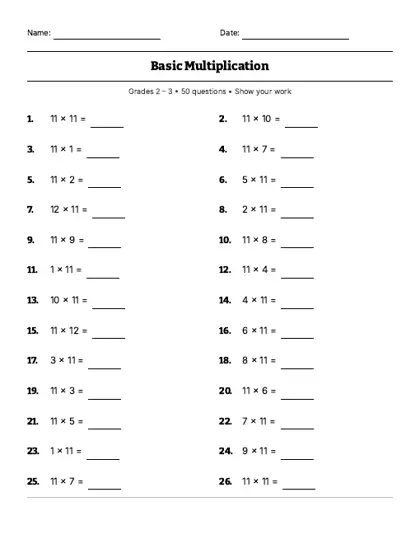 11 times tableGrades 3–4
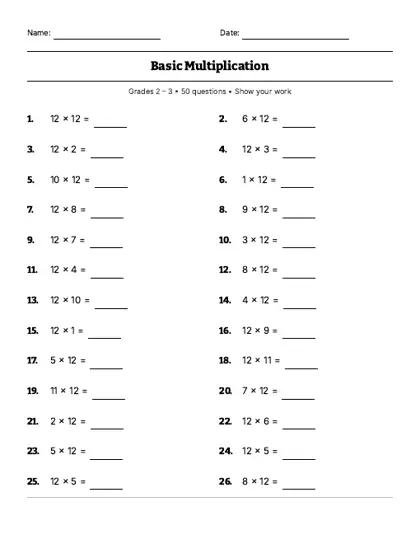 12 times tableGrades 3–4
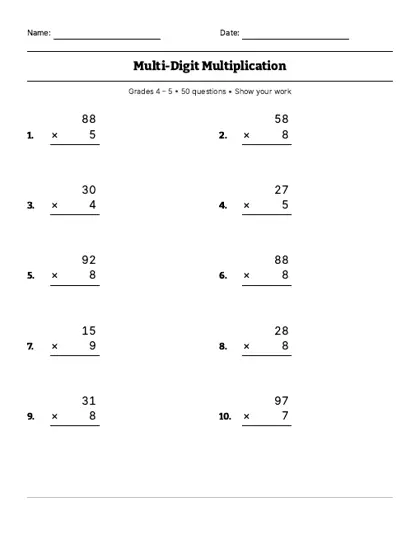 2-digit by 1-digit multiplicationGrade 4
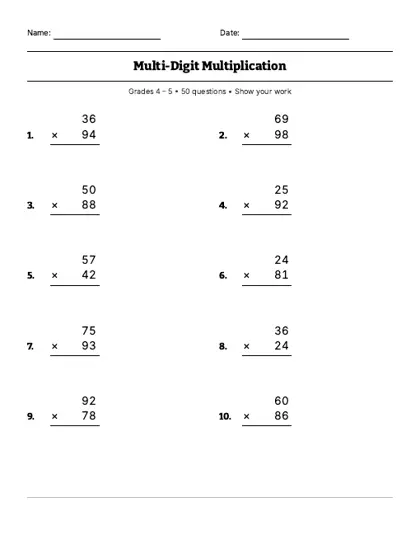 2-digit by 2-digit multiplicationGrade 4
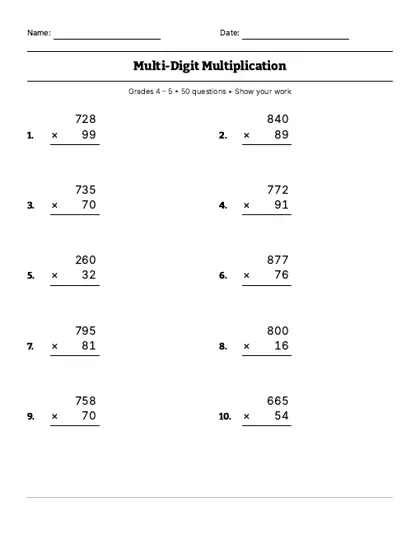 Multi-digit multiplicationGrade 5
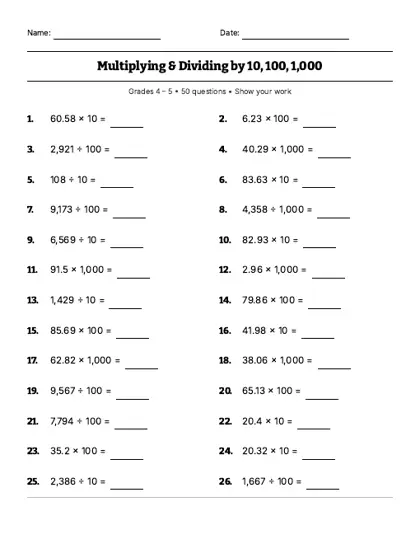 Multiply and divide by 10, 100 and 1000Grades 3–5
Make a fresh times tables test · Make a multi-digit multiplication test · Multiplication chart · Math Galaxy practice
How to teach multiplication at home
Find arrays everywhere
Egg cartons (2 × 6), muffin tins (3 × 4), window panes and chocolate bars are all arrays. Ask “how many, without counting one by one?”
Five minutes a day
One table per week, said forwards, backwards and mixed up, in the car or over breakfast.
Play multiplication war
Each player flips two cards and multiplies them. The bigger product wins all four cards.
Shop in multiples
“Four packs of 6 yogurts: how many yogurts?” Real groups make the facts stick.
Related: division (the reverse of multiplication) · factors and multiples · 3rd grade math
Last reviewed
Questions parents ask
What is multiplication?
Multiplication is repeated addition of equal groups. 4 × 6 means 4 groups of 6, which is 6 + 6 + 6 + 6 = 24. It can also be drawn as an array: 4 rows of 6.
What order should kids learn the times tables in?
Start with 2, 5 and 10 (they follow easy patterns), then 3 and 4, then 6, 7, 8 and 9. Many facts are learned twice for free: once you know 3 × 7, you know 7 × 3.
When should kids know their times tables?
By the end of grade 3, children are expected to know all multiplication facts up to 10 × 10 from memory (Common Core 3.OA.C.7).
What is the area model of multiplication?
A way to multiply bigger numbers by splitting them into tens and ones and drawing a rectangle. 23 × 4 = (20 × 4) + (3 × 4) = 80 + 12 = 92. It shows why the written method works.
How do you multiply 2-digit numbers?
Split one number into tens and ones, multiply each part, and add. 34 × 26 = 34 × 20 + 34 × 6 = 680 + 204 = 884. The standard method writes the same steps in columns.
What grade learns multiplication?
Grade 2 builds the idea with equal groups and arrays. Grade 3 learns the times tables and what multiplication means. Grade 4 multiplies up to 4 digits by 1 digit and 2 digits by 2 digits. Grade 5 uses the standard method for multi-digit numbers.