
Multiplication word problems
A multiplication word problem is a story about equal groups, rows, “times as many” or a rate like “6 points each”. The hard part is spotting it.
This page gives a 4-step method, the clue words, bar model pictures, worked examples, a quiz and 20 problems with answers.
Four steps for any word problem
- Read it twice. The first time for the story, the second time for the numbers.
- Ask: what is the question? Underline the last sentence. What are we finding?
- Draw it. Groups, an array or a bar model. A picture shows which operation to use.
- Write the number sentence, solve, and check. Does the answer make sense? Is it bigger than each group?
See it: pictures to draw with your child
Copy these onto paper or a whiteboard. A quick sketch makes the idea concrete before any written method.
Clue words for multiplication
| Story type | Clue words | Example |
|---|---|---|
| Equal groups | each, every, per, in each, groups of | 5 bags with 6 apples in each |
| Arrays | rows of, columns, rows and columns | 7 rows of 8 chairs |
| Comparison | times as many, times as long, twice, triple | Lia has 3 times as many stickers as Sam |
| Rate | each costs, per hour, a week, every day | Pens cost 4 each. How much for 9? |
| Area | length and width, square metres | A room 6 m by 4 m |
Clue words are hints, not rules. “Each” also appears in division stories (“24 sweets shared so each child gets the same”). The picture always tells the truth: if you know the groups and the size of each group, multiply. If you know the total and need the groups or the size, divide.
Draw a bar model
A bar model is a row of equal boxes. For “Lia has 4 times as many stickers as Sam. Sam has 6.” draw one box for Sam and four equal boxes for Lia. Each box is 6, so Lia has 4 × 6 = 24. Bar models work for every grade, and they make “times as many” problems easy to see.
Word problem quiz
Read each story, draw it in your head or on paper, then type the answer.
Two-step problems
From grade 3, stories often need two steps. “3 packs of 8 pencils and 5 loose pencils” is 3 × 8 = 24, then 24 + 5 = 29. Ask your child: “What do we need to find first?” and write each step on its own line.
In grade 4, a common type is “how much more”: “A book has 6 times as many pages as a comic. The comic has 32 pages. How many more pages does the book have?” Step 1: 6 × 32 = 192. Step 2: 192 − 32 = 160.
Where this fits: multiplying bigger numbers
What to say to your child
A short script for teaching it the first time. Pause after each line and let your child do the next step.
- “Read it to me. What is the story about?”
- “What is the question asking for?”
- “Can you draw it? How many groups? How many in each?”
- “So is it a multiplication or a division?”
- “Does your answer make sense? Should it be bigger or smaller than 6?”
More worked examples
Example 1: Equal groups
A baker puts 6 muffins in each box. She fills 8 boxes. 8 × 6 = 48 muffins.
Example 2: Times as many
A blue whale is about 4 times as long as a bus that is 12 m long. 4 × 12 = 48 m.
Example 3: Rate
A cyclist rides 15 km each day for 7 days. 7 × 15 = 105 km.
Example 4: Two steps
Tickets cost 9 each. A family buys 5 tickets and pays with 50. Change: 5 × 9 = 45, 50 − 45 = 5.
Practice questions (answers below)
Ask these out loud or write them down. Check each answer, and ask “how did you get that?” for one or two.
- 4 bags with 7 marbles each. How many marbles?
- 6 rows of 9 seats. How many seats?
- A spider has 8 legs. How many legs on 7 spiders?
- Tom read 5 books. Ana read 3 times as many. How many did Ana read?
- Pencils cost 6 each. Cost of 12 pencils?
- How many days in 9 weeks?
- A garden is 8 m by 7 m. Area?
- 5 packs of 10 stickers and 4 extra stickers. Total?
- A bus holds 42 children. How many in 3 buses?
- A class of 24 children each brings 3 cans for a food drive. How many cans?
- A rope is 9 m. Another is 4 times as long. How long?
- A shop sells 125 apples a day. How many in 6 days?
- 18 rows of 25 chairs. How many chairs?
- A book has 8 times as many pages as a comic of 24 pages. How many more pages does the book have?
- Eggs come in boxes of 12. How many eggs in 15 boxes?
- Each team has 11 players. How many players in 14 teams?
- A car travels 65 km each hour. How far in 4 hours?
- 36 chairs in rows of 9. How many rows? (Multiply or divide?)
- A pack has 24 cards. Mia buys 3 packs and gives away 10 cards. How many left?
- A poster costs 35. How much for 23 posters?
Show the answers
- 28
- 54
- 56
- 15
- 72
- 63
- 56 m²
- 54
- 126
- 72
- 36 m
- 750
- 450
- 192 − 24 = 168
- 180
- 154
- 260 km
- 4 rows (divide)
- 62
- 805
Common mistakes
How to teach it at home
Shopping stories
“3 packets of 4 yogurts: how many?” Let your child make up the next one.
Recipe maths
Double or triple a recipe and multiply each ingredient.
Story swap
You give a number sentence like 6 × 7; your child invents a story for it.
By grade
- Grade 3 (3.OA.A.3, 3.OA.D.8): equal groups, arrays and two-step problems within 100.
- Grade 4 (4.OA.A.2, 4.OA.A.3): “times as many” comparisons and multi-step problems with bigger numbers.
- Grade 5: word problems with multi-digit numbers, fractions and decimals.
More for each grade: Grade 3 math and the CBSE class 3 maths guide; Grade 4 math and the CBSE class 4 maths guide; Grade 5 math and the CBSE class 5 maths guide.
Worksheets and practice
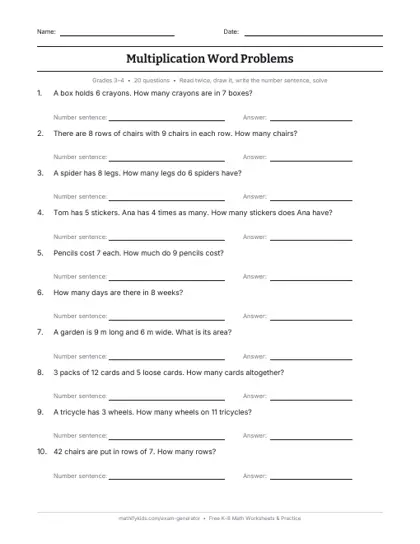
Multiplication word problems worksheet: printable PDF with an answer key. · Make a fresh test
Last reviewed
Questions parents ask
How do you know if a word problem is multiplication?
If you know how many groups there are and how many are in each group, and need the total, it is multiplication. Clue words like each, every, per, rows of and times as many help.
What are multiplication key words?
Each, every, per, groups of, rows of, times as many, twice, triple, and in all (with equal groups).
How do you solve a multiplication word problem?
Read it twice, find the question, draw groups or a bar model, write the multiplication, solve, and check the answer makes sense.
What is a “times as many” problem?
A comparison where one amount is a number of times another. If Sam has 4 and Lia has 3 times as many, Lia has 3 × 4 = 12.
What grade does multiplication word problems?
Grade 3 starts with equal groups and arrays; grade 4 adds comparison and multi-step problems; grade 5 uses bigger numbers, fractions and decimals.