
Multiplying by 10, 100 and 1000, step by step
When you multiply by 10, 100 or 1,000, every digit moves 1, 2 or 3 places to the left, one place for each zero. Dividing moves them to the right. 34 × 100 = 3,400 and 3.6 ÷ 10 = 0.36. This page shows why on a place value chart, explains why “just add a zero” fails for decimals, and has a tool to try any number.
The big idea: every place is worth ten times more
In our number system, each place is worth 10 times the place to its right: ones, tens, hundreds, thousands. Multiplying by 10 makes every digit worth 10 times more, so every digit moves one place to the left. Multiplying by 100 is multiplying by 10 twice, so two places.
The decimal point stays where it is; the digits move. (Many people find it easier to picture the point hopping the other way, which gives the same answer.)
Place value tool: multiply or divide by 10, 100, 1000
Type a number and choose an operation. The chart shows each digit before and after it moves.
How to multiply by 10, 100 and 1000
- Count the zeros: 10 has one, 100 has two, 1,000 has three.
- Move every digit that many places left (or move the decimal point that many places right).
- Fill empty places with zeros up to the decimal point.
- Check the size: multiplying by 10 or more must make the number bigger.
Worked examples
Example 1: 34 × 100
Two places left: 3 tens become 3 thousands, 4 ones become 4 hundreds. Fill with zeros: 3,400.
Example 2: 6 × 1,000
Three places left: 6,000. Grade 3 starts here, with facts like 4 × 60 = 240.
Example 3: 2.5 × 10
One place left: 2 ones become 2 tens, 5 tenths become 5 ones: 25.
Example 4: 0.045 × 1,000
Three places left: 45. Leading zeros drop away.
Example 5: 70 × 300
Use the facts: 7 × 3 = 21, then add on the three zeros from 70 and 300: 21,000.
Dividing by 10, 100 and 1000
Dividing makes every digit worth ten times less for each zero, so the digits move to the right.
- 4,500 ÷ 100 = 45
- 3.6 ÷ 10 = 0.36
- 72 ÷ 1,000 = 0.072: fill the gaps after the point with zeros.
Common mistakes
How to teach it at home
Money
10 dimes make a dollar, 100 pennies make a dollar. “What do 10 items at $2.50 cost?” is 2.5 × 10 in real life.
Metric measurements
1 m = 100 cm and 1 km = 1,000 m. Converting 2.3 m to centimeters is 2.3 × 100 = 230.
A paper place value chart
Write column headings on a strip of paper and the digits on small cards. Slide the cards to multiply and divide.
By grade
- Grade 3 (3.NBT.A.3): multiply one-digit numbers by multiples of 10, like 9 × 80.
- Grade 4 (4.NBT.A.1): each place is ten times the place to its right.
- Grade 5 (5.NBT.A.1, 5.NBT.A.2): multiply and divide whole numbers and decimals by powers of 10, and use exponents for them.
Worksheets and next steps
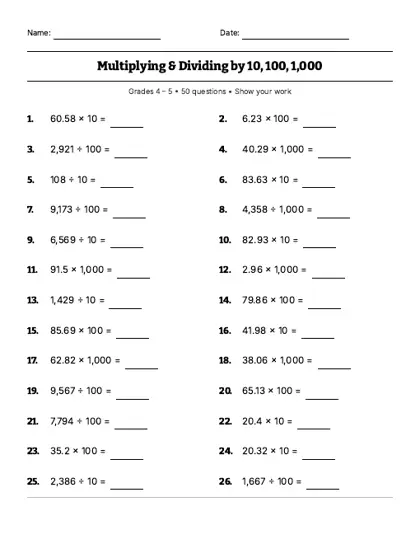
Multiply and divide by 10, 100 and 1000 worksheet: 50 problems with an answer key.
Make a fresh powers of 10 test.
Next: multiplying decimals · exponents and powers of 10 · place value chart
Last reviewed
Questions parents ask
How do you multiply by 10, 100 and 1000?
Move every digit 1, 2 or 3 places to the left, one place for each zero, and fill empty places with zeros. 34 × 100 = 3,400 and 2.5 × 10 = 25.
Is multiplying by 10 just adding a zero?
Only for whole numbers. 2.5 × 10 is 25, not 2.50. The real rule is that each digit moves one place to the left, which works for decimals too.
How do you divide by 10, 100 and 1000?
Move every digit 1, 2 or 3 places to the right. 4,500 ÷ 100 = 45 and 3.6 ÷ 10 = 0.36.
What is 0.45 × 100?
45. Each digit moves two places left: the 4 tenths become 4 tens and the 5 hundredths become 5 ones.
What are powers of 10?
10, 100, 1,000 and so on, written with exponents as 10¹, 10², 10³. The exponent tells you how many places the digits move.
What grade learns multiplying by 10, 100 and 1000?
Grade 3 multiplies one-digit numbers by multiples of 10 (3.NBT.A.3). Grade 4 understands that each place is ten times the one to its right (4.NBT.A.1). Grade 5 multiplies and divides whole numbers and decimals by powers of 10 (5.NBT.A.2).