
How to round numbers
To round a number, find the two “round” numbers it sits between and pick the closer one. The quick rule: look at the digit to the right of the place you are rounding to. 5 or more, round up. 4 or less, round down. 347 to the nearest 10 is 350; to the nearest 100 it is 300. This page shows why on a number line, covers the tricky cases, and has a rounding tool for any number.
Rounding: the big idea
Rounding replaces a number with a nearby, easier one. 347 is between 340 and 350 on a number line. It is closer to 350, so to the nearest 10, 347 rounds to 350. To the nearest 100, 347 is between 300 and 400 and closer to 300.
The digit rule is a shortcut for “which is closer?”. The halfway point between 340 and 350 is 345; anything from 345 up goes to 350.
Rounding tool: see it on a number line
Type any number and choose a place. The number line shows the two choices, the halfway point and which is closer.
How to round numbers, step by step
- Find the rounding place and underline that digit. To round 347 to the nearest 10, underline the 4.
- Look at the digit to its right (the 7). This is the “decider”.
- 5 or more: add 1 to the underlined digit. 4 or less: leave it as it is.
- Change every digit to the right to 0 (for decimals, drop them). 347 becomes 350.
Worked examples: rounding numbers
Example 1: 63 to the nearest 10
Ones digit 3 is 4 or less, so round down: 60.
Example 2: 285 to the nearest 10
Ones digit 5, so round up: 290.
Example 3: 6,749 to the nearest 100
Hundreds digit 7, decider 4: round down. 6,700.
Example 4: 45,678 to the nearest 1,000
Thousands digit 5, decider 6: round up. 46,000.
Example 5: 3.47 to the nearest tenth
Tenths digit 4, decider 7: round up. 3.5. See rounding decimals for more.
Tricky rounding cases
Rounding up past a 9
96 to the nearest 10: the 9 tens become 10 tens, which is 100. 3,962 to the nearest 100 is 4,000.
Exactly halfway
35, 250 and 4.5 are exactly halfway. School math rounds them up: 40, 300 and 5.
Rounding to a place with a zero
503 to the nearest 10: the tens digit is 0 and the decider is 3, so it rounds down to 500. The 0 is still a digit to round.
Common rounding mistakes
How to teach rounding at home
Use a number line
Draw a line from 40 to 50. Where does 47 go? Which end is closer? Children who picture this never mix up rounding up and down.
Round the shopping
Round each price to the nearest dollar and keep a running total. Compare with the receipt.
The hill rhyme
Numbers 0–4 roll back down the hill; 5–9 make it over the top. Draw a hill with the digits on it.
Estimate first
Before any addition or subtraction homework, round and estimate the answer. It turns rounding into a checking tool.
Rounding by grade
- Grade 3 (3.NBT.A.1): round whole numbers to the nearest 10 or 100.
- Grade 4 (4.NBT.A.3): round multi-digit numbers to any place.
- Grade 5 (5.NBT.A.4): round decimals to any place.
Rounding worksheets and charts
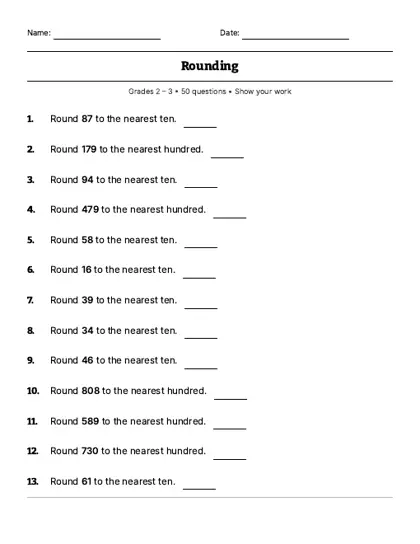
Rounding numbers worksheet: 50 problems with an answer key.
Rounding large numbers (PDF, grade 4) · rounding decimals worksheet
Last reviewed
Questions parents ask
How do you round to the nearest 10?
Look at the ones digit. If it is 5 or more, round up to the next ten; if it is 4 or less, round down. 47 rounds to 50 and 43 rounds to 40.
How do you round to the nearest 100?
Look at the tens digit. 5 or more rounds up, 4 or less rounds down. 347 rounds to 300 because the tens digit is 4; 352 rounds to 400.
What happens when a number is exactly halfway?
In school math it rounds up. 35 rounds to 40, 250 rounds to 300 and 4.5 rounds to 5.
Why do we round numbers?
To estimate quickly and to check answers. 389 + 412 is about 400 + 400 = 800, so an answer of 8,001 must be wrong.
How do you round 96 to the nearest 10?
100. The ones digit is 6, so round up. The next ten after 90 is 100.
What grade learns rounding?
Grade 3 rounds to the nearest 10 or 100 (3.NBT.A.1). Grade 4 rounds whole numbers to any place (4.NBT.A.3). Grade 5 rounds decimals (5.NBT.A.4).