
Teaching division facts: sharing, grouping and fact families
Division facts, like 56 ÷ 7 = 8, are the times tables backwards. The quickest way to know them is to ask “7 times what is 56?” This page explains the two meanings of division (sharing and grouping), fact families, and the trick for every divisor, with a sharing tool that shows remainders.
Two meanings of division
Sharing: 12 cookies shared by 3 children: how many each? (4.) Grouping: 12 cookies in bags of 3: how many bags? (4.) Both are 12 ÷ 3 = 4. Word problems use both, so children need to recognize both.
Sharing tool
Share any number into equal groups. Choose numbers that divide exactly, then try some that leave a remainder.
Think multiplication
Division is the missing factor in a multiplication: 56 ÷ 7 = ? means 7 × ? = 56. A child who knows 7 × 8 = 56 knows the answer straight away. That is why times tables come first.
Fact families
One array gives four facts: 6 × 7 = 42, 7 × 6 = 42, 42 ÷ 6 = 7 and 42 ÷ 7 = 6. Practice them together with fact family triangles: 42 at the top, 6 and 7 at the bottom; cover any number to find it.
Special cases
- ÷ 1: the number stays the same (9 ÷ 1 = 9).
- A number ÷ itself is 1 (9 ÷ 9 = 1).
- 0 ÷ a number is 0 (0 ÷ 5 = 0).
- A number ÷ 0 can’t be done: no number of zero groups makes 5.
Common mistakes
How to teach it at home
Deal cards
Deal a pile of cards to the family. How many each?
Pack snacks
Pack 24 crackers into bags of 6. How many bags?
Fact family triangles
Make cards and cover one corner each turn.
By grade
- Grade 3 (3.OA.A.2, 3.OA.B.6, 3.OA.C.7): understand division, see it as an unknown-factor problem, and know all division facts within 100.
- Next: division with remainders.
Worksheets and practice
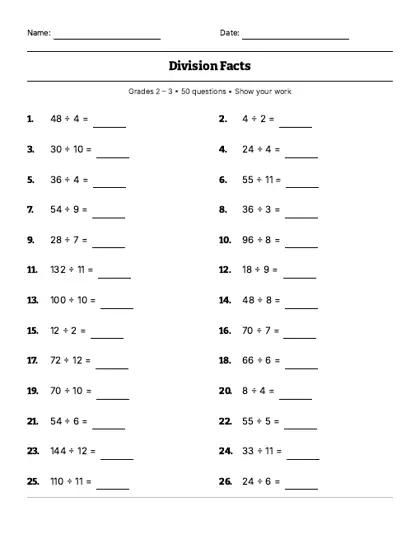
Division facts worksheet: printable PDF with an answer key. · Make a fresh test
Last reviewed
Questions parents ask
What is the fastest way to learn division facts?
Learn the times tables first, then turn each division into a missing-number multiplication: 56 ÷ 7 means 7 × ? = 56.
What are the two meanings of division?
Sharing (how many in each group) and grouping (how many groups). 12 ÷ 3 = 4 either way.
Why can’t you divide by zero?
Because no number of zero-sized groups adds up to anything but zero. 5 ÷ 0 has no answer.
What is a fact family in division?
The four related facts from one multiplication: 6 × 7 = 42, 7 × 6 = 42, 42 ÷ 6 = 7, 42 ÷ 7 = 6.
When should kids know their division facts?
By the end of grade 3, all division facts within 100 (3.OA.C.7).