
Measurement for kids
Measurement covers length, weight, capacity, time and money, in both US customary and metric units. This page maps what children learn from kindergarten to grade 5, has a unit converter that explains whether to multiply or divide, lists the conversions worth knowing, and links every measurement lesson, chart and worksheet.
What kids learn about measurement, grade by grade
- Kindergarten (K.MD.A): compare lengths and weights: longer, shorter, heavier.
- Grade 1 (1.MD.A, 1.MD.B): measure length with units, and tell time to the hour and half hour.
- Grade 2 (2.MD.A to 2.MD.C): measure in inches, feet, centimeters and meters; time to 5 minutes; count money.
- Grade 3 (3.MD.A): time to the minute and elapsed time; grams, kilograms and liters; area and perimeter.
- Grade 4 (4.MD.A): convert customary and metric units from big to small; measure angles.
- Grade 5 (5.MD.A, 5.MD.C): convert within a system in both directions; volume.
The big idea behind measurement
To measure, you count how many of a unit fit. Bigger units mean you need fewer of them: a table might be 2 meters or 200 centimeters. So converting to a smaller unit makes the number bigger (multiply), and converting to a bigger unit makes the number smaller (divide).
Unit converter that explains itself
Pick length, weight, capacity or time. Convert between customary and metric units and see whether to multiply or divide.
Conversions worth knowing
US customary
| Length | 12 inches = 1 foot · 3 feet = 1 yard · 5,280 feet = 1 mile |
| Weight | 16 ounces = 1 pound · 2,000 pounds = 1 ton |
| Capacity | 8 fluid ounces = 1 cup · 2 cups = 1 pint · 2 pints = 1 quart · 4 quarts = 1 gallon |
Metric
| Length | 10 mm = 1 cm · 100 cm = 1 m · 1,000 m = 1 km |
| Mass | 1,000 g = 1 kg |
| Capacity | 1,000 mL = 1 L |
Time
| 60 seconds = 1 minute · 60 minutes = 1 hour · 24 hours = 1 day · 7 days = 1 week |
Where kids get stuck with measurement
Multiply or divide?
Converting 5 feet to inches as 5 ÷ 12. Fix: smaller units, more of them, so multiply: 60 inches.
Starting the ruler at 1
Measuring from the 1 mark instead of 0 adds an extra unit. Fix: line up the end of the object with 0.
Time isn’t base 10
Adding 45 minutes to 2:30 and writing 2:75. Fix: 60 minutes make an hour: 3:15.
Mixing systems
Adding inches to centimeters. Fix: convert everything to one unit first.
Measurement lessons and charts
Measurement worksheets
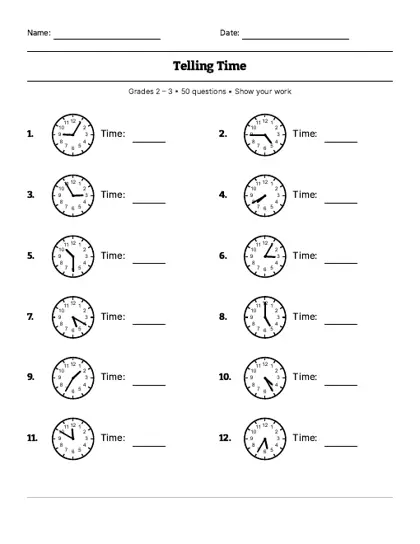 Telling time
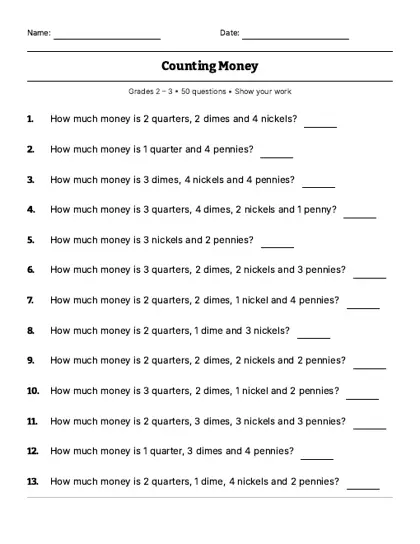 Money
Money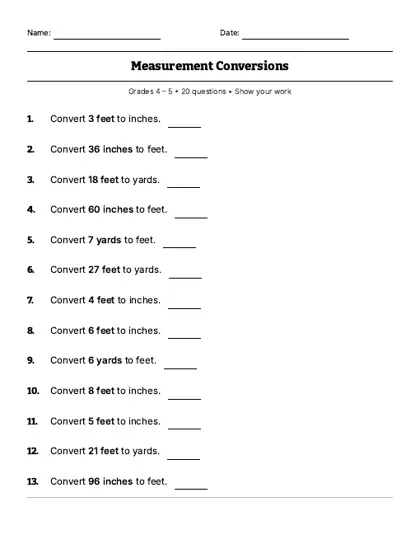 Customary units
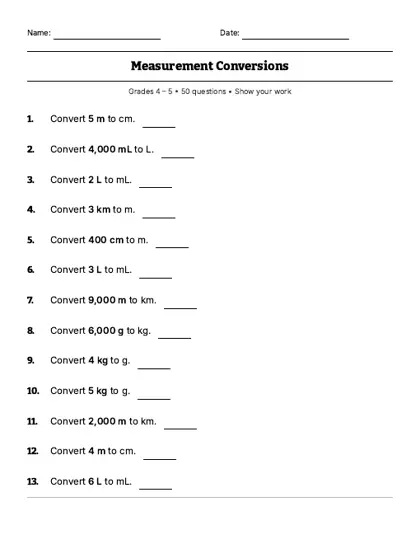 Metric units
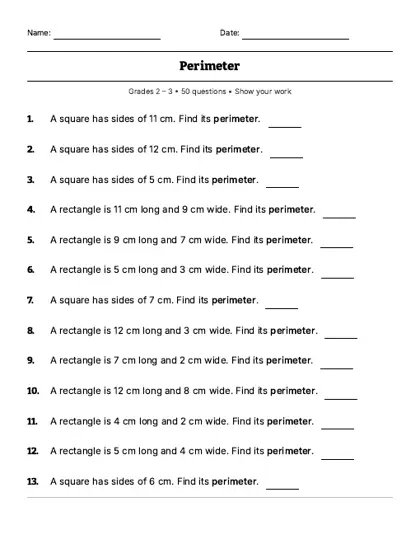 Perimeter
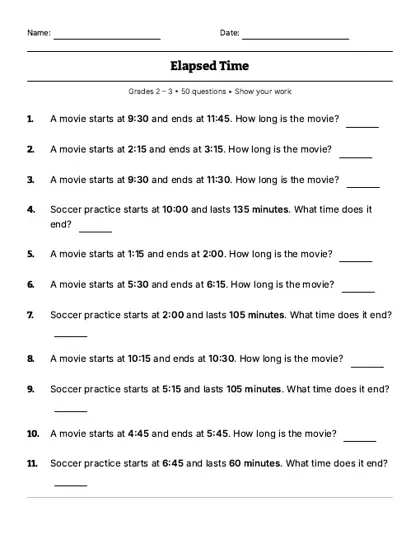 Elapsed time
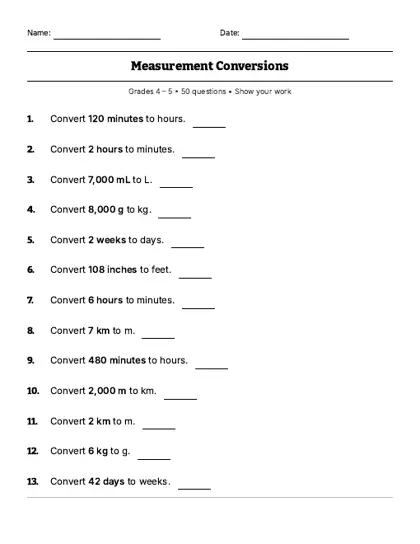 Mixed unit conversions
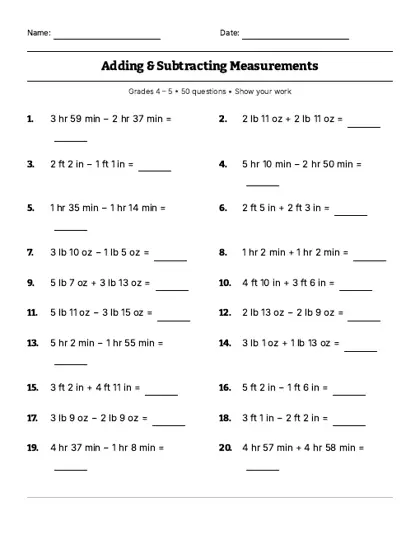 Adding measurements
Make a fresh unit conversions test · Make a telling time test · US coins chart
How to teach measurement at home
Bake together
Cups, tablespoons, ounces and grams all in one recipe. Doubling it adds conversion practice.
Estimate, then measure
“How long is the couch? How heavy is the cat?” Guess first, then check with a tape measure or scale.
Track a growing plant
Measure a bean plant every day in centimeters and record it. A real reason to measure carefully.
Plan the day in time
“Practice starts at 4:15 and lasts 50 minutes. When does it end?” Elapsed time comes up every day.
Last reviewed
Questions parents ask
How do you convert units of measurement?
To a smaller unit, multiply; to a bigger unit, divide. 3 feet to inches: inches are smaller, so 3 × 12 = 36 inches. 48 inches to feet: feet are bigger, so 48 ÷ 12 = 4 feet.
How many cups are in a gallon?
16. There are 2 cups in a pint, 2 pints in a quart and 4 quarts in a gallon, so 2 × 2 × 4 = 16 cups.
What is the difference between metric and customary units?
Metric units (meters, grams, liters) go up in tens, so converting is moving the decimal point. US customary units (inches, feet, pounds, cups) use different numbers like 12, 3 and 16, which have to be learned.
How do I teach measurement to my child?
Measure real things: height on a door frame, ingredients for baking, weight on a kitchen scale, time on a clock. Estimating first, then measuring, builds a feel for the units.
How do you find elapsed time?
Count on from the start time to the end time in easy chunks. From 2:45 to 3:20: 15 minutes to 3:00, then 20 more, so 35 minutes.
What grade learns measurement?
Kindergarten compares lengths and weights. Grades 1–2 measure length in units, tell time and count money. Grade 3 does elapsed time, mass, volume and area. Grade 4 converts units, and grade 5 converts within a system and finds volume.