
Making change
Making change means finding the money to give back. Count up from the price to the amount paid, using coins first, then bills.
What change is
When you pay more than something costs, you get money back. That money is the change. It is the difference between the amount paid and the price.
Paying $5.00 for a $3.65 toy gives $1.35 change, because $3.65 + $1.35 = $5.00. There are two ways to find it: counting up, the way cashiers do, or subtracting.
Counting up, the cashier’s way
- Start at the price. $3.65.
- Add coins to reach a round amount. A dime makes $3.75, a quarter makes $4.00.
- Add bills to reach the amount paid. One dollar makes $5.00.
- Add up what you counted: 10¢ + 25¢ + $1.00 = $1.35.
Subtracting money
On paper, subtract the price from the amount paid. Line up the decimal points and subtract like whole numbers: $5.00 − $3.65 = $1.35. Regrouping across the zeros is the tricky part, so counting up is often easier in your head.
Both methods should agree, which makes a good check. See subtracting decimals and decimals and money for the written method.
Giving change with the fewest coins
Cashiers use as few coins as they can. Start with the biggest coin or bill that fits, and repeat.
For 85¢: three quarters make 75¢, then one dime makes 85¢. That is 4 coins instead of, say, 8 dimes and a nickel.
Checking the change
Add the change back to the price. The total should be the amount paid: $3.65 + $1.35 = $5.00. If it is not, count up again.
Estimating first helps too: $3.65 is a bit more than $3.50, so the change from $5 should be a bit less than $1.50.
Change from $10 and $20
The method is the same with bigger bills, just with more steps. Paying $20.00 for $12.35: a nickel makes $12.40, a dime makes $12.50, two quarters make $13.00, two dollars make $15.00 and a $5 bill makes $20.00. The change is $7.65.
Writing each step as you go, like a cashier saying it out loud, keeps the count clear.
Making change in word problems
Ana buys a book for $6.25 and a pen for $1.50. She pays with a $10 bill. How much change does she get?
First add the prices: $7.75. Then count up to $10.00: a quarter makes $8.00, two dollars make $10.00. Change: $2.25.
Two-step problems like this are common in grades 3 and 4. Find the total cost first, then the change.
Why counting up works
Counting up is subtraction in disguise. Finding what to add to $3.65 to reach $5.00 is the same as $5.00 − $3.65.
It is easier in your head because it uses friendly round numbers, not regrouping. It is the same idea as counting on to find a difference in subtraction.
Making change quiz
Find the change and type it in dollars, like 1.35. Wrong answers show how to count up.
What to say to your child
A short script for teaching it the first time. Pause after each line and let your child do the next step.
- “The toy costs $3.65. You pay with a $5 bill. Let’s count up to $5.”
- “From $3.65, what gets us to a round number?” (A dime: $3.75.)
- “Then a quarter?” ($4.00.)
- “Then a dollar?” ($5.00.)
- “Add what we counted: 10¢ + 25¢ + $1.00.” ($1.35 change.)
More worked examples
Example 1: Pay $1.00 for 65¢
Count up: a dime to 75¢, a quarter to $1.00. Change: 35¢.
Example 2: Pay $5.00 for $2.40
Count up: a dime to $2.50, two quarters to $3.00, two dollars to $5.00. Change: $2.60.
Example 3: Pay $10.00 for $6.85
Count up: a nickel to $6.90, a dime to $7.00, three dollars to $10.00. Change: $3.15.
Example 4: Pay $20.00 for $12.50
Subtract: $20.00 − $12.50 = $7.50.
Practice questions (answers below)
Ask these out loud or write them down. Check each answer, and ask “how did you get that?” for one or two.
- Pay $1.00 for 80¢
- Pay $1.00 for 45¢
- Pay $2.00 for $1.25
- Pay $5.00 for $3.50
- Pay $5.00 for $4.15
- Pay $10.00 for $7.60
- Pay $10.00 for $9.99
- Pay $20.00 for $14.75
Show the answers
- 20¢
- 55¢
- 75¢
- $1.50
- 85¢
- $2.40
- 1¢
- $5.25
Common mistakes
How to teach it at home
Real shopping
Let your child pay for a small item and check the change before leaving the counter.
Play shop
Price items like $2.35 and pay with play money; your child gives change.
Receipt check
Look at a receipt: what was paid, what it cost and what came back.
By grade
- Grade 2 (2.MD.C.8): money word problems with $ and ¢.
- Grade 3: adding and subtracting within 1,000, including money.
- Grade 4 (4.MD.A.2): money problems with decimals.
- See also counting coins and how to count money.
More for each grade: Grade 2 math and the CBSE class 2 maths guide; Grade 3 math and the CBSE class 3 maths guide; Grade 4 math and the CBSE class 4 maths guide.
Worksheets and practice
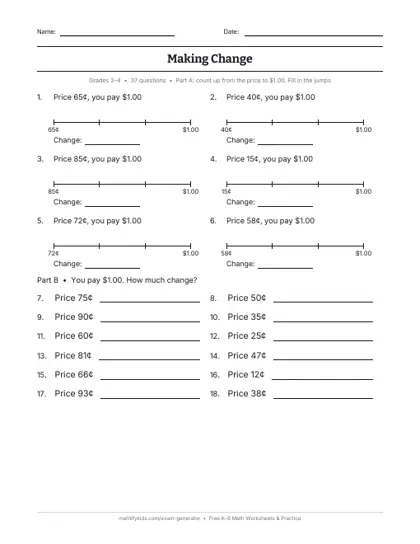
Making change worksheet: printable PDF with an answer key. · Make a fresh test
Practice making change online · Money chart · Decimals for kids
Last reviewed
Questions parents ask
How do you make change?
Count up from the price to the amount paid. Use coins to reach a round amount, then bills. The coins and bills you counted are the change.
How do you count back change?
Start at the price and count up out loud as you hand over each coin and bill: “$3.65, $3.75, $4, $5.” The customer ends up with the amount they paid.
How do you calculate change from $20?
Subtract the price from $20.00, or count up. For $14.75: a quarter makes $15.00, then $5 makes $20.00, so the change is $5.25.
What is the fewest coins for 85 cents?
Three quarters and one dime: 75¢ + 10¢ = 85¢. That is 4 coins.
What grade learns to make change?
Grade 2 starts money word problems (2.MD.C.8), and grades 3 and 4 make change from bills using decimals (4.MD.A.2).