
How to count money
To count money, start with the coin worth the most and count on: quarters by 25s, dimes by 10s, nickels by 5s, then pennies by 1s. 2 quarters, 1 dime and 3 pennies make 63¢. This page covers coin values, counting mixed coins, dollars and cents, making change, and has a coin counter game.
US coin values
| Coin | Value | Count by |
|---|---|---|
| Penny | 1¢ | 1s |
| Nickel | 5¢ | 5s |
| Dime | 10¢ | 10s |
| Quarter | 25¢ | 25s |
| Dollar | 100¢ = $1.00 | Ones |
A dime is smaller than a nickel but worth more. Size doesn’t tell the value.
How to count mixed coins, step by step
- Sort the coins from most to least valuable.
- Count the quarters: 25, 50, 75.
- Count on the dimes: 85, 95.
- Count on the nickels: 100.
- Count on the pennies: 101, 102.
- Write it: 102¢ = $1.02.
Coin counter: make the amount
Add coins to make the target. Then try again with as few coins as possible.
Dollars and cents
100 cents make 1 dollar. $3.45 means 3 dollars and 45 cents: the decimal point separates them. Money is a great way into decimals later: dimes are tenths of a dollar and pennies are hundredths.
Making change by counting up
Something costs 65¢ and you pay with $1. Count up from 65¢: a nickel makes 70¢, three dimes make $1.00. The change is 5 + 30 = 35¢. Cashiers count up rather than subtract, and it is easier for children too.
Common mistakes
How to teach it at home
Pay at the shop
Let your child pay for small items and check the change.
Piggy bank count
Sort and count the piggy bank once a week.
Play shop
Price toys and buy them with real coins.
By grade
- Grade 1: know coin names and values.
- Grade 2 (2.MD.C.8): solve word problems with dollar bills, quarters, dimes, nickels and pennies, using $ and ¢ correctly.
Worksheets and practice
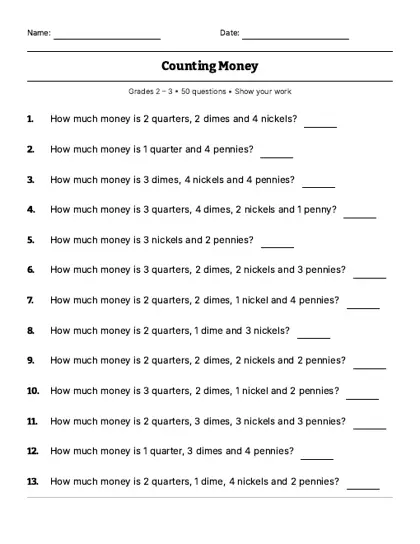
Counting money worksheet: printable PDF with an answer key. · Make a fresh test
Last reviewed
Questions parents ask
How do you teach a child to count money?
Learn the coin values, then sort coins from most to least valuable and count on: by 25s, 10s, 5s, then 1s.
How much is each US coin worth?
Penny 1¢, nickel 5¢, dime 10¢, quarter 25¢. 100¢ make $1.
How do you make change?
Count up from the price to the amount paid, using the fewest coins.
How do you write money amounts?
With a dollar sign and two decimal places ($3.45), or with a cent sign for amounts under a dollar (45¢). Not both.
What grade learns to count money?
Grade 2 (2.MD.C.8), building on coin names in grade 1.