
How to measure angles with a protractor
An angle measures a turn, in degrees. To measure one, put the protractor’s center on the corner, line up 0 with one arm, and read where the other arm crosses the scale. This page explains degrees, the types of angles, how to use both protractor scales without mixing them up, and has an interactive angle maker.
What an angle measures
An angle is the amount of turn between two rays that meet at a point (the vertex). A full turn is 360°, a half turn is 180° and a quarter turn, a right angle, is 90°. The length of the arms doesn’t change the angle.
Types of angles
Angle maker
Drag the slider from 0° to 360°. The angle is drawn on a protractor and named.
How to use a protractor, step by step
- Estimate first: is the angle acute or obtuse? This tells you whether the answer is under or over 90°.
- Put the center point of the protractor exactly on the vertex.
- Line up the 0 line with one arm of the angle.
- Read the scale that starts at 0 on that arm, where the other arm crosses it.
- Check against your estimate. If you estimated acute and read 130°, use the other scale: 50°.
Arms too short to reach the scale? Extend them with a ruler first.
Adding angles
Angles that sit side by side add up (4.MD.C.7). If a right angle is split into two parts and one is 35°, the other is 90° − 35° = 55°. On a straight line the parts add to 180°, and all the way round a point they add to 360°.
Common mistakes
How to teach it at home
Door angles
Open a door to acute, right and obtuse angles.
Clock hands
What angle do the hands make at 3:00? (90°) At 6:00? (180°)
Paper corner tester
Use a sheet of paper’s corner to check for right angles around the house.
By grade
- Grade 4 (4.MD.C.5 to 4.MD.C.7, 4.G.A.1): understand degrees, measure and draw angles with a protractor, and add angles.
- Grade 7: angle relationships (supplementary, complementary, vertical).
Worksheets and practice
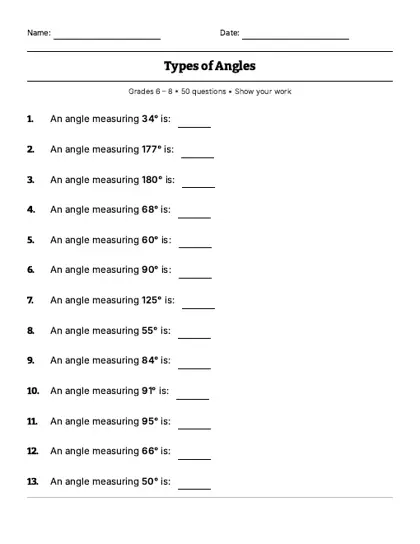
Types of angles worksheet: printable PDF with an answer key. · Make a fresh test
Last reviewed
Questions parents ask
How do you measure an angle with a protractor?
Put the center point on the vertex, line up 0 with one arm, and read the scale that starts at 0 where the other arm crosses it.
Which scale do I use on a protractor?
The one that starts at 0 on the arm you lined up. Estimate first: acute angles are under 90°, obtuse over 90°.
What are the types of angles?
Acute (under 90°), right (90°), obtuse (between 90° and 180°), straight (180°) and reflex (over 180°).
How many degrees are in a full turn?
360°. A half turn is 180° and a quarter turn is 90°.
What grade learns to measure angles?
Grade 4 (4.MD.C.6).