
Divisibility rules for 2, 3, 4, 5, 6, 9 and 10
Divisibility rules tell you whether a number divides exactly, without doing the division. A number is divisible by 2 if it is even, by 3 if its digits add to a multiple of 3, by 5 if it ends in 0 or 5, and so on. This page lists every rule with examples, explains why the digit-sum rules work, and has a checker for any number.
The divisibility rules
| Divisible by | Rule | Example |
|---|---|---|
| 2 | Last digit is even (0, 2, 4, 6, 8) | 346 |
| 3 | Digits add to a multiple of 3 | 471: 4 + 7 + 1 = 12 |
| 4 | Last two digits make a multiple of 4 | 1,324: 24 |
| 5 | Last digit is 0 or 5 | 835 |
| 6 | Divisible by both 2 and 3 | 354: even, 3 + 5 + 4 = 12 |
| 9 | Digits add to a multiple of 9 | 729: 7 + 2 + 9 = 18 |
| 10 | Last digit is 0 | 4,560 |
Divisibility checker
Type any number to test every rule and see why.
Why the rules work
2, 5 and 10: every ten is divisible by 2, 5 and 10, so only the ones digit matters. 4: every hundred is divisible by 4, so only the last two digits matter. 3 and 9: 10 is one more than 9, 100 is one more than 99, and so on. So each digit leaves its own value as a remainder when divided by 3 or 9, and the digit sum tells you the total remainder.
Where divisibility rules help
- Finding factors: quickly test which small numbers divide. See factors and multiples.
- Simplifying fractions: 135/180, both divisible by 5 and 9.
- Prime numbers: rule out 2, 3 and 5 at a glance.
Common mistakes
How to teach it at home
Number plate test
Check car number plates for divisibility by 3 or 9.
Birthday years
Is this year divisible by 2, 3, 4, 5?
Fast factors
Race to list all factors of 72 using the rules.
By grade
- Grade 4 (4.OA.B.4): find factor pairs and multiples; the rules are a tool for this.
- Grades 5–6: simplifying fractions and finding the GCF.
Worksheets and practice
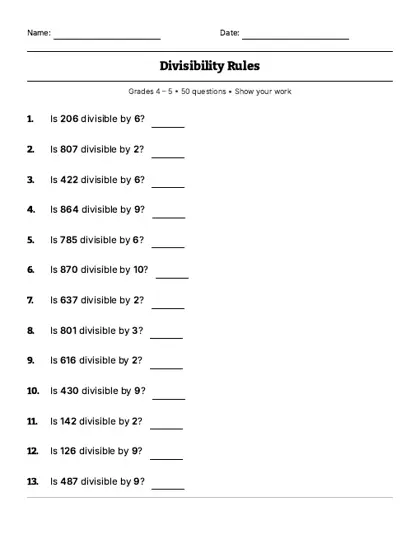
Divisibility rules worksheet: printable PDF with an answer key. · Make a fresh test
Last reviewed
Questions parents ask
What is the divisibility rule for 3?
Add the digits. If the total is a multiple of 3, so is the number. 471: 4 + 7 + 1 = 12, so 471 is divisible by 3.
What is the divisibility rule for 4?
Look at the last two digits. If they make a multiple of 4, the whole number is divisible by 4.
What is the divisibility rule for 6?
The number must be divisible by both 2 and 3: even, and its digits add to a multiple of 3.
What is the divisibility rule for 9?
Add the digits. If the total is a multiple of 9, the number is divisible by 9.
Is there a divisibility rule for 7?
There are rules, but they are slower than just dividing, so they are rarely taught.