
Checking division with multiplication
Multiply the answer by the number you divided by, then add any remainder. If you get the starting number, the division is right.
Why multiplication checks division
Division and multiplication undo each other. If 72 ÷ 6 = 12, then 12 groups of 6 must make 72. So multiply: 12 × 6 = 72. You are back where you started, and the answer is right.
This check is quick, it catches most mistakes, and it uses a skill children already have. It turns “I hope it’s right” into “I know it’s right”.
See it: pictures to draw with your child
Copy these onto paper or a whiteboard. A quick sketch makes the idea concrete before any written method.
The checking rule
quotient × divisor + remainder = dividend
- No remainder: 84 ÷ 4 = 21. Check: 21 × 4 = 84. Correct.
- With a remainder: 29 ÷ 4 = 7 r 1. Check: 7 × 4 = 28, and 28 + 1 = 29. Correct.
- Bigger numbers: 735 ÷ 6 = 122 r 3. Check: 122 × 6 = 732, and 732 + 3 = 735. Correct.
If the check gives a different number, something went wrong. Look at the difference: it often points to the mistake.
What the check tells you
Suppose a child writes 612 ÷ 6 = 12. Check: 12 × 6 = 72, not 612. The check is far too small, a sign that a 0 is missing from the quotient. The right answer is 102. See zeros in the quotient.
Suppose a child writes 50 ÷ 7 = 6 r 8. Check: 6 × 7 + 8 = 50, which works, but the remainder 8 is bigger than 7. Another 7 fits: 7 r 1. So a full check has two parts: the multiplication works, and the remainder is smaller than the divisor.
A quick estimate first
Before multiplying, ask whether the answer is about the right size. 456 ÷ 8 should be near 400 ÷ 8 = 50 or 480 ÷ 8 = 60. An answer of 57 fits; 5.7 or 570 does not.
Estimating catches place-value slips, and multiplying back catches small arithmetic slips. Together they make division very reliable. The estimating quotients lesson shows how.
Making checking a habit
Children often skip checks because they feel like extra work. Make it routine: every division answer gets a check written beside it, at least for the first few weeks.
Praise the check, not just the answer. When a check catches a mistake, celebrate it. That is the check doing its job, and it shows your child why it matters.
A calculator can confirm checks at first, but the goal is to multiply by hand or in your head.
Quiz: check the division
Multiply back, and add the remainder if there is one.
Where this fits: division step by step
- What is division
- Division as repeated subtraction
- Division on a number line
- Dividend, divisor and quotient
- Dividing by 2, 5 and 10
- Division facts
- Checking division with multiplication (this page)
- Division with remainders
- Interpreting remainders
- 2-digit by 1-digit division
- 3-digit by 1-digit division
- Partial quotients
- Short division
- Long division
- Zeros in the quotient
- Estimating quotients
- Long division with 2-digit divisors
- Division word problems
What to say to your child
A short script for teaching it the first time. Pause after each line and let your child do the next step.
- “You worked out 56 ÷ 4 = 14. How can we be sure?” (Multiply?)
- “Yes: 14 × 4. What is it?” (56!) “So it’s right.”
- “Now 23 ÷ 5 = 4 r 3. Multiply 4 × 5.” (20.) “Add the 3.” (23!)
- “What if someone says 23 ÷ 5 = 3 r 8?” (8 is bigger than 5. Wrong!)
- “Every division gets a check. That’s our rule.”
More worked examples
Example 1: a fact
42 ÷ 7 = 6. Check: 6 × 7 = 42. Correct.
Example 2: a 2-digit answer
96 ÷ 8 = 12. Check: 12 × 8 = 96. Correct.
Example 3: a remainder
47 ÷ 6 = 7 r 5. Check: 7 × 6 = 42, 42 + 5 = 47. Correct.
Example 4: catching a mistake
Someone says 845 ÷ 5 = 168. Check: 168 × 5 = 840, not 845. The right answer is 169.
Practice questions (answers below)
Ask these out loud or write them down. Check each answer, and ask “how did you get that?” for one or two.
- Check 63 ÷ 9 = 7
- Check 48 ÷ 4 = 12
- Check 38 ÷ 5 = 7 r 3
- Check 91 ÷ 7 = 12
- Check 75 ÷ 6 = 11 r 9
- Check 144 ÷ 12 = 12
- Check 515 ÷ 5 = 13
- A quotient of 8, divisor 7, remainder 4. What is the dividend?
- Stretch: check 1,000 ÷ 8 = 125
Show the answers
- 7 × 9 = 63. Correct.
- 12 × 4 = 48. Correct.
- 7 × 5 + 3 = 38. Correct.
- 12 × 7 = 84, so wrong: it is 13
- Remainder too big: 12 r 3
- 12 × 12 = 144. Correct.
- 13 × 5 = 65, so wrong: 103
- 60
- 125 × 8 = 1,000. Correct.
Common mistakes
How to teach it at home
Teacher for a day
Write a few divisions, one with a mistake, and let your child check them.
Shop check
Split a bill and multiply back to check.
Check buddy
Your child divides, you multiply back, then swap.
By grade
- Grade 3 (3.OA.B.6): division as an unknown-factor problem, so multiplication checks it.
- Grade 4 (4.NBT.B.6): check quotients and remainders with up to 4-digit dividends.
- Grade 5 (5.NBT.B.6): explain division answers using the relationship with multiplication.
- Next: division with remainders and interpreting remainders.
More for each grade: Grade 3 math and the CBSE class 3 maths guide; Grade 4 math and the CBSE class 4 maths guide; Grade 5 math and the CBSE class 5 maths guide.
Worksheets and practice
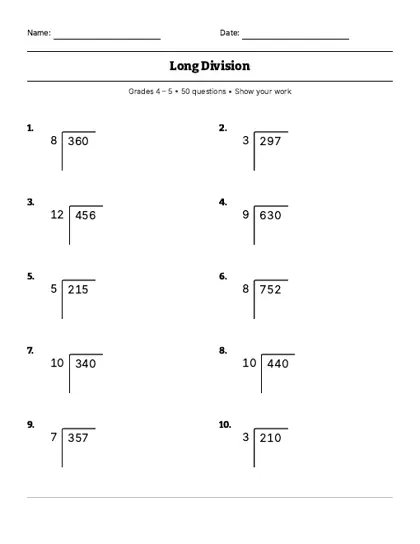
Division with remainders worksheet: printable PDF with an answer key. · Make a fresh test
Division practice · division speed test · division chart · division for kids · 2-digit by 1-digit multiplication · multi-digit multiplication · Multiplication practice trainer · 1-minute speed test
Last reviewed
Questions parents ask
How do you check a division answer?
Multiply the quotient by the divisor and add any remainder. You should get the dividend.
How do you check division with a remainder?
quotient × divisor + remainder = dividend. For 29 ÷ 4 = 7 r 1: 7 × 4 + 1 = 29.
Why does multiplication check division?
Because division undoes multiplication. If 72 ÷ 6 = 12, then 12 × 6 must equal 72.
What if the check doesn’t match?
There is a mistake. Look at how far off the check is: a big difference often means a missing digit or a 0 in the quotient.
Is the remainder check important?
Yes. Even if the multiplication works, the remainder must be smaller than the divisor, or another group fits.