
Dividing by 2, 5 and 10
The first division facts to learn: halve for ÷ 2, count in 5s for ÷ 5 and drop the 0 for ÷ 10. Practice for kids, parent help below.
🧒 Kids: divide by 2, 5 and 10!
Look at the facts. Then tap Practice and answer!
▶ Practice ⏱️ 1-minute challenge
Facts to know first
- 16 ÷ 2 = 8
- 18 ÷ 2 = 9
- 35 ÷ 5 = 7
- 45 ÷ 5 = 9
- 70 ÷ 10 = 7
- 90 ÷ 10 = 9
💡 Trick: 18 ÷ 2? Half of 18 is 9! 70 ÷ 10? Take the 0 off: 7!
More facts: ÷ 2, 5 and 10 · ÷ 3 and 4 · ÷ 6, 7, 8 and 9 · ÷ 0 and 1 · Fact families · Within 100
This part is for grown-ups: the trick that makes these facts easy, pictures to draw, what to say, common mistakes, questions with answers and a free worksheet.
The trick: halve it, count in 5s, drop the 0
These three tables are the easiest place to start division because each has its own shortcut. Dividing by 2 is halving, which children already know from sharing fairly between two people. Dividing by 10 removes a 0 from the end, because 7 tens is 70. Dividing by 5 is counting in 5s until you reach the number, or doubling and then dividing by 10. Each shortcut is just the matching times table run backwards.
- 14 ÷ 2: half of 14 is 7
- 40 ÷ 5: count in 5s: 5, 10, 15, 20, 25, 30, 35, 40. That is 8 fives
- 35 ÷ 5: double 35 is 70, and 70 ÷ 10 = 7
- 60 ÷ 10: take the 0 off: 6
Patterns to spot
- Every number in the 2 times table is even, so only even numbers divide by 2 with nothing left over.
- Numbers that divide by 5 end in 0 or 5.
- Numbers that divide by 10 end in 0, and the answer is the number without its last 0.
- Dividing by 5 always gives twice the answer of dividing by 10: 40 ÷ 10 = 4, 40 ÷ 5 = 8.
- Dividing by 2 gives five times the answer of dividing by 10: 20 ÷ 10 = 2, 20 ÷ 2 = 10.
- A number divided by itself is 1: 5 ÷ 5 = 1, 10 ÷ 10 = 1.
See it: pictures to draw with your child
Draw these on paper or a whiteboard. Seeing the counters makes the fact stick.
Facts you already know
There are 30 facts in these three tables, from 2 ÷ 2 to 100 ÷ 10. If your child can count in 2s, 5s and 10s, they already have every answer: count until you reach the number and see how many counts it took. Facts like 10 ÷ 2 = 5 and 10 ÷ 5 = 2 come as a pair, so learning one gives the other.
In real life: Sharing is division: “Share 14 grapes between the two of you.” “We have 30 minutes and each game takes 5. How many games can we play?” Coins help too: how many 10p coins make 70p?
Worked examples
Example 1: 12 ÷ 2 with objects
- Put out 12 counters.
- Share them between 2 plates, one at a time.
- Each plate has 6.
- So 12 ÷ 2 = 6.
- Check: 6 + 6 = 12.
Example 2: 45 ÷ 5 by counting in 5s
- Count in 5s and keep track on your fingers: 5, 10, 15, 20, 25, 30, 35, 40, 45.
- Nine fingers, so 45 ÷ 5 = 9.
Example 3: 80 ÷ 10 with tens
- 80 is 8 tens.
- Sharing 80 into groups of 10 makes 8 groups.
- So 80 ÷ 10 = 8.
- Check: 8 × 10 = 80.
Common mistakes
What to say to your child
A short script for your first session. Pause after each line and let your child answer.
- “Here are 10 sweets. Share them between you and me.” (Shares one each until gone.)
- “How many do we each have?” (5.) “So 10 ÷ 2 = 5. Dividing by 2 is halving.”
- “Now put the 10 sweets into groups of 5. How many groups?” (2.) “So 10 ÷ 5 = 2.”
- “How many 10s are in 60?” (6.) “So 60 ÷ 10 = 6.”
- “Can you make up a sharing story for 20 ÷ 2?”
Questions to try (answers below)
Ask these out loud or write them down. The last one is a stretch.
- 8 ÷ 2
- 18 ÷ 2
- 15 ÷ 5
- 35 ÷ 5
- 30 ÷ 10
- 100 ÷ 10
- ? ÷ 5 = 6
- Share 16 stickers between 2 friends. How many each?
- Stretch: how many 5p coins make 50p?
Show the answers
- 4
- 9
- 3
- 7
- 3
- 10
- 30
- 8 stickers
- 10 coins
Games to play at home
Fair shares
Share snacks, toys or cards between two people and say the division out loud.
Hand counting
Count fingers in 5s around the family: how many people make 25 fingers?
Coin piles
Make 70p in 10p coins. How many coins? Then try 5p coins.
A 5-day plan for dividing by 2, 5 and 10
Ten minutes a day is enough. Short, regular practice helps facts stick far better than one long session.
- Day 1: Learn it with objects. Use the pictures above with real counters, fingers or toys.
- Day 2: Read the script together, then ask the first four questions.
- Day 3: Play one round in the practice tool at the top of the page, with no timer.
- Day 4: Play one of the games above for ten minutes.
- Day 5: Ask the rest of the questions, then try the 1-minute challenge and write down the score.
Next week, repeat the round in the practice tool and compare the fact map. When most facts are green, move on to the next page.
By grade
Grade 2 (Common Core 2.OA.C.4) builds equal groups and arrays, ready for division. Grade 3 (3.OA.A.2) understands division as sharing and grouping, and 3.OA.C.7 asks for fluent division within 100 by the end of the year. In India, sharing and dividing by 2, 5 and 10 come in class 3 maths.
More for each grade: Grade 2 math and the CBSE class 2 maths guide; Grade 3 math and the CBSE class 3 maths guide.
What comes next
When these facts are quick, move on to dividing by 3 and 4, then 6, 7, 8 and 9. Keep the matching 2, 5 and 10 times tables sharp, because every division fact is a times table fact turned around.
Worksheet and more practice
Print a free worksheet with an answer key, or keep practicing online with the division practice trainer.
 Dividing by 2, 5 and 10
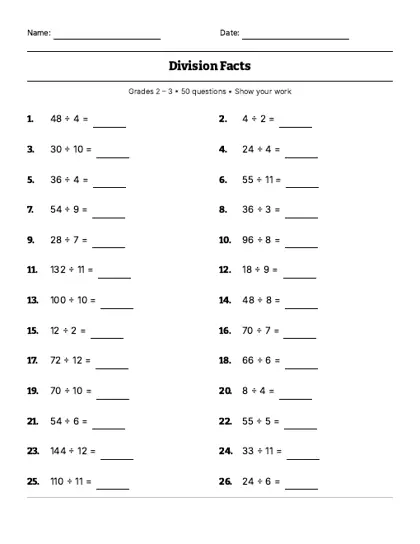 Division facts
More: division for kids · division facts lesson · division chart · times tables
Last reviewed
Questions parents ask
How do you divide by 2?
Halve the number. 18 ÷ 2 is half of 18, which is 9. Only even numbers divide by 2 with nothing left over.
What is the trick for dividing by 5?
Count in 5s until you reach the number, or double the number and divide by 10. 35 × 2 = 70, and 70 ÷ 10 = 7.
How do you divide by 10?
Take the 0 off the end. 60 ÷ 10 = 6, because 60 is 6 tens.
Why learn dividing by 2, 5 and 10 first?
Children already count in 2s, 5s and 10s, so these facts have easy shortcuts and build confidence for the harder tables.
What grade learns dividing by 2, 5 and 10?
Grade 3 (class 3), after equal groups in grade 2. The goal is to divide within 100 fluently by the end of grade 3 (3.OA.C.7).