
Dividing by 0 and 1
Four simple division rules: ÷ 1, a number ÷ itself, 0 ÷ a number, and why you cannot divide by 0. Practice for kids, parent help below.
🧒 Kids: learn the 0 and 1 rules!
Learn the rules. Then tap Practice!
▶ Practice ⏱️ 1-minute challenge
Dividing by 1 and by itself
- 7 ÷ 1 = 7
- 12 ÷ 1 = 12
- 8 ÷ 8 = 1
- 12 ÷ 12 = 1
- 9 ÷ 9 = 1
- 5 ÷ 5 = 1
💡 Trick: 7 ÷ 1 = 7. 7 ÷ 7 = 1. 0 ÷ 7 = 0. But 7 ÷ 0? You can’t!
More facts: ÷ 2, 5 and 10 · ÷ 3 and 4 · ÷ 6, 7, 8 and 9 · ÷ 0 and 1 · Fact families · Within 100
This part is for grown-ups: the trick that makes these facts easy, pictures to draw, what to say, common mistakes, questions with answers and a free worksheet.
The trick: four rules to remember
These facts follow rules rather than tables. Dividing by 1 leaves a number unchanged: 9 sweets in 1 group is still 9. A number divided by itself is 1: 9 sweets in groups of 9 makes 1 group. Zero divided by any number is 0: sharing nothing gives everyone nothing. Dividing by 0 cannot be done: there is no way to share 9 sweets into 0 groups, and no number times 0 makes 9.
- 8 ÷ 1: one group of 8, so 8
- 8 ÷ 8: groups of 8 from 8 make 1 group
- 0 ÷ 8: sharing nothing gives 0 each
- 8 ÷ 0: cannot be done: no number × 0 = 8
Patterns to spot
- Any number ÷ 1 = that number, the same as any number × 1.
- Any number (except 0) ÷ itself = 1.
- 0 ÷ any number (except 0) = 0, just as 0 × any number = 0.
- Dividing by 0 is undefined: calculators show “Error”.
- These rules work for big numbers too: 365 ÷ 1 = 365 and 365 ÷ 365 = 1.
See it: pictures to draw with your child
Draw these on paper or a whiteboard. Seeing the counters makes the fact stick.
Facts you already know
These rules cover more than 30 facts in one go: every number divided by 1, every number divided by itself, and 0 divided by every number. They are the same rules children met in multiplication: × 1 keeps a number the same and × 0 makes 0. Only dividing by 0 is new, and it is a rule to know rather than a fact to learn.
In real life: Ask silly sharing questions: “If 1 person gets all 9 biscuits, how many do they get?” “If there are 0 biscuits and 5 children, how many each?” “Can we share 9 biscuits among 0 children?” The last one makes children laugh and remember.
Worked examples
Example 1: 12 ÷ 1
- Put 12 counters into 1 group.
- The group has 12.
- So 12 ÷ 1 = 12.
- Check: 12 × 1 = 12.
Example 2: 0 ÷ 6
- There are 0 counters to share among 6 plates.
- Each plate gets 0.
- So 0 ÷ 6 = 0.
- Check: 0 × 6 = 0.
Example 3: why 6 ÷ 0 cannot be done
- Division asks what times 0 makes 6.
- Any number times 0 is 0, never 6.
- So there is no answer: 6 ÷ 0 is undefined.
Common mistakes
What to say to your child
A short script for your first session. Pause after each line and let your child answer.
- “Here are 5 crayons. Put them all in 1 box. How many in the box?” (5.) “5 ÷ 1 = 5.”
- “Now make groups of 5. How many groups?” (1.) “5 ÷ 5 = 1.”
- “There are 0 crayons. Share them with 3 friends. How many each?” (0!)
- “Can you share 5 crayons with 0 friends?” (No! Nobody to give them to.)
- “That’s why we can’t divide by 0.”
Questions to try (answers below)
Ask these out loud or write them down. The last one is a stretch.
- 9 ÷ 1
- 4 ÷ 4
- 0 ÷ 3
- 15 ÷ 15
- 0 ÷ 10
- 25 ÷ 1
- 8 ÷ 0
- 6 children share 6 apples. How many each?
- Stretch: 1,000 ÷ 1,000
Show the answers
- 9
- 1
- 0
- 1
- 0
- 25
- Cannot be done
- 1 apple
- 1
Games to play at home
Silly sharing
Act out sharing with 1 person, with everyone getting 1, and with nothing to share.
Calculator test
Try 8 ÷ 0 on a calculator and see the error message.
Rule cards
Write the four rules on cards and match each card to an example.
A 5-day plan for dividing by 0 and 1
Ten minutes a day is enough. Short, regular practice helps facts stick far better than one long session.
- Day 1: Learn it with objects. Use the pictures above with real counters, fingers or toys.
- Day 2: Read the script together, then ask the first four questions.
- Day 3: Play one round in the practice tool at the top of the page, with no timer.
- Day 4: Play one of the games above for ten minutes.
- Day 5: Ask the rest of the questions, then try the 1-minute challenge and write down the score.
Next week, repeat the round in the practice tool and compare the fact map. When most facts are green, move on to the next page.
By grade
Grade 3 (3.OA.B.5) uses the properties of operations, including the rules for 0 and 1. Standard 3.OA.C.7 includes these facts in fluency within 100. Grades 5 and 6 meet division by 0 again with fractions and algebra. In India, the rules for 0 and 1 are taught in class 3 and 4 maths.
More for each grade: Grade 3 math and the CBSE class 3 maths guide; Grade 4 math and the CBSE class 4 maths guide; Grade 5 math and the CBSE class 5 maths guide.
What comes next
These rules show up everywhere later. In long division a zero can appear in the quotient, and in fractions 5/5 = 1 and 0/5 = 0. Put all the facts together on division facts within 100, and see the matching rules in multiplying by 0 and 1.
Worksheet and more practice
Print a free worksheet with an answer key, or keep practicing online with the division practice trainer.
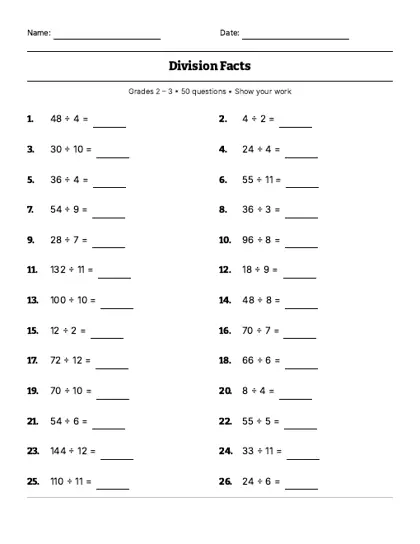 Division facts
 Multiplication facts
More: division for kids · division facts lesson · division chart · times tables
Last reviewed
Questions parents ask
What is any number divided by 1?
The number itself. 7 ÷ 1 = 7, because 7 in one group is still 7.
What is a number divided by itself?
1, for any number except 0. 9 ÷ 9 = 1, because 9 in groups of 9 makes one group.
What is 0 divided by a number?
0. Sharing nothing among any number of groups gives 0 in each: 0 ÷ 5 = 0.
Why can't you divide by 0?
Division asks what number times the divisor gives the total. Any number times 0 is 0, so no number works. Dividing by 0 is undefined.
What is 0 divided by 0?
It is also undefined. Mathematicians leave it without an answer, and a calculator shows an error.