
How to do long division, step by step
Long division repeats four steps for each digit: divide, multiply, subtract, bring down. 735 ÷ 6 = 122 r 3.
The four steps of long division
- Divide: how many times does the divisor go into the current number?
- Multiply: that answer × the divisor.
- Subtract: take it away. The result must be smaller than the divisor.
- Bring down the next digit and repeat.
Memory aid: “Does McDonald’s Sell Burgers?” (Divide, Multiply, Subtract, Bring down).
See it: pictures to draw with your child
Copy these onto paper or a whiteboard. A quick sketch makes the idea concrete before any written method.
Long division step by step
Try 735 ÷ 6, then something with a zero in the answer like 612 ÷ 6, or a 2-digit divisor like 3,456 ÷ 12.
Worked example: 735 ÷ 6
- 7 ÷ 6 = 1. 1 × 6 = 6. 7 − 6 = 1. Bring down 3: 13.
- 13 ÷ 6 = 2. 2 × 6 = 12. 13 − 12 = 1. Bring down 5: 15.
- 15 ÷ 6 = 2. 2 × 6 = 12. 15 − 12 = 3.
- Answer: 122 r 3. Check: 6 × 122 + 3 = 735.
Zeros in the answer
612 ÷ 6: 6 ÷ 6 = 1, bring down 1. 1 ÷ 6 = 0, so write 0 in the answer and bring down 2: 12 ÷ 6 = 2. The answer is 102, not 12. Every digit brought down needs a digit in the answer.
Before you start: three things to check
- Times tables. Every step asks a times table question. If 7 × 8 is slow, long division by 7 will be painful. Practice the divisor’s table first, or use the division trainer.
- Subtraction with regrouping. Each step subtracts. Shaky regrouping causes wrong remainders that spread through the rest of the problem.
- Place value. Children need to know that in 735 the 7 means 7 hundreds. Then “7 ÷ 6 = 1” means 1 hundred in each group, and the 1 goes in the hundreds place.
If one of these is missing, a gentler start is partial quotients, which uses easy chunks instead of one digit at a time.
Estimate first, check after
Long division is easy to get wildly wrong by one slipped digit. Two quick habits catch almost every mistake.
Estimate first with a nearby easy number. 735 ÷ 6 is close to 720 ÷ 6 = 120, so the answer should be a bit over 120. An answer of 12 or 1,220 is clearly wrong. See estimating quotients.
Check after by multiplying: answer × divisor + remainder should give the starting number. 122 × 6 + 3 = 735. See checking division.
Long division and the other methods
Long division is one of three written methods, and they all give the same answer. Short division (the bus stop method) does the multiplying and subtracting in the head, so it fits on one line. Partial quotients takes away easy chunks, such as 100 groups at a time, and adds them up.
Many schools teach partial quotients first because it shows what division means, then long division because it is faster. If your child learned a different method at school, use that one at home too.
Dividing by a 2-digit number
Estimate each step by rounding the divisor. For 3,456 ÷ 12: 34 ÷ 12 is about 30 ÷ 10 = 3, but 12 × 3 = 36 is too big, so use 2. Writing out the 12 times table (12, 24, 36, 48…) before starting makes every step quicker. The full method is on long division with 2-digit divisors.
Quiz: long division
Divide. Some have remainders, and some have a 0 in the answer.
Where this fits: division step by step
- What is division
- Division as repeated subtraction
- Division on a number line
- Dividend, divisor and quotient
- Dividing by 2, 5 and 10
- Division facts
- Checking division with multiplication
- Division with remainders
- Interpreting remainders
- 2-digit by 1-digit division
- 3-digit by 1-digit division
- Partial quotients
- Short division
- Long division (this page)
- Zeros in the quotient
- Estimating quotients
- Long division with 2-digit divisors
- Division word problems
What to say to your child
A short script for teaching it the first time. Pause after each line and let your child do the next step.
- “How many 6s go into 7?” (1.) “Write 1 above the 7.”
- “1 × 6 is 6. Take it away: 7 − 6 = 1.”
- “Bring down the 3. Now we have 13.”
- “How many 6s go into 13?” (2.) “Write it, multiply, subtract, bring down.”
- “Same four steps every time: divide, multiply, subtract, bring down.”
More worked examples
Example 1: No remainder
848 ÷ 4 = 212.
Example 2: Zero in the answer
824 ÷ 4: 8 ÷ 4 = 2, 2 ÷ 4 = 0 (write 0), 24 ÷ 4 = 6: 206.
Example 3: 2-digit divisor
3,456 ÷ 12 = 288.
Practice questions (answers below)
Ask these out loud or write them down. Check each answer, and ask “how did you get that?” for one or two.
- 96 ÷ 4
- 156 ÷ 3
- 525 ÷ 5
- 738 ÷ 6
- 847 ÷ 7
- 962 ÷ 8
- 1,236 ÷ 4
- 864 ÷ 12
Show the answers
- 24
- 52
- 105
- 123
- 121
- 120 r 2
- 309
- 72
Common mistakes
How to teach it at home
Write the table first
Before dividing by 7, write 7, 14, 21… down the side.
Real sharing
Split a $135 prize between 4 people: 33 r 3, or $33.75.
Check every answer
Multiply back and add the remainder. Make it a habit.
By grade
- Grade 4 (4.NBT.B.6): up to 4 digits ÷ 1 digit.
- Grade 5 (5.NBT.B.6): up to 4 digits ÷ 2 digits.
- Grade 6 (6.NS.B.2): fluent long division with the standard algorithm.
More for each grade: Grade 4 math and the CBSE class 4 maths guide; Grade 5 math and the CBSE class 5 maths guide; Grade 6 math and the CBSE class 6 maths guide.
Worksheets and practice
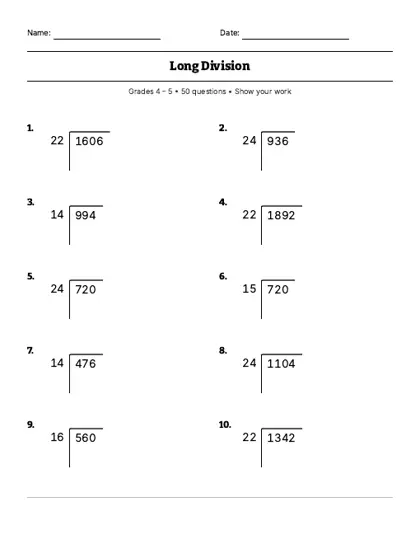
Long division worksheet: printable PDF with an answer key. · Make a fresh test
Division with remainders · All division · multi-digit multiplication (to check) · estimating products
Last reviewed
Questions parents ask
What are the steps of long division?
Divide, multiply, subtract, bring down, and repeat for each digit. A memory aid is “Does McDonald’s Sell Burgers?”
How do you do long division with a 2-digit divisor?
The same four steps. Estimate each step by rounding the divisor, and write out its multiples first to make it quicker.
What happens when the divisor doesn’t go into a digit?
Write 0 in the answer above that digit and bring down the next one. Forgetting this 0 is the most common long division mistake.
How do you check long division?
Multiply the answer by the divisor and add the remainder. You should get the number you started with.
What grade learns long division?
Grade 4 starts with 1-digit divisors, grade 5 uses 2-digit divisors, and grade 6 is expected to be fluent (6.NS.B.2).